
Close Menu
    Facebook X (Twitter) Instagram
    SciTechDaily
    • Biology
    • Chemistry
    • Earth
    • Health
    • Physics
    • Science
    • Space
    • Technology
    Facebook X (Twitter) Pinterest YouTube RSS
    SciTechDaily
    Home»Technology»Chemical Breakthrough Could Unlock the “Holy Grail” of Solid-State Battery Technology
    Technology

    Chemical Breakthrough Could Unlock the “Holy Grail” of Solid-State Battery Technology

    By Science China PressNovember 6, 2026No Comments3 Mins Read
    Facebook Twitter Pinterest Telegram LinkedIn WhatsApp Email Reddit
    Share
    Facebook Twitter LinkedIn Pinterest Telegram Email Reddit
    Solid State Battery Technology Concept
    Solid-state batteries are a promising alternative to conventional lithium-ion batteries because they replace flammable liquid electrolytes with solid materials. Credit: Stock

    A simple chemical treatment could overcome a persistent weakness in next-generation solid-state batteries.

    Scientists in China have developed a thin protective coating that could help overcome a major obstacle to longer-lasting, high-capacity batteries. In laboratory tests, solid-state batteries using the treated lithium metal retained 82.3% of their initial capacity after 300 charging cycles, compared with just 43.0% for batteries using untreated lithium.

    The researchers at Xidian University developed a simple liquid coating that reacts with lithium metal to form a protective barrier. Their findings, published in Science China Chemistry, suggest a possible route toward safer, more durable batteries for electric vehicles and energy storage.

    Solving a Persistent Battery Problem

    Lithium metal has been called the “holy grail” of energy storage because it can theoretically store nearly ten times as much charge per gram as the graphite used in conventional lithium-ion batteries. Its exceptional capacity could enable lighter batteries that store more energy and potentially support longer driving ranges.

    To address this problem, researchers led by Professors Siwu Li, Weiwei Wu, and Chuang Yu combined a silicon-based polymer with indium chloride. When applied to lithium, the mixture forms lithium fluoride and lithium-indium alloy nanoparticles within a flexible protective film just 12 micrometers thick (about 0.00047 inches).

    “This hybrid layer acts like a smart fortress,” explains corresponding author Siwu Li. “The polymer backbone provides flexibility to absorb the mechanical stress of lithium expanding and contracting. The lithium fluoride phase blocks electrons to prevent dendrite nucleation. And the lithium-indium alloy nanoparticles act as traffic conductors, guiding lithium ions to deposit evenly rather than piling up in dangerous spikes.”
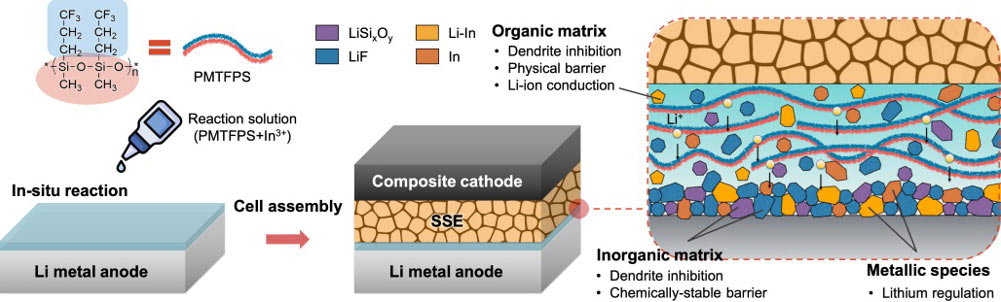
    Schematic of the PFSIn Li Hybrid Protective Layer
    This illustration depicts the in-situ formation of the PFSIn-Li interlayer on a lithium metal anode. A liquid precursor containing a fluorinated siloxane polymer and indium salt reacts on the lithium surface to generate a multifunctional hybrid film. The organic polymer network interpenetrates with inorganic lithium fluoride, lithium-indium alloy, and lithium silicon oxide nanodomains, simultaneously suppressing dendrite growth and stabilizing the interface with the sulfide solid electrolyte. Credit: Science China Press

    Stronger Performance in Laboratory Tests

    The coated lithium electrodes withstood a critical current density of 3.5 milliamperes per square centimeter, more than four times the 0.8 achieved by untreated lithium. In complete batteries containing a nickel-cobalt-manganese oxide cathode and a sulfide solid electrolyte, the protected electrodes delivered an initial capacity of 129.8 milliampere-hours per gram and retained 82.3% after 300 cycles at 0.5C.

    Spectroscopy and electron microscopy confirmed the coating’s composition and revealed a dense, uniform layer without visible cracks or gaps.

    A Simpler Path to Better Batteries

    The coating could help address the chemical instability between lithium metal and sulfide solid electrolytes, a major challenge in solid-state battery development.

    Because the protective layer forms from an applied liquid, it may be compatible with existing industrial coating equipment without requiring expensive vacuum processing. The researchers also plan to explore alternatives to indium, including tin and zinc.

    Although commercial performance remains unproven, the findings offer a promising approach to making high-energy lithium metal batteries more stable and longer-lasting.

    Reference: “In situ reductive construction of a silicon-based polymer/indium alloy hybrid layer for stable lithium metal anodes in sulfide solid-state batteries” by Kun Song, Qun Zhao, Xianbo Zhao, Siwu Li, Jun Liu, Haitao Chen, Weiwei Wu and Chuang Yu, 6 August 2026, Science China Chemistry.
    DOI: 10.1007/s11426-026-3450-y

    Never miss a breakthrough: Join the SciTechDaily newsletter.
    Follow us on Google and Google News.

    Battery Technology Energy Renewable Energy Science China Press
    Share. Facebook Twitter Pinterest LinkedIn Email Reddit

    Related Articles

    Scientists Develop Floating Device That Harvests Energy From Raindrops

    Inexpensive New Liquid Battery Could Replace $10,000 Lithium Systems

    Safer, Stronger, Smarter: Scientists Develop Game-Changing Quasi-Solid Battery

    Stanford Unveils Game-Changing Liquid Fuel Technology for Grid Energy Storage

    Impressive Capacity and Extended Lifespan – Scientists Have Invented Recyclable “Water Batteries” That Won’t Catch Fire

    MIT Discovery Could Unlock a Safer and Lighter Lithium Battery

    Turning Buildings Into Batteries To Cheaply Improve Power Quality

    A Step Towards Seasonal Storage: “Freeze-Thaw Battery” Can Freeze Its Energy for Later Use

    MIT Researchers Design Inexpensive Liquid Batteries With Distinct Layers

    Leave A Reply Cancel Reply

    • Facebook
    • Twitter
    • Pinterest
    • YouTube

    Don't Miss a Discovery

    Subscribe for the Latest in Science & Tech!

    Trending News

    NASA’s Voyager 1 Is About to Become the First Spacecraft One Light-Day From Earth

    A Woman Who Lived 30,000 Years Ago Is Changing What We Know About Ice Age Europe

    A Rare Radioactive Element Reveals a Hidden Secret About the Heaviest Atoms

    Breakthrough Cancer Treatment Wipes Out Deadly Brain Tumors in Every Mouse Tested

    Something Remarkable Is Happening to Dogs Living Near Chernobyl’s Nuclear Plant

    Hubble Uncovers a Mysterious 93-Billion-Mile Structure Hiding in a Nearby Star System

    Earth’s Oceans Were Slowly Suffocating Millions of Years Before a Devastating Mass Extinction

    Why Are Men Twice As Likely To Develop Parkinson’s? Scientists Discover a Hidden Clue in the Brain

    Follow SciTechDaily
    • Facebook
    • Twitter
    • YouTube
    • Pinterest
    • Newsletter
    • RSS
    SciTech News
    • Biology News
    • Chemistry News
    • Earth News
    • Health News
    • Physics News
    • Science News
    • Space News
    • Technology News
    Recent Posts
    • Chemical Breakthrough Could Unlock the “Holy Grail” of Solid-State Battery Technology
    • Kids Who Learn To Swim Early May Have an Unexpected Advantage in School
    • Could Type 2 Diabetes Be Reversed? 14-Year Study Reveals Remarkable Results
    • The Secret to Saving Shellfish From Acidifying Oceans Could Be Hiding in Crushed Shells
    • Earthquake Faults Can Suddenly Become Almost As Fluid as Water, Study Finds
    Copyright © 1998 - 2026 SciTechDaily. All Rights Reserved.
    • Science News
    • About
    • Contact
    • Editorial Board
    • Privacy Policy
    • Terms of Use

    Type above and press Enter to search. Press Esc to cancel.