
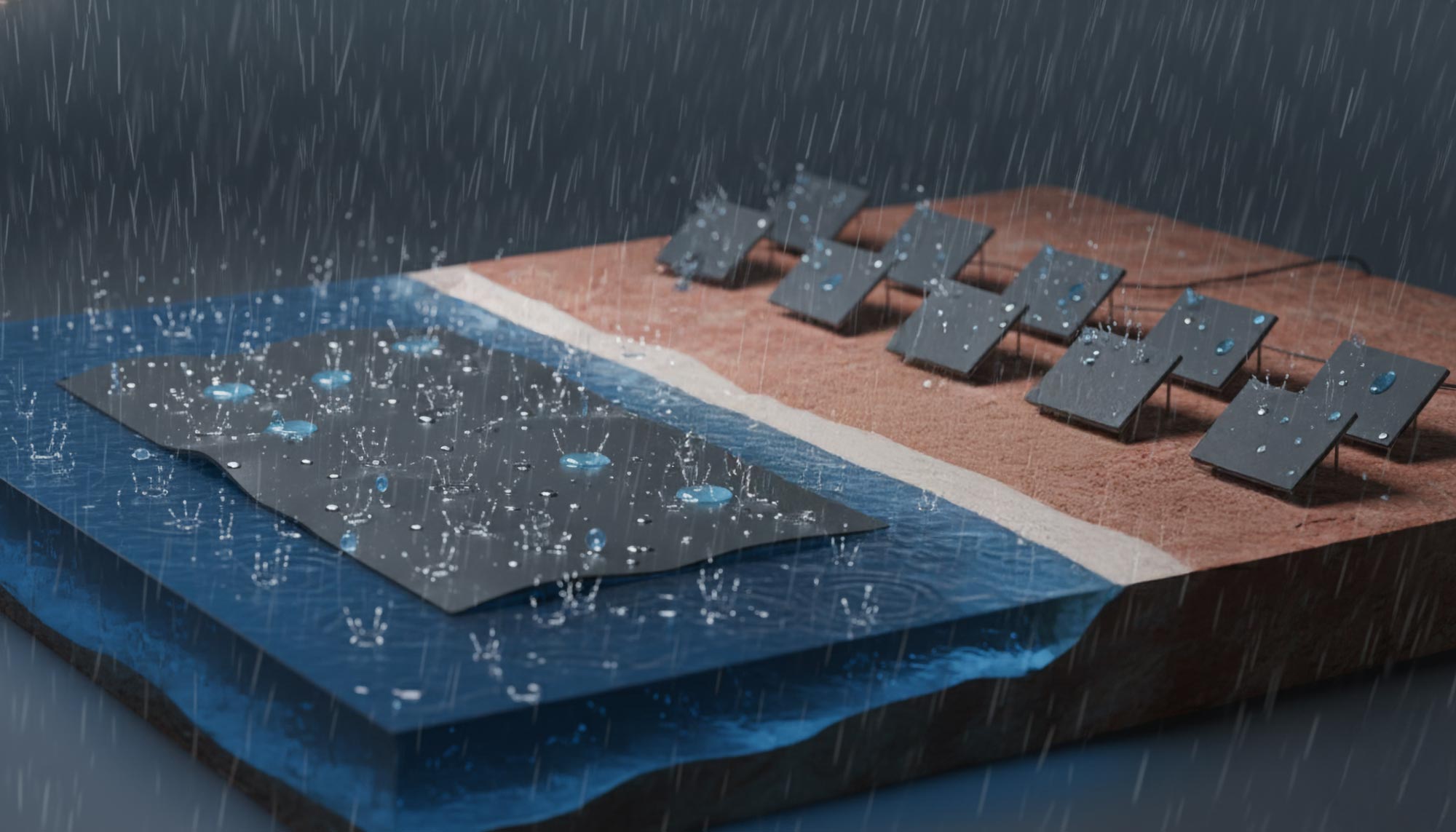
A new water-integrated droplet electricity generator produces high electrical output while floating on water surfaces.
Raindrops are not only a source of fresh water, they also carry unused energy that falls naturally from the sky. Scientists have long explored ways to convert this falling water into electricity, but traditional droplet electricity generators have struggled with problems such as low efficiency, heavy construction, and limited potential for scaling up.
Researchers at Nanjing University of Aeronautics and Astronautics have now developed a new solution: a floating droplet electricity generator that uses natural water as an essential part of its structure. This design provides a lightweight, affordable, and eco-friendly path toward renewable energy production. The team’s findings appear in National Science Review.
In most conventional droplet electricity generators, electricity is produced when raindrops strike a dielectric film that sits on a rigid base with a metal electrode underneath. While these systems can generate voltages in the hundreds of volts, their reliance on solid and often costly materials makes them heavy and expensive to build. The new design takes a different approach by floating directly on water. In this setup, the water acts as both the supporting base and the conductive electrode. This integration with nature cuts the overall material weight by about 80% and the cost by roughly 50% compared with older models, while maintaining similar electrical output.
The Science Behind the Splash
When raindrops land on the floating dielectric surface, the water’s natural properties—its incompressibility and strong surface tension—provide the mechanical stability needed to absorb each impact and let the droplets spread efficiently. Meanwhile, ions within the water serve as charge carriers, allowing it to act as a dependable electrode. Working together, these features enable the floating generator to produce peak voltages of around 250 volts per droplet, matching the performance of traditional designs that depend on metal electrodes and rigid structures.
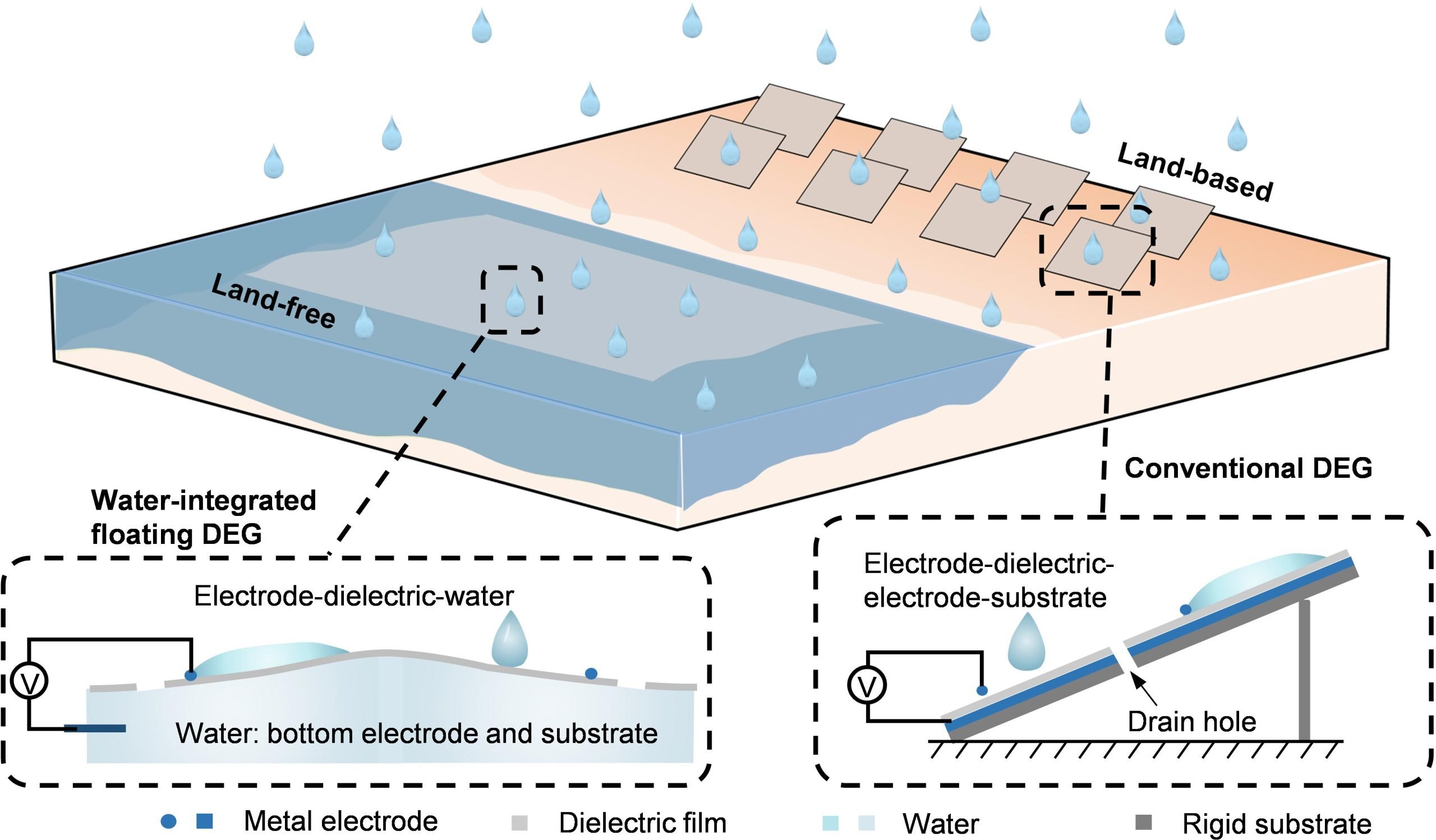
Durability is another strength of the design. Tests showed that the W-DEG maintained performance across a wide range of conditions, including varying temperatures, salt concentrations, and even exposure to outdoor lake water with biofouling. Unlike many energy devices that degrade in harsh environments, the floating generator continued to operate stably thanks to the chemical inertness of its dielectric layer and the resilience of its water-based structure. To further enhance stability, the team exploited water’s high surface tension to design drainage holes that allow water to pass downward but not upward, creating a self-regulating system for removing excess droplets. This innovation ensures that the device avoids water accumulation, which could otherwise reduce output.
Scaling Up and Powering the Future
Scalability is promising aspect of the floating droplet electricity generator. The researchers demonstrated a 0.3-square-meter integrated device—significantly larger than previously reported droplet generators—that could power 50 light-emitting diodes (LEDs) simultaneously. The integrated system also charged capacitors to useful voltages within minutes, showing the potential to power small electronics and wireless sensors. With further development, such systems could be deployed across lakes, reservoirs, or coastal regions, where they would harvest renewable electricity without occupying valuable land resources.
“By letting water itself play both structural and electrical roles, we’ve unlocked a new strategy for droplet electricity generation that is lightweight, cost-effective, and scalable,” said Prof. Wanlin Guo, a corresponding author of the study. “This opens the door to land-free hydrovoltaic systems that can complement other renewable technologies like solar and wind.”
The implications of this work extend beyond rainwater harvesting. Because the device floats naturally on water surfaces, it could be deployed in diverse aquatic environments for powering environmental monitoring systems, such as sensors that track water quality, salinity, or pollution. In regions with frequent rainfall, it could provide a distributed energy solution that supplements local grids or powers off-grid applications. Moreover, the concept of “nature-integrated design”—using abundant natural materials like water as functional components—could inspire new approaches in green technology.
The researchers note that while the laboratory results are promising, challenges remain before large-scale deployment. Real raindrops vary in size and velocity, which could affect performance, and ensuring the integrity of large dielectric films in dynamic outdoor conditions will require further engineering. Still, the demonstration of a durable, efficient, and scalable prototype marks an important step toward practical applications.
Reference: “Floating droplet electricity generator on water” by Wei Deng, Zihao Wang, Jingmin Wang, Tao Hu, Xiao Wang, Xuemei Li, Jun Yin and Wanlin Guo, 4 August 2025, National Science Review.
DOI: 10.1093/nsr/nwaf318
Never miss a breakthrough: Join the SciTechDaily newsletter.
Follow us on Google and Google News.