
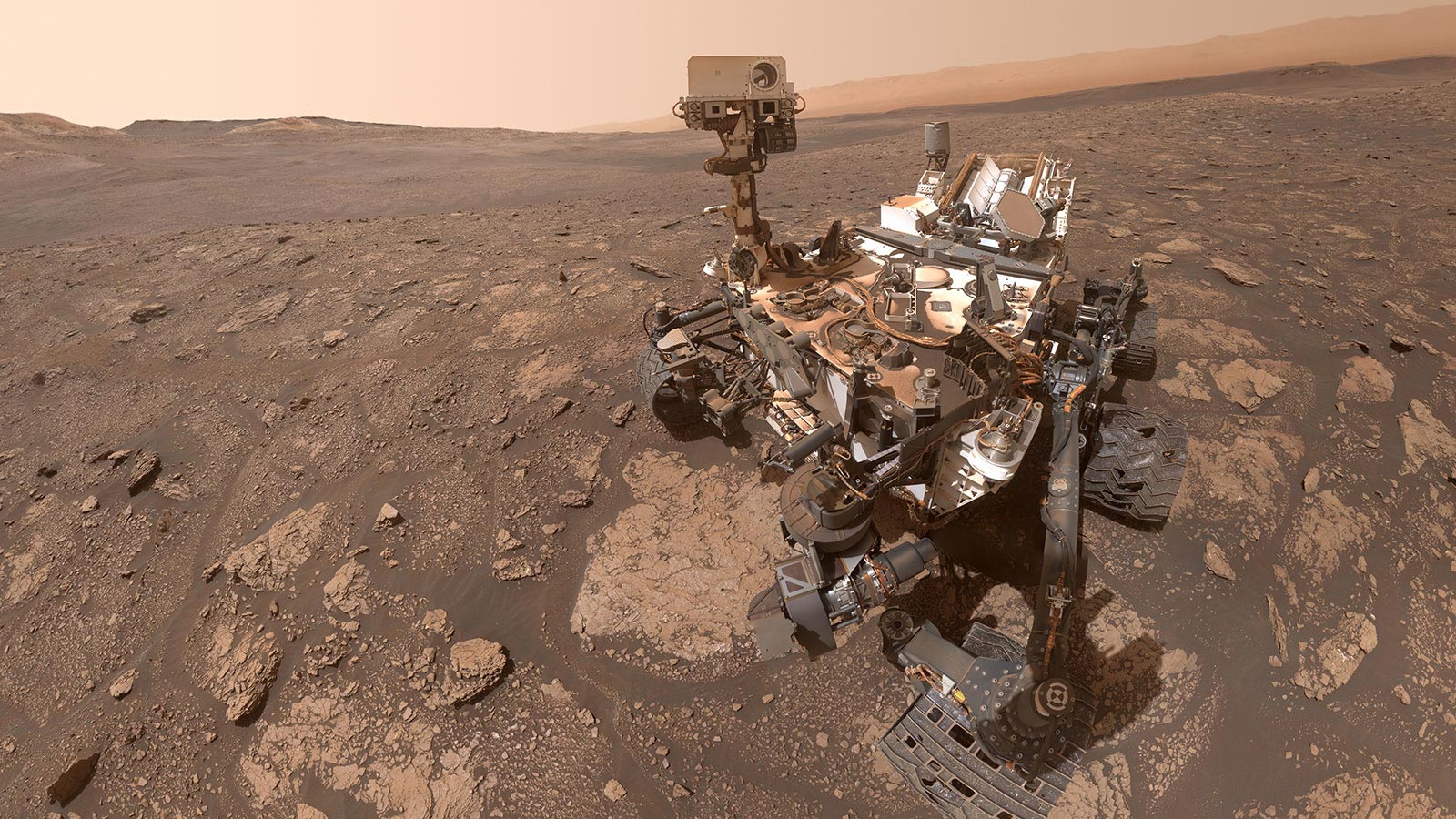
Curiosity just found molecules on Mars tied to the chemistry of life, hinting at a more habitable past.
NASA’s Curiosity rover has discovered a wide variety of organic molecules on Mars, including compounds often viewed as essential ingredients for the origin of life on Earth.
These results come from a chemical experiment carried out on another planet for the first time. The findings show that the Martian surface can preserve molecules that might serve as indicators of ancient life. However, the experiment cannot determine whether these organic compounds formed from past life on Mars, natural geological activity, or arrived via meteorites.
To confirm any true signs of past life, scientists would need to return Martian rock samples to Earth for more detailed analysis.

New Experiment Points to Long-Term Preservation
The research was led by Amy Williams, Ph.D., a professor of geological sciences at the University of Florida and a member of the Curiosity and Perseverance rover science teams. Curiosity landed on Mars in 2012 to investigate whether the planet once had conditions suitable for microbial life billions of years ago. Perseverance, which arrived in 2021, is focused on searching for direct evidence of ancient life.
“We think we’re looking at organic matter that’s been preserved on Mars for 3.5 billion years,” said Williams, who helped develop the experiment. “It’s really useful to have evidence that ancient organic matter is preserved, because that is a way to assess the habitability of an environment. And if we want to search for evidence of life in the form of preserved organic carbon, this demonstrates it’s possible.”
Williams and an international team of researchers published the study April 21 in the journal Nature Communications.
DNA-Like Molecule Among Key Findings
The experiment identified more than 20 different chemicals. Among them was a nitrogen-containing molecule with a structure similar to compounds involved in building DNA, something never before detected on Mars. The rover also found benzothiophene, a large sulfur-containing compound with a double-ring structure that is commonly delivered to planets by meteorites.
“The same stuff that rained down on Mars from meteorites is what rained down on Earth, and it probably provided the building blocks for life as we know it on our planet,” Williams said.
Gale Crater Clays Help Preserve Organic Compounds
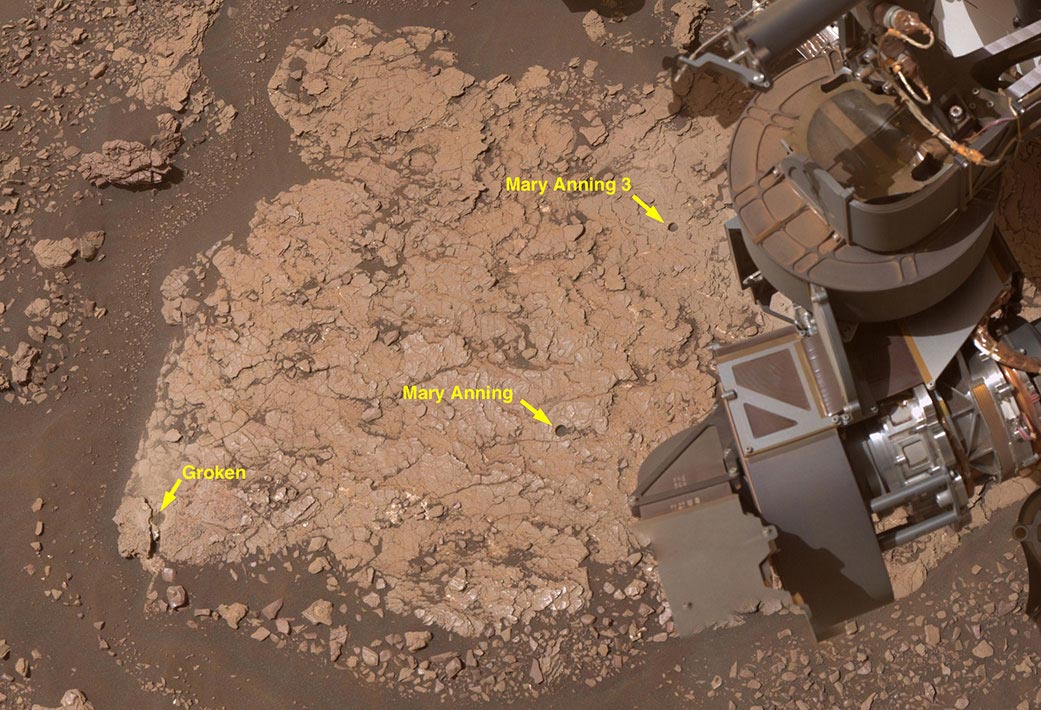
Curiosity, managed by NASA’s Jet Propulsion Laboratory, landed in Gale crater in August 2012. This location was once a lake bed. The experiment took place in 2020 in the Glen Torridon region, an area rich in clay minerals that formed in the presence of water. These clays are particularly effective at trapping and preserving organic molecules, making them an ideal target for this type of research.
SAM Instrument and TMAH Chemical Process
The work was carried out using the Sample Analysis at Mars instrument suite, known as SAM. Jennifer Eigenbrode, Ph.D., an astrobiologist at NASA’s Goddard Space Flight Center and co-author of the study, helps lead the SAM team. The instrument has played a central role in many of Curiosity’s discoveries related to Mars’ chemistry, atmosphere, and potential habitability.
For this experiment, scientists used a chemical called TMAH to break down larger organic molecules into smaller components that could be examined by SAM’s onboard instruments. Because Curiosity carries only about two cups of TMAH, the team had to carefully plan the experiment and select the most promising sampling site.
Implications for Future Mars and Titan Missions
The success of this approach is influencing upcoming missions. Future projects, including the Rosalind Franklin mission to Mars and the Dragonfly mission to Saturn’s moon Titan, are expected to include similar TMAH-based experiments to search for organic compounds.
“We now know that there are big complex organics preserved in the shallow subsurface of Mars, and that holds a lot of promise for preserving large complex organics that might be diagnostic of life,” Williams said.
Reference: “Diverse organic molecules on Mars revealed by the first SAM TMAH experiment” by Amy J. Williams, Jennifer L. Eigenbrode, Maëva Millan, Ross H. Williams, Ophélie M. Mcintosh, Samuel Teinturier, Janelle Roach, Charles Malespin, Amy C. McAdam, Paul Mahaffy, Alexander B. Bryk, Arnaud Buch, David Boulesteix, Luoth Chou, Jason P. Dworkin, Valerie Fox, Heather B. Franz, Caroline Freissinet, Daniel P. Glavin, Christopher H. House, Sarah Stewart Johnson, James M. T. Lewis, Angel Mojarro, Rafael Navarro-Gonzalez, Chad Pozarycki, Andrew Steele, Roger E. Summons, Cyril Szopa, Michael T. Thorpe and Ashwin R. Vasavada, 21 April 2026, Nature Communications.
DOI: 10.1038/s41467-026-70656-0
Never miss a breakthrough: Join the SciTechDaily newsletter.
Follow us on Google and Google News.
5 Comments
Intriguing discoveries. How will these be coordinated with earth’s past development of life? Hope to hear more of these discoveries and the research that comes in the future. Look for them. Thank you.
The Martian rovers were originally sent to Mars to look for evidence of life, now or in the recent past. Fossil organic matter carbon, cellular remains.. Having found none, ” habitability” was a secondary goal. But for life to have ever been present on Mars would require both liquid water and some viable protection from the young Sun’s damaging UV radiation. That would require some atmospheric oxygen to form a stratospheric ozone screen. At this point in this venture so little positive evidence has been found that it might be time to give it up and move on, Work on plans to protect life on Earth.
Similar sentiments where given during the Apollo missions, and the US abandoned most space exploration
What we have found since then, is that our plans to preserve life on Earth are constantly usurped by companies seeking profits
If we fail to advance our abilities to understand planetary sciences, we are doomed to die when corporations finally suck the last bit of life from this planet, our only hope is to advance our capabilities beyond this planet, regardless of what penny-pinching doomsayers say
Are you suggesting that companies that provide us with energy should do it for nothing? Our taxes are already paying for these rovers to wander around and send “stunning” landscape photos back.
Why are those scientists always stunned? Don’t they know anything in advance?