
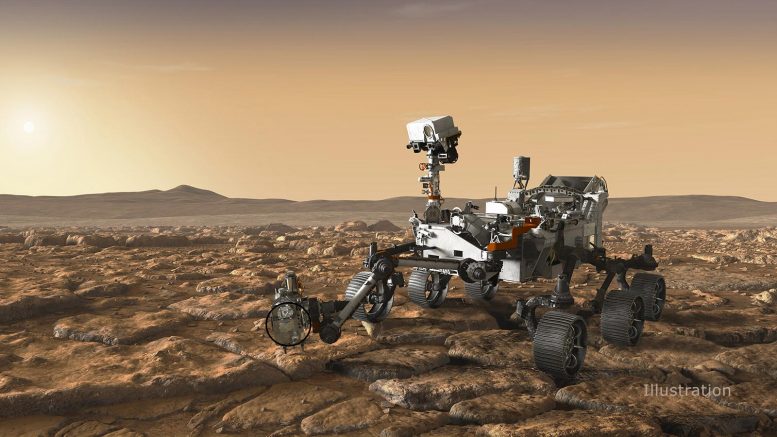
Scientists gain vital insights into Mars’ history and potential for supporting life.
A new study using data from NASA’s Mars Perseverance rover has found potential evidence of organic molecules on Mars, indicating a complex organic geochemical cycle and the possibility of prolonged habitability. The research used a novel technique with the SHERLOC instrument to detect signs of past life, setting the stage for future extraterrestrial investigations.
A new study featuring data from the NASA Mars Perseverance rover reports on an instrumental detection potentially consistent with organic molecules on the Martian surface, hinting toward past habitability of the Red Planet. The research, led by a team of scientists that includes University of Florida astrobiologist Amy Williams, was recently published in the journal Nature.
Scientists have long been fueled by the possibility of finding organic carbon on Mars, and while previous missions provided valuable insights, the latest research introduces a new line of evidence that adds to our understanding of Mars. The findings indicate the presence of a more intricate organic geochemical cycle on Mars than previously understood, suggesting the existence of several distinct reservoirs of potential organic compounds.
Notably, the study detected signals consistent with molecules linked to aqueous processes, indicating that water may have played a key role in the diverse range of organic matter on Mars. The key building blocks necessary for life may have persisted on Mars for a far more extended period than previously thought.
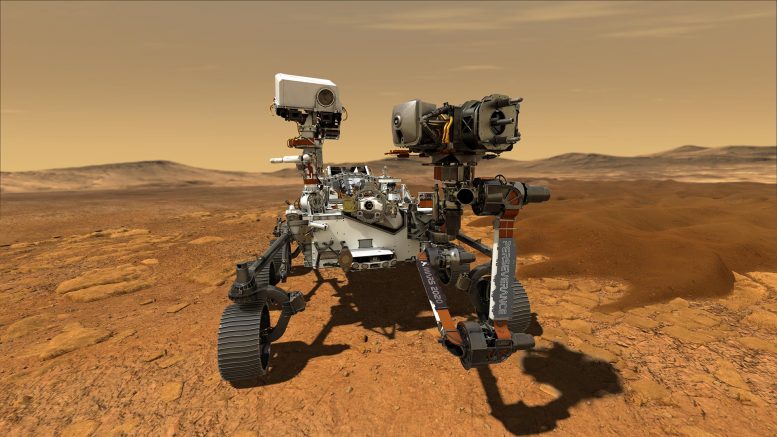
The Search for Life’s Building Blocks
Amy Williams, an expert in organic geochemistry, has been at the forefront of the search for life’s building blocks on Mars. As a participating scientist on the Perseverance mission, Williams’ work centers on the quest for organic matter on the Red Planet. She aims to detect habitable environments, search for potential life materials, and uncover evidence of past life on Mars. Eventually, the on-site samples collected by Perseverance will be sent back to Earth by future missions, but it will be a complex and ambitious process spanning many years.
“The potential detection of several organic carbon species on Mars has implications for understanding the carbon cycle on Mars, and the potential of the planet to host life throughout its history,” said Williams, an assistant professor in UF’s Department of Geological Sciences.
Organic matter can be formed from various processes, not just those related to life. Geological processes and chemical reactions can also form organic molecules, and these processes are favored for the origin of these possible Martian organics. Williams and the team of scientists will work to further examine the potential sources of these molecules.
Until now, organic carbon had only been detected by the Mars Phoenix lander and the Mars Curiosity rover by using advanced techniques like evolved gas analysis and gas chromatography-mass spectrometry. The new study introduces a different technique that also potentially identifies simple organic compounds on Mars.
Why Jezero Crater is the Perfect Landing Site
The chosen landing site for the rover within Jezero crater offers a high potential for past habitability: As an ancient lake basin, it contains an array of minerals, including carbonates, clays, and sulfates. These minerals have the potential to preserve organic materials and possible signs of ancient life.
“We didn’t initially expect to detect these potential organics signatures in the Jezero crater floor,” Williams said, “but their diversity and distribution in different units of the crater floor now suggest potentially different fates of carbon across these environments.”
The scientists used a first-of-its-kind instrument called the Scanning Habitable Environments with Raman and Luminescence for Organics and Chemicals (SHERLOC) to map the distribution of organic molecules and minerals on rock surfaces. SHERLOC employs deep ultraviolet Raman and fluorescence spectroscopy to simultaneously measure weak Raman scattering and strong fluorescence emissions, providing crucial insights into the organic composition of Mars.
The findings mark a significant step forward in our exploration of the Red Planet, laying the groundwork for future investigations into the possibility of life beyond Earth.
“We are just now scratching the surface of the organic carbon story on Mars,” Williams said, “and it is an exciting time for planetary science!”
Reference: “Diverse organic-mineral associations in Jezero crater, Mars” by Sunanda Sharma, Ryan D. Roppel, Ashley E. Murphy, Luther W. Beegle, Rohit Bhartia, Andrew Steele, Joseph Razzell Hollis, Sandra Siljeström, Francis M. McCubbin, Sanford A. Asher, William J. Abbey, Abigail C. Allwood, Eve L. Berger, Benjamin L. Bleefeld, Aaron S. Burton, Sergei V. Bykov, Emily L. Cardarelli, Pamela G. Conrad, Andrea Corpolongo, Andrew D. Czaja, Lauren P. DeFlores, Kenneth Edgett, Kenneth A. Farley, Teresa Fornaro, Allison C. Fox, Marc D. Fries, David Harker, Keyron Hickman-Lewis, Joshua Huggett, Samara Imbeah, Ryan S. Jakubek, Linda C. Kah, Carina Lee, Yang Liu, Angela Magee, Michelle Minitti, Kelsey R. Moore, Alyssa Pascuzzo, Carolina Rodriguez Sanchez-Vahamonde, Eva L. Scheller, Svetlana Shkolyar, Kathryn M. Stack, Kim Steadman, Michael Tuite, Kyle Uckert, Alyssa Werynski, Roger C. Wiens, Amy J. Williams, Katherine Winchell, Megan R. Kennedy and Anastasia Yanchilina, 12 July 2023, Nature.
DOI: 10.1038/s41586-023-06143-z
Never miss a breakthrough: Join the SciTechDaily newsletter.
Follow us on Google and Google News.
3 Comments
There are organic chemicals throughout the universe. Organic carbon won’t evidence life, because you need something requiring a living process to synthesize. Add the “Life on Mars?” headline when Perserverence finds organic cotton.
Though the paper could not exclude a biotic origin either.
But the more interesting finds may come with sample return and/or ExoMars deep drilling.
This website is becoming intolerable for advertising.
To get to this page I endured not one but TWO google vignettes. Then arriving on the article a button “press to read full article”. Then A THIRD advertisement comes up.
Fix your site. I have other options.