
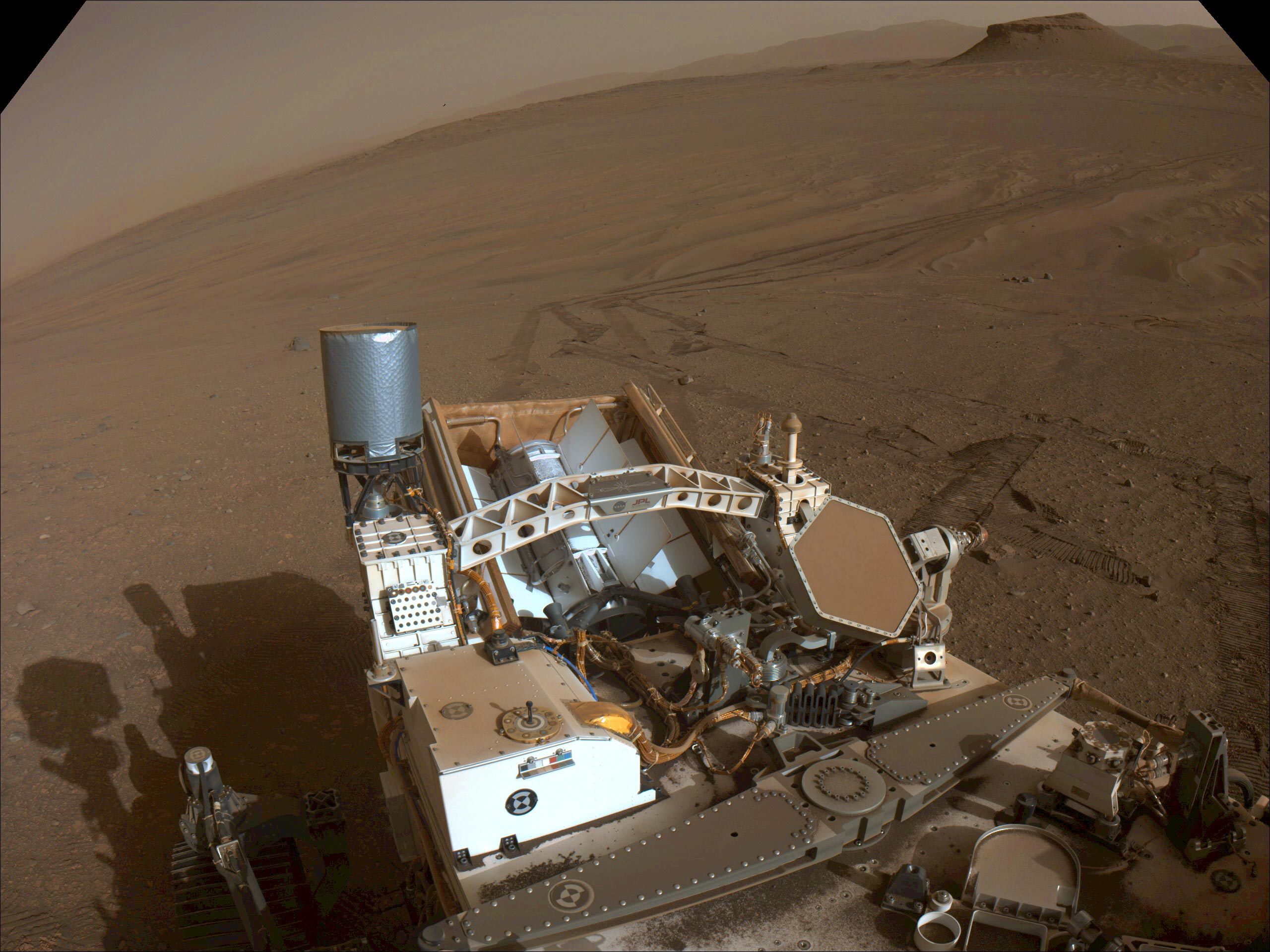
After completing the first sample depot on another world, the rover continues its hunt for Mars rocks worthy of study on Earth.
NASA’s Perseverance rover will celebrated its second anniversary on the surface of Mars on Saturday, February 18. Since arriving at Jezero Crater in 2021, the six-wheeled, nuclear-powered rover has been examining geologic features and collecting samples of the Red Planet that are central to the first step of the NASA-ESA (European Space Agency) Mars Sample Return campaign. Scientists want to study Martian samples with powerful lab equipment on Earth to search for signs of ancient microbial life and to better understand the processes that have shaped the surface of Mars.
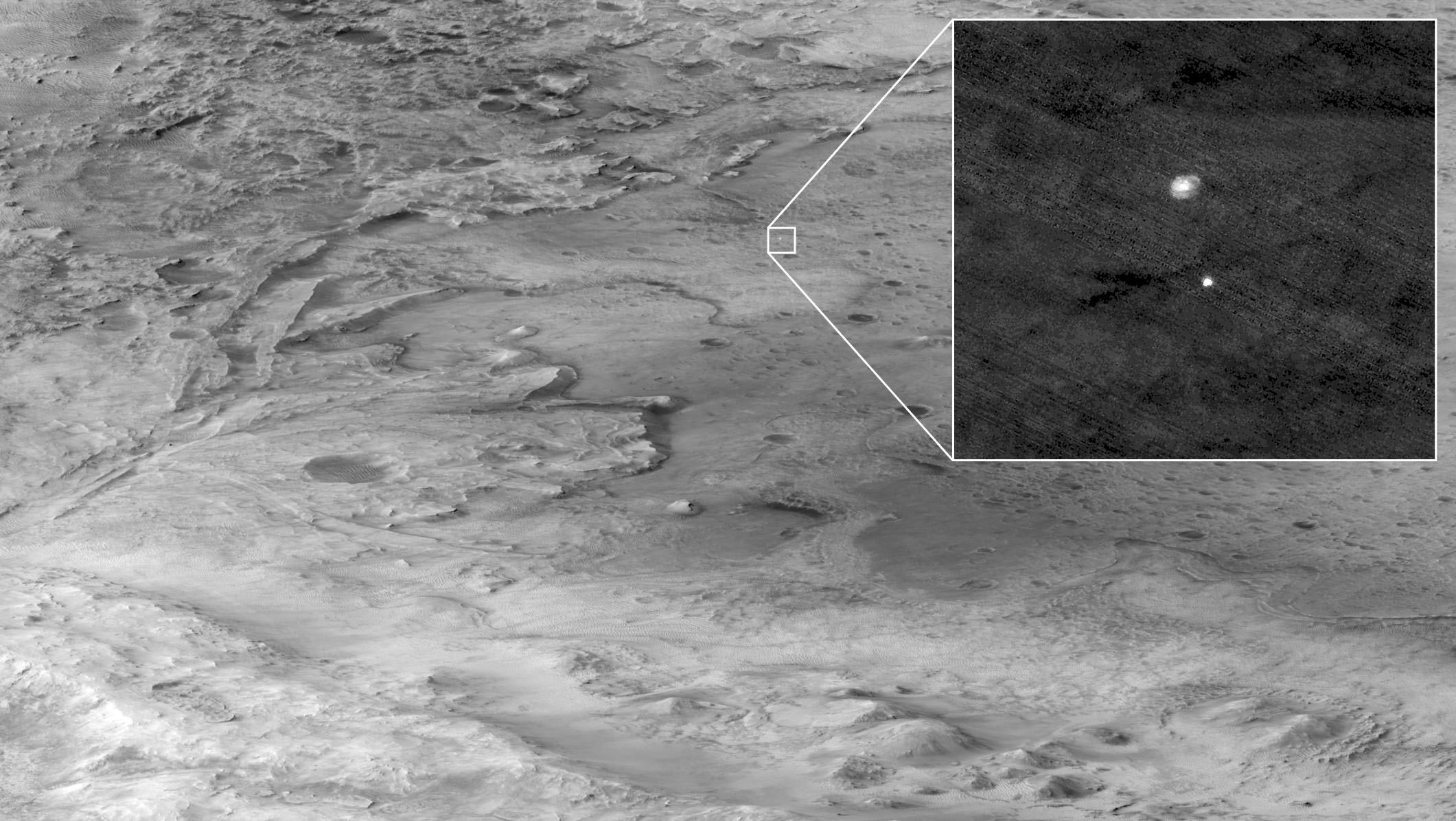
High-Resolution Video of Perseverance’s Landing: This is a high-resolution version of a video taken by several cameras as NASA’s Perseverance rover touched down on Mars on Feb. 18, 2021. Cameras aboard the rover captured these shots; a microphone captured the first-ever audio of a Mars landing. Credit: NASA/JPL-Caltech
“Anniversaries are a time of reflection and celebration, and the Perseverance team is doing a lot of both,” said Perseverance project scientist Ken Farley of Caltech in Pasadena. “Perseverance has inspected and performed data collection on hundreds of intriguing geologic features, collected 15 rock cores, and created the first sample depot on another world. With the start of the next science campaign, known as ‘Upper Fan,’ on February 15, we expect to be adding to that tally very soon.”
In addition to the rock cores, Perseverance has collected two regolith samples and one atmospheric sample, and it has sealed three “witness” tubes. (Learn more about all 18 samples taken so far.)
Numbers play a big role in the life of a Mars rover mission, not just because the team includes an impressive quantity of scientists (who don’t usually mind numbers) and engineers (who love them), but because statistics provide the best and most efficient glimpse of vehicle trends and performance.
For instance, the mission can tell you not only that the rover has driven 9.3 miles (14.97 kilometers), but also that as of February 14, its left front wheel has performed 9,423 revolutions. They can tell you not only that the MOXIE (short for Mars Oxygen In-Situ Resource Utilization Experiment) technology demonstration has produced 3.25 ounces (92.11 grams) of oxygen, but also that the Gas Dust Removal Tool (gDRT) – the little gas-puffing device on the robotic arm – has puffed 62 times to clear residual dust and particles from rock-abrading activities.
“We deal with a lot of numbers,” said Perseverance deputy project manager Steve Lee from NASA’s Jet Propulsion Laboratory in Southern California. “We collect them, evaluate them, compare them, and more times than we want to admit, bore our loved ones with them during a family dinner.”
With that, here are some the most up-to-date statistics regarding Perseverance’s first two Earth years of Jezero surface operations. Some will seem obscure, while others are more immediate, but they all underscore how productive the mission has been.
Perseverance Science Statistics
The rover carries seven science instruments, and they’ve been busy.
- Laser shots fired by the SuperCam science instrument: 230,554
- Soundings performed by the RIMFAX (Radar Imager for Mars’ Subsurface Experiment) ground-penetrating radar to study underground rock layers: 676,828
- Mars audio recordings taken by SuperCam’s microphone: 662
- Hours of Mars weather data recorded by MEDA (Mars Environmental Dynamics Analyzer): 15,769.1
- Hours the X-ray filament on the PIXL (Planetary Instrument for X-ray Lithochemistry) instrument has operated: 298.2
- Laser shots by the SHERLOC (Scanning Habitable Environments with Raman & Luminescence for Organics & Chemicals) instrument: 4,337,010
- SHERLOC spectroscopy observations: 33
Perseverance Mobility and Operational Statistics
Along with the massive drill-toting robotic arm, the rover has a small sample handling arm inside its belly.
- Times the rover’s main robotic arm has been unstowed and stowed: 64
- Times the drill on that arm has touched Mars: 39
- Times drill bits have been exchanged: 48
- Abrasions performed by the drill: 17
- Distance the rover’s sample handling arm’s z-stage has traveled up and down: 676.1 feet (206.1 meters)
Perseverance’s Camera Statistics
Perseverance packs seven science cameras along with nine engineering cameras. Together, those cameras have taken more than 166,000 images. Here are the image tallies for several of them.
- Mastcam-Z: 86,660
- Navigation Cameras: 21,571
- Front Hazard-Avoidance Cameras: 3,909
- Rear Hazard-Avoidance Cameras: 474
- Sampling and Caching System Camera:1,321
- SuperCam Remote Micro-Imager: 2,825
- SHERLOC WATSON: 5,754
- SHERLOC Context Imager: 2,260
- MEDA SkyCam: 1,831
- PIXL Micro-Context Camera: 1,012
- Entry, Descent, and Landing Cameras: 33,279
“Behind each number is a lot of thought and effort from a very talented group of women and men on the Perseverance team,” said Art Thompson, Perseverance project manager at JPL. “We have come a long way together, and I can’t think of a better group to work with as we go even farther.”
In fact, when Perseverance marks its second landing anniversary, Mars will be 97 million miles (156 million kilometers) from Earth. The weather at Jezero Crater is expected to be sunny with a high of about 7 degrees Fahrenheit (minus 14 degrees Celsius). The rover has instructions to perform remote science and take images of a place in Jezero Crater called “Jenkins Gap.” And people on the mission team are expected to take at least one moment to recall where they were and how they felt two years ago, when Perseverance landed on Mars.
More About the Mission
Perseverance’s primary objective during its mission on Mars is astrobiology, including the retrieval of samples that could potentially contain evidence of ancient microbial life. The rover will analyze the planet’s geology and climate history, while also paving the way for future human exploration of Mars by being the first to gather and store Martian rock and regolith.
In subsequent missions, NASA and the European Space Agency (ESA) will work together to send spacecraft to Mars to retrieve these sealed samples from the planet’s surface and bring them back to Earth for comprehensive analysis.
As part of NASA’s Moon to Mars exploration initiative, the Mars 2020 Perseverance mission is accompanied by Artemis missions to the Moon, which will help prepare for human exploration of Mars.
The Jet Propulsion Laboratory (JPL), managed by Caltech on behalf of NASA, constructed and operates the Perseverance rover.
Never miss a breakthrough: Join the SciTechDaily newsletter.
Follow us on Google and Google News.
2 Comments
Unfortunately, unlike Curiosity with it’s mineral identification technology, what the Perseverance rover hasn’t done is make any meaningful attempts to study the lake sediments it chose to land in. Any evaporite minerals (especially chlorides like halite) left after the lake dried up might tell more about the conditions for life to evolve and persist under the stringent conditions on the Martian surface. Even help determine if the crater water was fresh or saline. Had this been done before taking samples, such samples might be the best to study years from now when they are returned to Earth.
… there is no life on the Mars.
But if there is a life out there how would they treat us. … Let’s se how do we do it with less intelligent animals when we wanna observe them… well, you should a tranquilizer into them an put them for a sleep for a while… although, the technology aliens would poses is more advanced like …