
Close Menu
    Facebook X (Twitter) Instagram
    SciTechDaily
    • Biology
    • Chemistry
    • Earth
    • Health
    • Physics
    • Science
    • Space
    • Technology
    Facebook X (Twitter) Pinterest YouTube RSS
    SciTechDaily
    Home»Space»NASA’s Mars Perseverance Rover Picks Up an Unwanted Hitchhiker
    Space

    NASA’s Mars Perseverance Rover Picks Up an Unwanted Hitchhiker

    By Evan Gough, Universe TodayMarch 13, 20228 Comments4 Mins Read
    Facebook Twitter Pinterest Telegram LinkedIn WhatsApp Email Reddit
    Share
    Facebook Twitter LinkedIn Pinterest Telegram Email Reddit
    Mars Perseverance Rover Rock Wheel
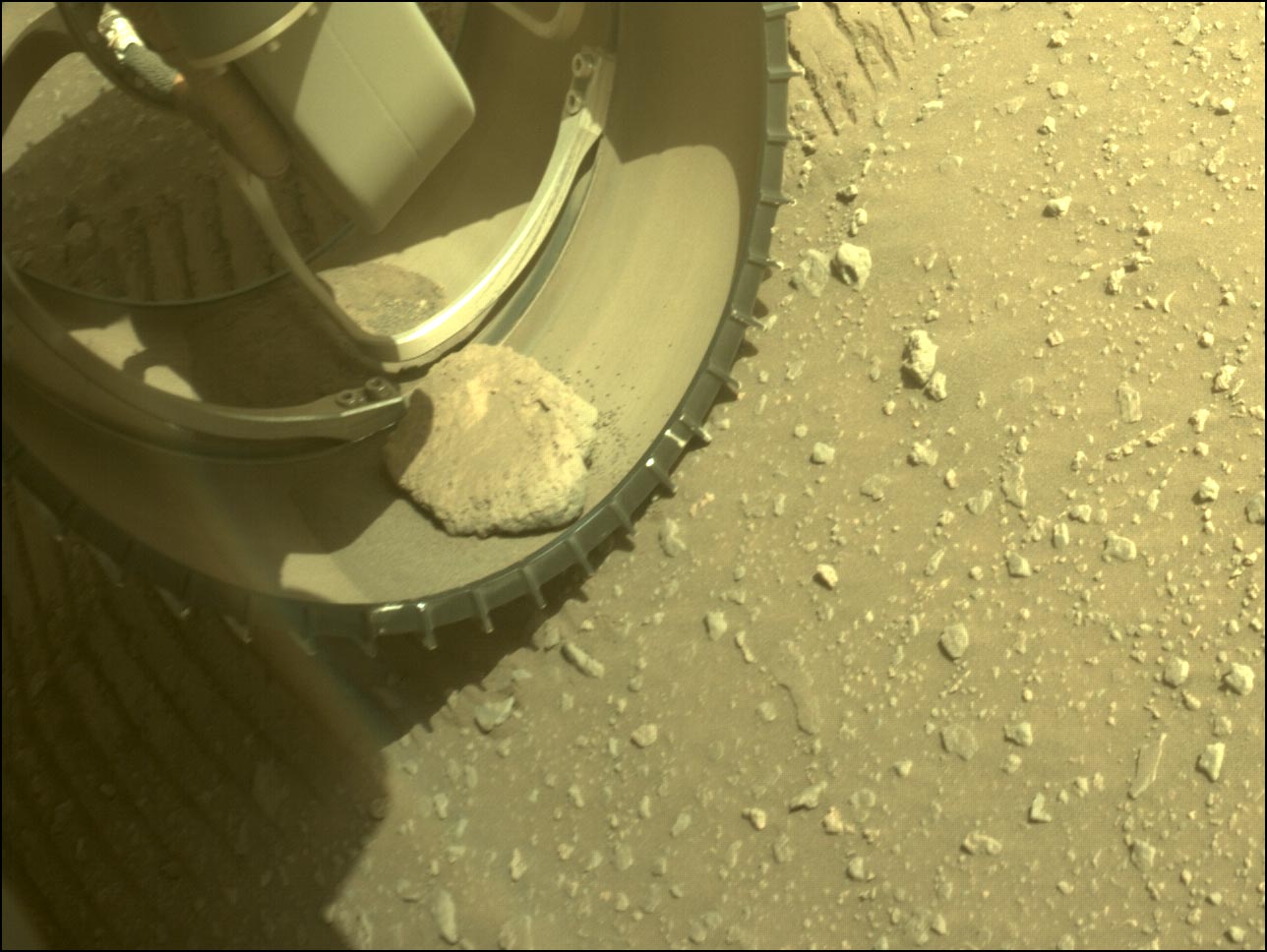
    NASA’s Mars Perseverance rover acquired this image of the area in front of it using its onboard Front Left Hazard Avoidance Camera A. This image was acquired on February 25, 2022 (Sol 362) at the local mean solar time of 14:24:43. Credit: NASA/JPL-Caltech

    A rock stuck in Perseverance’s wheel isn’t affecting the mission, and NASA expects it to fall out naturally.

    It looks like the Perseverance rover has an unwanted passenger, a rock stuck inside one of its wheels. The image of the stone was recently selected as the “Image of the Week” for the Perseverance mission. The Image of the Week is selected by public input. Perseverance captured this image on February 25th, 2022.

    The rover’s Front Left Hazard Avoidance Camera A captured the image. When the rover is driving, it makes periodic stops to let the Hazard Cameras survey the immediate surroundings. The Hazard Cameras help evaluate the hazards in front of and behind the rover, like large boulders, deep trenches, or dunes. The cameras create 3D views of the surroundings that help the rover make its own decisions without consulting with the rover team on Earth on every move.
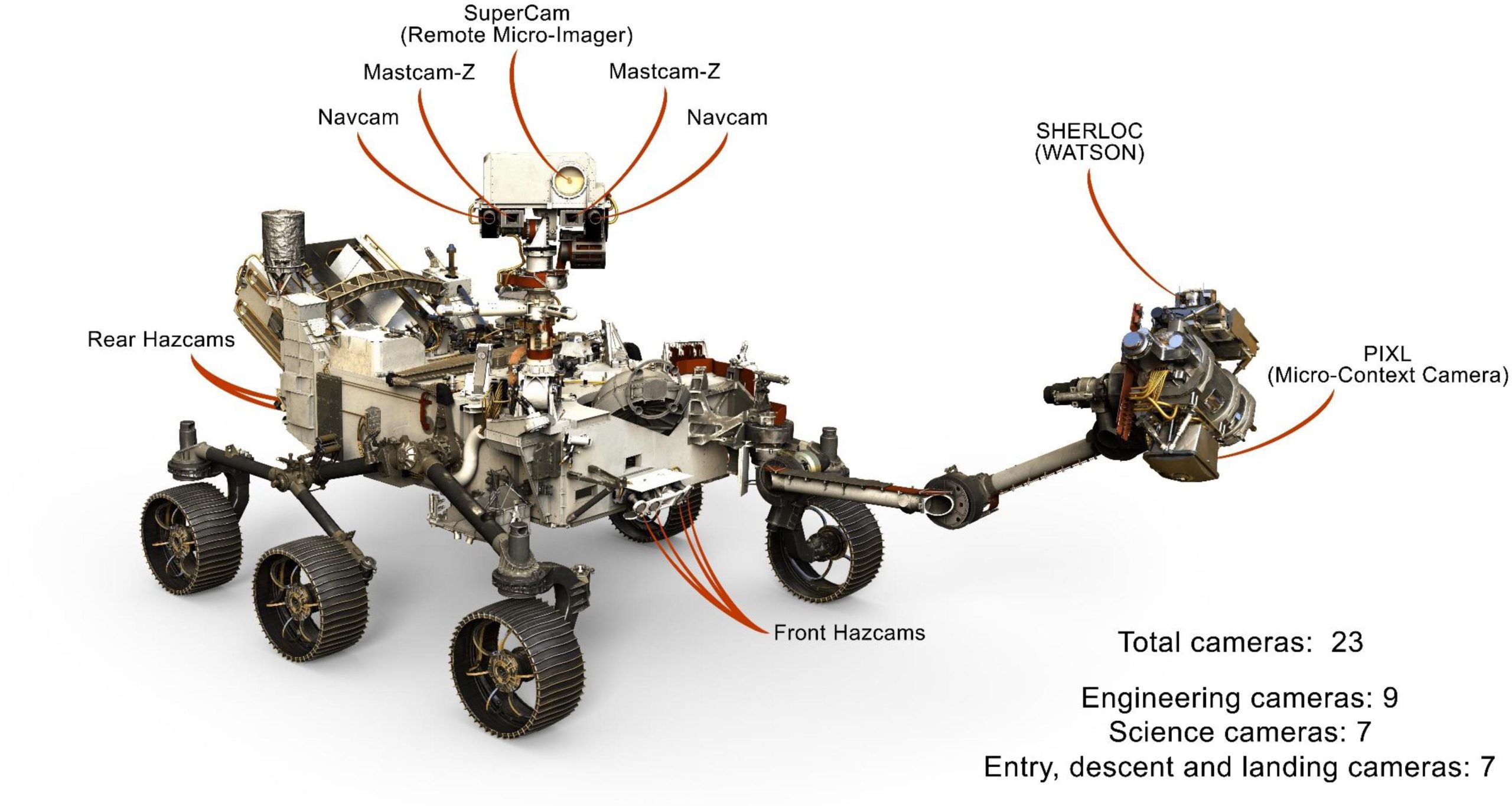
    Mars Perseverance Rover Cameras
    The Mars Perseverance mission carries more cameras to Mars than any interplanetary mission in history. The Perseverance rover itself has 19 cameras that will deliver images of the landscape in breathtaking detail. These include cameras for engineering (9), entry, descent and landing (3), and science (7). Credit: NASA/JPL-Caltech

    The rock’s stayed there for quite a while already, based on images from March 10th. It’s difficult to tell from the picture for sure, but it doesn’t appear to be wedged in. Will it fall out during normal operations?

    The rock doesn’t appear to be causing any damage or hindering the rover’s operations. And it’s not the first time a stone got stuck in a rover’s wheel. MSL Curiosity also had a rocky hitchhiker in one of its wheels.
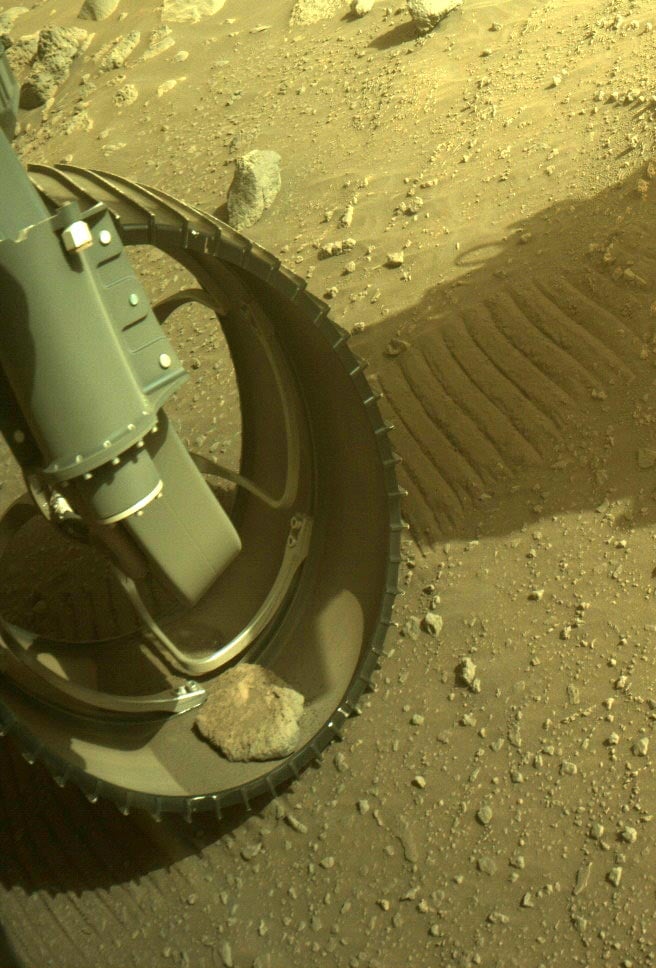
    Mars Perseverance Rover Rock Wheel Sol 374
    This image from March 10th shows the rock still stuck in one of Perseverance’s six wheels. Will it fall out on its own? Is there any way to get it out? Does it matter? Credit: NASA/JPL-Caltech

    NASA thinks rovers can get rocks stuck in their wheels when traversing slopes. They can also get in there as the rover moves over loose terrain and as the rover’s weight breaks rocks into pieces. In a 2017 article at Mashable, Curiosity Project Scientist Ashwin Vasavada said, “We don’t exactly know how the rocks get in the wheels, but it’s likely that they can hop in as the wheels (and heavy rover) break rocks and sink into the soil around loose rocks.”

    They’ve said that rocks in rover wheels aren’t a problem in the past. The rocks are pretty soft and tend to fall out on their own. The only potential problem is if the rocks somehow interfere with cables running to the motor on each wheel.
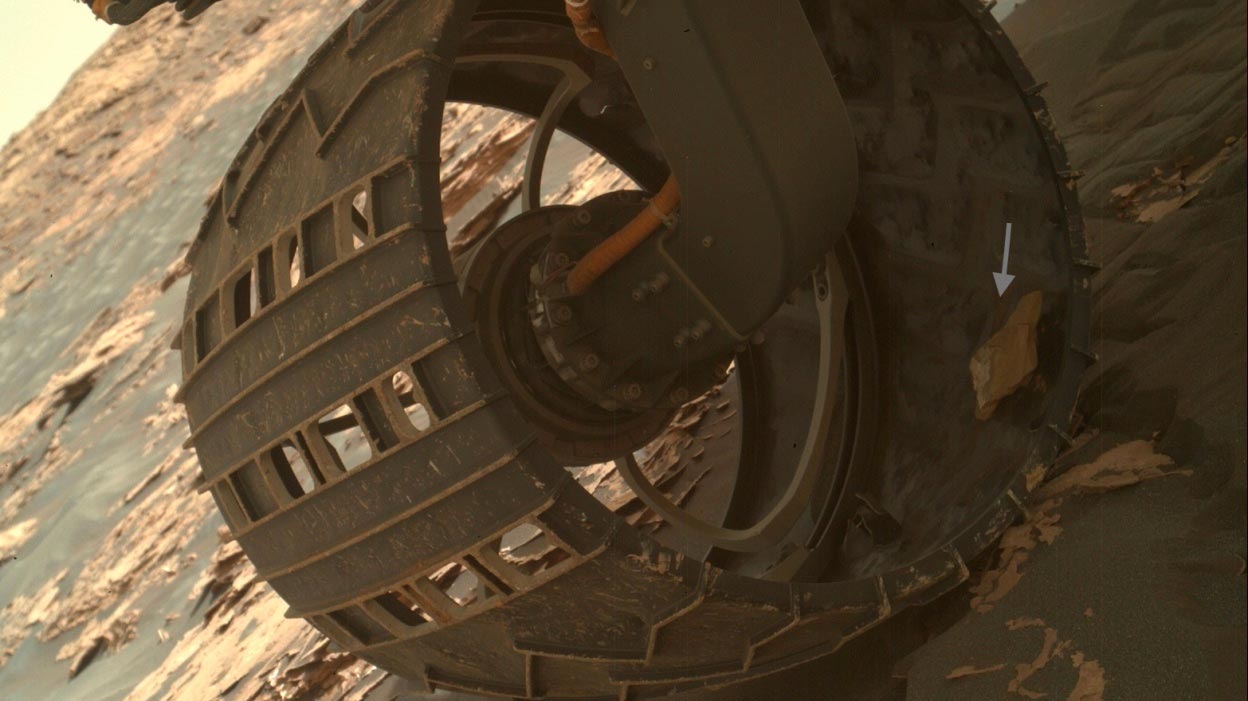
    Curiosity Rock Wheel
    MSL Curiosity had a rock stuck in its wheel in June 2017. Credit: NASA/JPL-Caltech

    NASA doesn’t seem worried about it, though; otherwise, they would’ve changed the design to prevent it.

    At least one Mars rover ended due to problems with its wheels, but not because a rock got stuck. In 2009, NASA’s Spirit Rover got one of its wheels stuck in soft soil. After months of carefully planned maneuvers and extrication attempts, NASA announced that the rover was stuck. In May 2011, they ended the mission.

    Perseverance’s mission was planned to last at least one Mars year or 687 Earth days. It’s a little over halfway through its planned mission at 373 sols on March 8th.

    But rover missions to Mars tend to last longer than planned. Spirit and Opportunity were supposed to last about 90 sols, but Spirit lasted 2208 sols, and Opportunity lasted 5,352 sols. MSL Curiosity has been active on Mars for over nine years, and its primary mission was set at only 687 days.

    Perseverance’s planned mission length is at least one full Martian year. But it’s already exceeded that, and its Multi-Mission Radioisotope Thermoelectric Generator (MMRTG) could last ten years or more. Hopefully, Perseverance will complete its mission and cache samples for later retrieval and even find preserved biosignatures.

    Eventually, the mission will end. But it probably won’t be because of a rock in its wheel.

    Adapted from an article originally published on Universe Today.

    Never miss a breakthrough: Join the SciTechDaily newsletter.
    Follow us on Google and Google News.

    JPL Mars Mars 2020 Perseverance Rover NASA Popular
    Share. Facebook Twitter Pinterest LinkedIn Email Reddit

    Related Articles

    NASA’s Mars Perseverance Rover Has a Pet Rock!

    NASA’s Mars Perseverance Rover Now Selects Its Own Targets To Zap With Its Laser

    NASA’s Ingenuity Mars Helicopter in Contact With Perseverance Rover After Communications Dropout

    NASA’s Ingenuity Mars Helicopter Scouts Ridgeline for Perseverance Science Team

    NASA Ingenuity Helicopter Spots Spacecraft Wreckage on Mars – Perseverance’s Cone-Shaped Backshell

    We’ve Arrived! NASA’s Mars Perseverance Rover Starts the Delta Front Campaign

    Incredible Video of Solar Eclipse on Mars – Captured by NASA’s Perseverance Rover

    NASA’s Mars Perseverance Rover Arrives at Ancient Delta for New Science Campaign

    NASA Perseverance Rover’s Self-Driving Capabilities Put to the Test in Rush to Martian Delta

    8 Comments

    1. Stanislaus on March 13, 2022 10:08 am

      I reckon we should name the rock, if it’ll be accompanying us on this journey. I call for the name Rockardo.

      Reply
    2. curious on March 13, 2022 10:35 am

      how do we know that is called rock on mars?

      Reply
      • Michael on March 13, 2022 3:04 pm

        How do we know Mars is called “Mars” on Mars?

        Reply
    3. Sekar on March 14, 2022 3:24 am

      Interesting.

      Some thoughts about redesigning the wheels of future Rover’s.

      1. Distances being covered are limited compared to other transportation vehicles.

      2.So why not redesign the wheel for creating All terrain wheels with grip necessary for traversing high inclines and steep slopes , depending on the type of land aligning wheel features as required.

      Views expressed are personal and not binding on anyone.

      Reply
    4. Ray on March 15, 2022 7:23 am

      Martian prank

      Reply
    5. Jordi Heguilor on March 15, 2022 7:39 am

      Rock and roll?

      Reply
    6. Nicole Henry on March 15, 2022 1:02 pm

      How about a hybrid rover that can roll over soil and also fly through the martian air.

      Reply
    7. David L Bridgland on March 20, 2022 6:10 am

      Maybe a vigorous plant seeds and water 💧 enough to see if it could germination?

      Reply
    Leave A Reply Cancel Reply

    • Facebook
    • Twitter
    • Pinterest
    • YouTube

    Don't Miss a Discovery

    Subscribe for the Latest in Science & Tech!

    Trending News

    New Study Reveals Why Ozempic Works Better for Some People Than Others

    Climate Change Is Altering a Key Greenhouse Gas in a Way Scientists Didn’t Expect

    New Study Suggests Gravitational Waves May Have Created Dark Matter

    Scientists Discover Why the Brain Gets Stuck in Schizophrenia

    Scientists Engineer “Tumor-Eating” Bacteria That Devour Cancer From Within

    Even “Failed” Diets May Deliver Long-Term Health Gains, Study Finds

    NIH Scientists Discover Powerful New Opioid That Relieves Pain Without Dangerous Side Effects

    Collapsing Plasma May Hold the Key to Cosmic Magnetism

    Follow SciTechDaily
    • Facebook
    • Twitter
    • YouTube
    • Pinterest
    • Newsletter
    • RSS
    SciTech News
    • Biology News
    • Chemistry News
    • Earth News
    • Health News
    • Physics News
    • Science News
    • Space News
    • Technology News
    Recent Posts
    • This 15,000-Year-Old Discovery Changes What We Know About Early Human Creativity
    • 35-Million-Year-Old Mystery: Strange Arachnid Discovered Preserved in Amber
    • Revolutionary Gas Turbine Generates Power Without Air Compression
    • Is AI Really Just a Tool? It Could Be Altering How You See Reality
    • JWST Reveals a “Forbidden” Planet With a Baffling Composition
    Copyright © 1998 - 2026 SciTechDaily. All Rights Reserved.
    • Science News
    • About
    • Contact
    • Editorial Board
    • Privacy Policy
    • Terms of Use

    Type above and press Enter to search. Press Esc to cancel.