
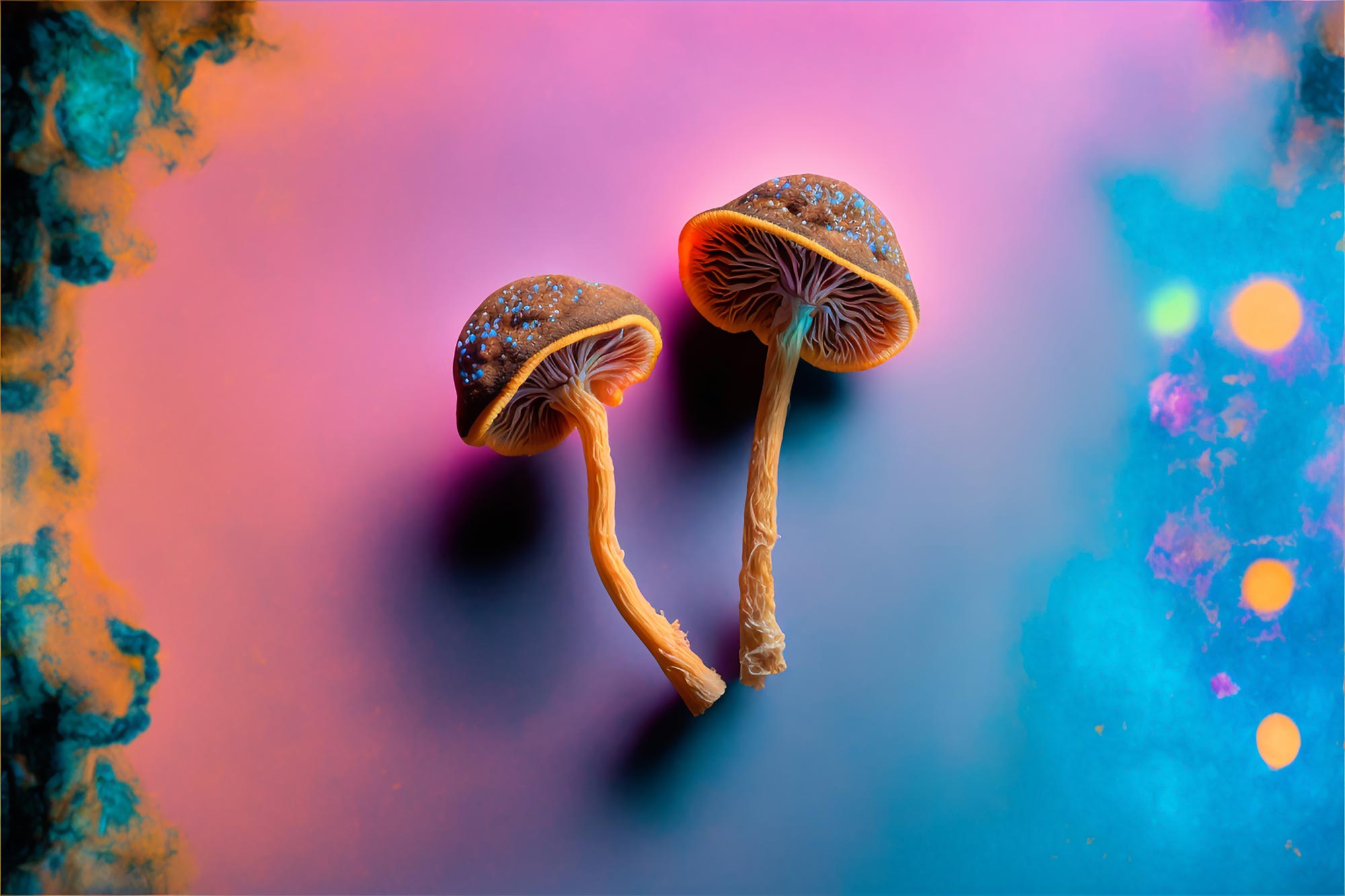
Low doses of psilocybin made aggressive fish calmer without stopping social interaction, revealing a selective effect on escalated conflict behaviors.
More than 200 mushroom species contain the psychoactive compound psilocybin, especially gilled mushrooms from the genus Psilocybe. In mammals, psilocybin interacts with serotonin receptors in the brain and can affect mood, appetite, aggression, and other behaviors. However, scientists still know relatively little about how it influences social behavior in animals.
Researchers in Canada explored that question in a new study published in Frontiers in Behavioral Neuroscience. The team investigated whether psilocybin changes social behavior in the mangrove rivulus fish (Kryptolebias marmoratus), an amphibious species known for its naturally aggressive behavior.
“We show that an acute, low dose of psilocybin significantly reduces activity and aggressive attack behavior during social interactions in adult mangrove rivulus fish, a species that is naturally highly aggressive,” said first author Dayna Forsyth, a research associate and former MSc student at Acadia University in Nova Scotia.
“These findings provide the first evidence that psilocybin can selectively reduce escalated aggression in a vertebrate model without suppressing social interaction,” added senior author Dr. Suzie Currie, a biologist at the University of British Columbia.
Why Mangrove Rivulus Fish Were Chosen
Mangrove rivulus fish are highly aggressive, particularly when interacting with other fish. Their behaviors are easy to observe, making even small behavioral changes detectable. The species also reproduces through self-fertilization, producing genetically identical embryos. This allowed the researchers to better isolate the effects of psilocybin without genetic variation influencing the results.
The scientists used three separate laboratory-bred genetic lines. One group received psilocybin exposure, another served as the stimulus fish during social interactions, and the third was used to measure how much psilocybin the fish absorbed throughout its body.
At the start of the experiment, a focal fish was placed in a tank with a stimulus fish to establish baseline behavior. An opaque divider covered a fiberglass mesh barrier that allowed the fish to see and smell each other without physical contact. After a five-minute acclimation period, researchers removed the divider and monitored the interaction.
Twenty-four hours later, the same focal fish was placed in water containing dissolved psilocybin for 20 minutes. The fish was then returned to the same tank with the same stimulus fish from the previous day. Once the opaque divider was removed again, the researchers observed their interaction.
Psilocybin Lowered Aggression
The researchers tracked activity levels by measuring movement and aggressive actions such as swimming bursts. Fish exposed to psilocybin moved less and displayed fewer swimming bursts than fish that did not receive the treatment.
“Swimming bursts are high‑energy attack behaviors that represent an escalation of aggression towards the stimulus fish without making physical contact,” explained Currie. “Other types of aggressive behaviors, like head‑on displays, are more about communication and social assessment and require very little energy.”
“Psilocybin’s calming effect appears to selectively reduce energetically costly, escalated behaviors while lower‑energy social display behaviors remained largely unchanged,” said Forsyth. “This suggests that this compound can selectively dampen escalated social conflict rather than shutting down behavior altogether.”
Fish treated with psilocybin also spent less time moving overall when paired with another fish.
Implications for Future Psilocybin Research
The researchers said studies using nonhuman animal models can help scientists better understand how drugs may eventually affect humans. Findings like these could help future therapeutic research identify which parts of social behavior are most sensitive to psilocybin. However, the team emphasized that the study did not test medical treatments, and the findings cannot be directly applied to humans.
The study only examined single doses over short periods and did not investigate long-term effects, repeated exposure, or adaptation over time. More research will be needed to determine whether the reduction in aggression can persist.
“Future studies can build on this work to explore how psilocybin alters neural signaling, which serotonin pathways are involved, and why some aspects of social behavior are affected while others are not,” concluded Currie. “These are questions that are difficult or impossible to answer directly in humans.”
Reference: “The magic of mushrooms: psilocybin influences behavior in the mangrove rivulus fish, Kryptolebias marmoratus” by Dayna Forsyth, Nicoletta Faraone, Simon G. Lamarre and Suzanne Currie, 13 March 2026, Frontiers in Behavioral Neuroscience.
DOI: 10.3389/fnbeh.2026.1767175
Never miss a breakthrough: Join the SciTechDaily newsletter.
Follow us on Google and Google News.