
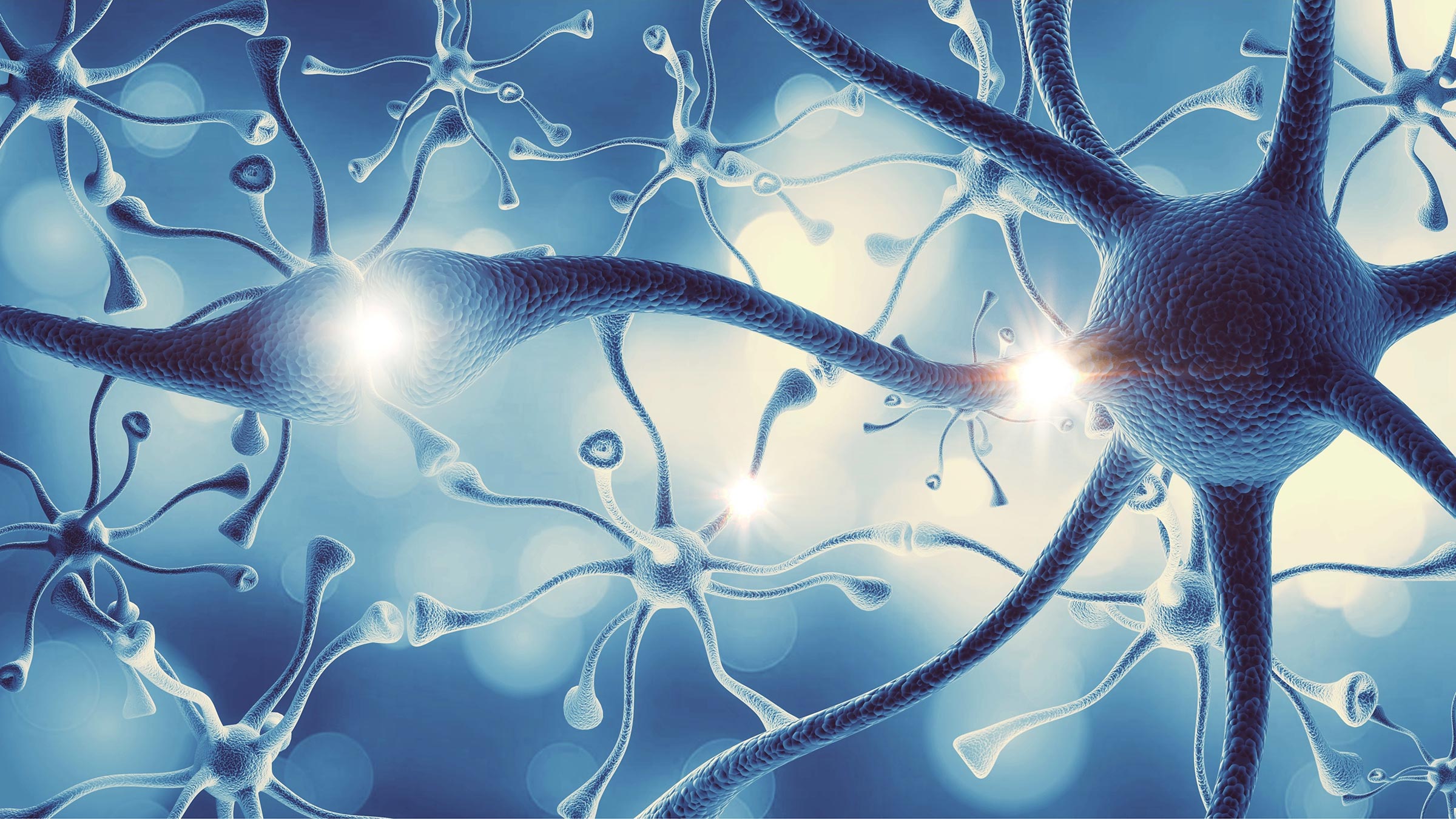
Neurons communicate through chemical signals known as neurotransmitters. Researchers at St. Jude Children’s Research Hospital, leveraging their expertise in structural biology, have successfully elucidated the structures of the vesicular monoamine transporter 2 (VMAT2), a key component of neuronal communication.
By visualizing VMAT2 in different states, scientists now better understand how it functions and how the different shapes the protein takes influence drug binding — critical information for drug development to treat hyperkinetic (excess movement) disorders such as Tourette syndrome. The work was recently published in the journal Nature.
How our neurons talk to each other
Chemical compounds called monoamines, which include dopamine, serotonin, and adrenaline, play a central role in neuronal communication. These molecules affect how the brain works, controlling our emotions, sleep, movement, breathing, circulation, and many other functions. Monoamines are neurotransmitters (signaling molecules) produced and released by neurons, but before they can be released, they must first be packaged into vesicles.
Vesicles are cellular compartments that store neurotransmitters before they are released at the synapses (the junction through which chemical signals pass from one neuron to another). Think of vesicles as the cargo ships of the neuronal cell — neurochemicals are packed inside them and taken to where they need to go. VMATs are proteins on the membrane of these vesicles that move monoamines into the space within, acting like loading cranes for the cargo ships.
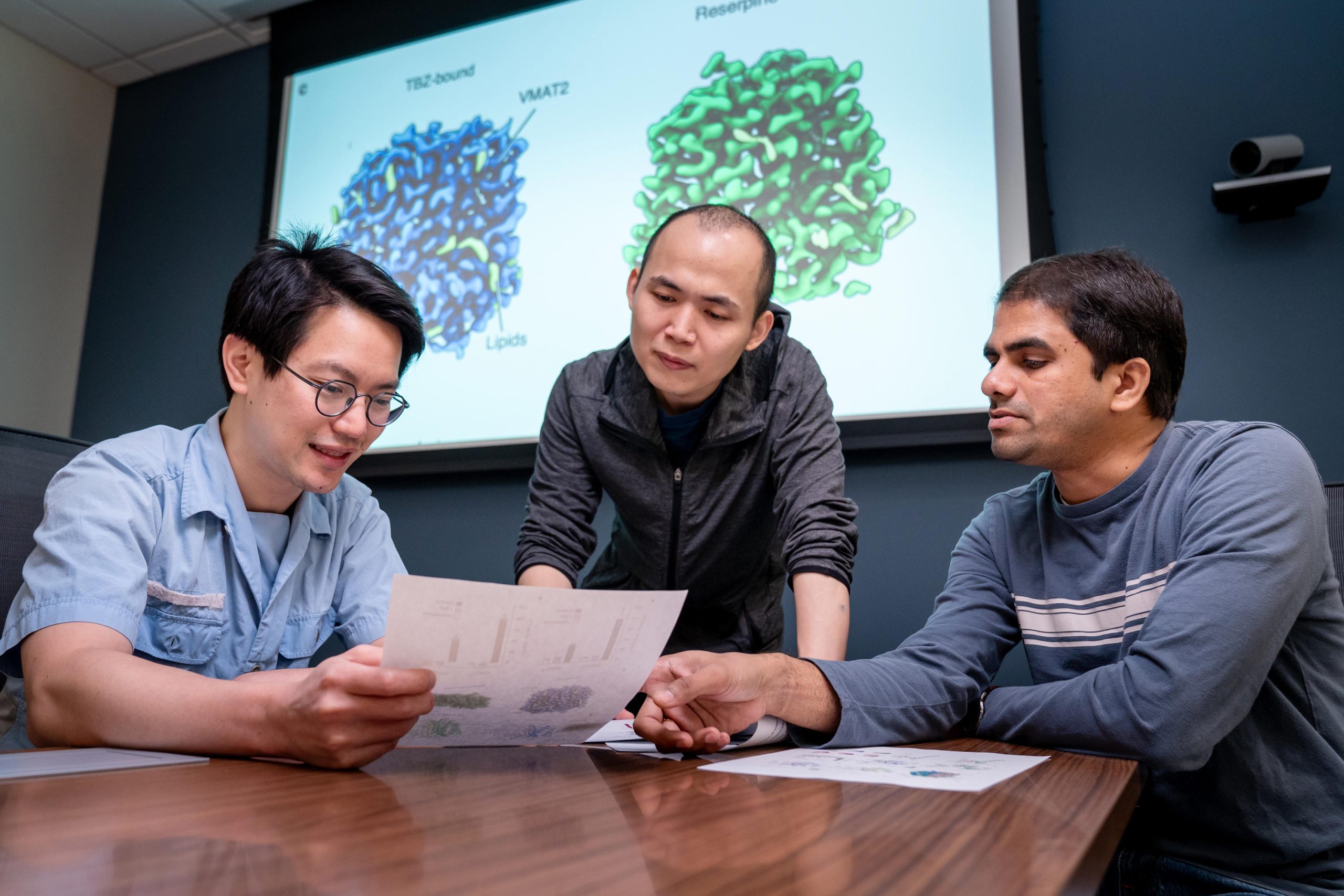
“VMATs are transporters that are required for packing these monoamine neurotransmitters into synaptic vesicles,” explained co-corresponding author Chia-Hsueh Lee, Ph.D., St. Jude Department of Structural Biology.
Once the VMAT has packed the vesicle with monoamines, the “cargo ship” moves towards the synaptic gap (the space between neurons), where it releases the chemical compounds.
The many faces of monoamine transporters
There are two types of VMAT: VMAT1 and VMAT2. VMAT1 is more specialized, found only in neuroendocrine cells, whereas VMAT2 is found throughout the neuronal system and has significant clinical relevance.
“We knew that VMAT2 is physiologically very important,” Lee said. “This transporter is a target for pharmacologically relevant drugs used in the treatment of hyperkinetic disorders such as chorea and Tourette Syndrome.”
Despite their importance, the structure of VMAT2, which would allow researchers to investigate how it works fully, had remained elusive. Lee and his team used cryo-electron microscopy (cryo-EM) to obtain structures of VMAT2 bound to the monoamine serotonin and the drugs tetrabenazine and reserpine, which are used to treat chorea and hypertension, respectively. This was no easy feat.
“VMAT2 is a small membrane protein,” explained co-first author Yaxin Dai, PhD., St. Jude Department of Structural Biology. “This makes it a very challenging target for cryo-EM structure determination.”
Despite the difficulty and using some clever tricks, the team captured multiple structures of VMAT2 that allowed them to tease out how the protein functions and investigate how exactly those drugs work. “VMAT transporters adopt multiple conformations [shapes] while transporting their substrate. This is called alternating access transport, where the protein is either “outward” or “inward” facing,” explained co-first author Shabareesh Pidathala, Ph.D., St. Jude Department of Structural Biology. “To completely gain mechanistic understanding at an atomic level, we needed to capture multiple conformations of this transporter.”
Answering a 40-year-old question
The researchers discovered this dynamic mechanism means multiple opportunities for drugs to bind. They confirmed that reserpine and tetrabenazine bind two different conformations of VMAT2. “30 or 40 years of pharmacological research had suggested that these two drugs bind to the transporter in different ways,” said Pidathala, “but nobody knew the atomic details of how this works. Our structures nicely demonstrate that these two drugs stabilize two different conformations of the transporter to block its activity.”
The structure of VMAT2 with serotonin bound allowed the researchers to pinpoint specific amino acids that interact with the neurotransmitter and drive transport. “We believe this is a common mechanism that this transporter uses to engage all the monoamines,” said Lee.
While this work offers a huge leap forward in understanding monoamine transport, Lee and his team are delving deeper into its mechanism. For example, the intake of monoamines into vesicles is fueled by protons moving in the other direction. “We identified amino acids that are important for this proton-dependent process,” Lee said, “but we still don’t know how exactly protons drive this transport. Determining this mechanism is our future direction, which will help us to fully appreciate how this transporter works.”
Reference: “Mechanisms of neurotransmitter transport and drug inhibition in human VMAT2” by Shabareesh Pidathala, Shuyun Liao, Yaxin Dai, Xiao Li, Changkun Long, Chi-Lun Chang, Zhe Zhang and Chia-Hsueh Lee, 1 November 2023, Nature.
DOI: 10.1038/s41586-023-06727-9
The study’s other first author is Shuyun Liao of the School of Life Sciences, Peking University. The study’s co-corresponding author is Zhe Zhang of the School of Life Sciences, Peking University. Other authors include Xiao Li and Chi-Lun Chang of St. Jude, and Changkun Long of the School of Life Sciences, Peking University.
The study was supported by grants from National Institutes of Health (R01GM143282), the National Key Research and Development Program of China (2021YFA1302300), the National Natural Science Foundation of China (32171201), the SLS-Qidong innovation fund, the Li Ge-Zhao Ning Life Science Youth Research Foundation, the State Key Laboratory of Membrane Biology of China, and ALSAC, the fundraising and awareness organization of St. Jude.
Never miss a breakthrough: Join the SciTechDaily newsletter.
Follow us on Google and Google News.
1 Comment
Nice and rewarding effort for the St. Jude researchers.