
Close Menu
    Facebook X (Twitter) Instagram
    SciTechDaily
    • Biology
    • Chemistry
    • Earth
    • Health
    • Physics
    • Science
    • Space
    • Technology
    Facebook X (Twitter) Pinterest YouTube RSS
    SciTechDaily
    Home»Space»Spitzer Views Star-Forming Region ON2
    Space

    Spitzer Views Star-Forming Region ON2

    By European Space AgencyMarch 24, 2014No Comments3 Mins Read
    Facebook Twitter Pinterest Telegram LinkedIn WhatsApp Email Reddit
    Share
    Facebook Twitter LinkedIn Pinterest Telegram Email Reddit
    Spitzer Views Star Forming Region ON2
    Credit: L.M. Oskinova, R.A. Gruendl, Spitzer Space Telescope, JPL, NASA & ESA

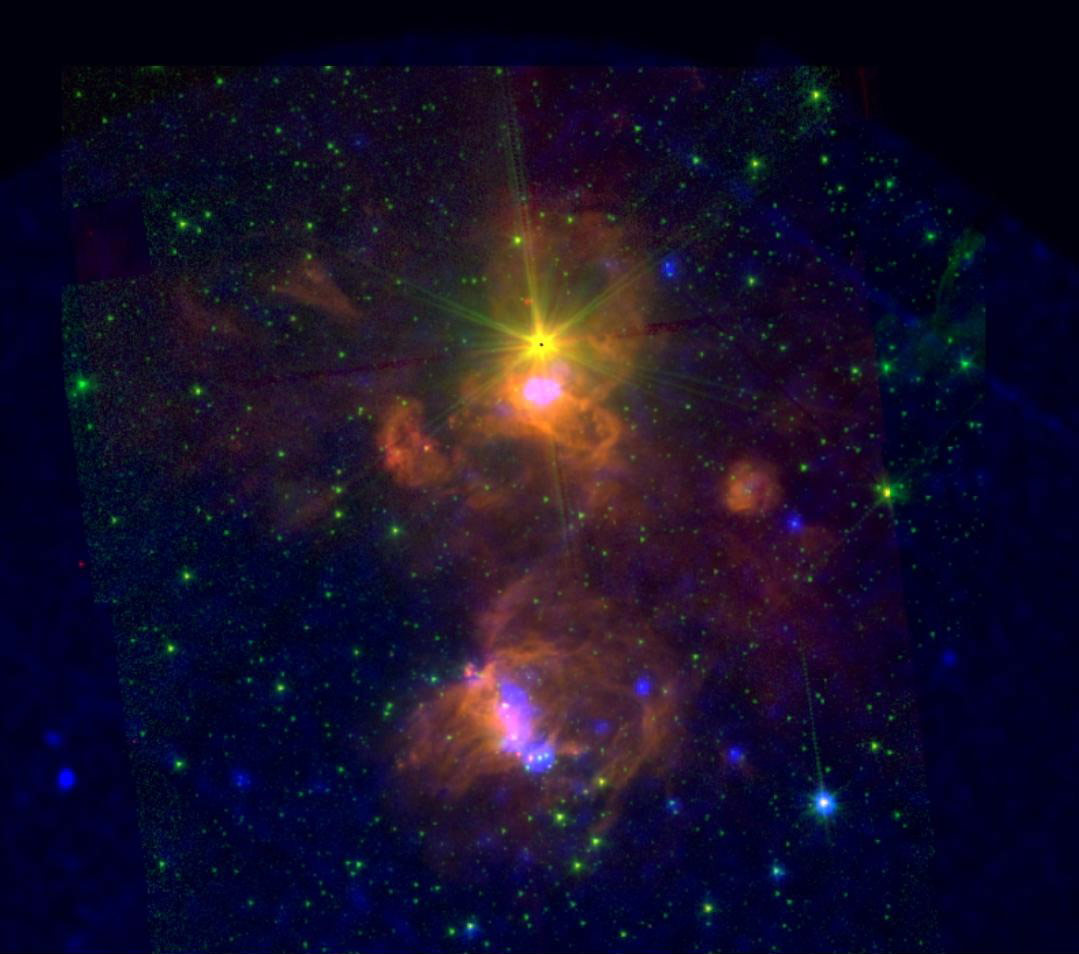
    This newly released image combines X-ray coverage from ESA’s XMM-Newton X-ray observatory with an infrared view from NASA’s Spitzer Space Telescope to show the star-forming region ON2.

    Massive stars are born in tumultuous clouds of gas and dust. They lead a brief but intense life, blowing powerful winds of particles and radiation that strike their surroundings, before their explosive demise as supernovas.

    The interplay between massive stars and their environment is revealed in this image of the star-forming region ON2. It combines X-ray coverage from ESA’s XMM-Newton X-ray observatory with an infrared view from NASA’s Spitzer Space Telescope.

    This stellar cradle is associated with the open cluster of stars named Berkeley 87, some 4000 light-years from Earth. The cluster is home to over 2000 stars, most of which are low-mass stars like our Sun or smaller, but some – a few dozen – are stellar monsters weighing 10–80 times more.

    Two glowing clouds of gas and dust – the raw material from which stars form – dominate the center of the image and are shown in red. Scattered across the image are a multitude of protostars – seeds of future stellar generations; these are shown in green. The bright yellow star in the upper part of the image is BC Cygni, a massive star that has puffed up enormously and will eventually explode as a supernova.

    Shown in blue is XMM-Newton’s X-ray view of ON2: it reveals individual sources – young, massive stars as well as protostars – and more diffuse regions of X-rays. Two ‘bubbles’ of X-rays can be seen in the upper and lower clouds, respectively, pink against the red background. These two bubbles conceal the cumulative emissions from many protostars, but also light radiated by very energetic particles – a signature of shockwaves triggered by massive stars and their winds.

    The image combines observations performed in the X-ray energy range of 0.25–12 keV (blue) and at infrared wavelengths of 3.6 microns (green) and 8 microns (red). It spans about 15 arcminutes on each side; north is up and east is to the left.

    This image was first published in the paper “Hard X-Ray Emission in the Star-Forming Region ON 2: Discovery with XMM-Newton” by Oskinova et al.

    Reference: “HARD X-RAY EMISSION IN THE STAR-FORMING REGION ON 2: DISCOVERY WITH XMM-NEWTON” by L. M. Oskinova, R. A. Gruendl, R. Ignace, Y.-H. Chu, W.-R. Hamann and A. Feldmeier, 8 March 2010, The Astrophysical Journal.
    DOI: 10.1088/0004-637X/712/2/763

    Never miss a breakthrough: Join the SciTechDaily newsletter.
    Follow us on Google and Google News.

    Astronomy Astrophysics European Space Agency Spitzer Space Telescope Star Formation XMM-Newton
    Share. Facebook Twitter Pinterest LinkedIn Email Reddit

    Related Articles

    Scientists Watch Black Hole Create Near Light Speed Winds in Hours

    This Red Dwarf Just Launched a Planet-Killing Blast Into Space

    Sleeping Black Hole Erupts in Real Time – Blasting Out Record-Breaking X-Rays

    XMM-Newton Spacecraft Detects Black Hole Winds Hindering Star Formation

    A Cosmic Tale of Death & Dust Revealed in Orion Constellation

    Beautiful Cosmic Creature Accelerates Particles From Head

    Mysterious “Lonely Cloud” Bigger Than Milky Way Found in a Galaxy “No-Man’s Land”

    Light Echo From Behind a Black Hole Confirms Einstein’s Theory of General Relativity

    Cosmic Neon Lights: Strange New Type of Star Revealed in X-ray Light

    Leave A Reply Cancel Reply

    • Facebook
    • Twitter
    • Pinterest
    • YouTube

    Don't Miss a Discovery

    Subscribe for the Latest in Science & Tech!

    Trending News

    Collapsing Plasma May Hold the Key to Cosmic Magnetism

    This Breakthrough Solar Panel Generates Power From Both Sunlight and Raindrops

    Scientists Uncover New Metabolic Effects Beyond Weight Loss of Mounjaro

    Scientists Discover Cancer Tumors Are “Addicted” to This Common Antioxidant

    1,800 Miles Down: Scientists Uncover Mysterious Movements at the Edge of Earth’s Core

    Scientists Discover Hidden “Good Fats” in Green Rice That Could Transform Nutrition

    Your Child’s Clothes Could Contain Toxic Lead, Study Finds

    Researchers Break a 150-Year-Old Math Law With a Surprising Donut Discovery

    Follow SciTechDaily
    • Facebook
    • Twitter
    • YouTube
    • Pinterest
    • Newsletter
    • RSS
    SciTech News
    • Biology News
    • Chemistry News
    • Earth News
    • Health News
    • Physics News
    • Science News
    • Space News
    • Technology News
    Recent Posts
    • Natural Oils vs. Antibiotics: The Swine Study That Could Change Farming
    • The Biggest Volcanic Event in Earth’s History Transformed an Entire Oceanic Plate
    • Scientists Warn: Humanity Has Pushed the Planet Past Its Limits
    • Stronger Flu Shot Linked to Nearly 55% Lower Alzheimer’s Risk, Study Finds
    • Researchers Say That Eating Mango With Avocado Offers Surprising Heart Benefits
    Copyright © 1998 - 2026 SciTechDaily. All Rights Reserved.
    • Science News
    • About
    • Contact
    • Editorial Board
    • Privacy Policy
    • Terms of Use

    Type above and press Enter to search. Press Esc to cancel.