

A mysterious black hole in a distant galaxy just woke up after decades of silence—and it’s putting on a cosmic light show!
ESA’s XMM-Newton and other X-ray telescopes are capturing massive bursts of energy known as quasiperiodic eruptions (QPEs) that defy current theories. Unlike anything seen before, these powerful flashes may be rewriting the rulebook on how black holes behave, evolve, and interact with their surroundings.
XMM-Newton Observes Rare Black Hole Activity
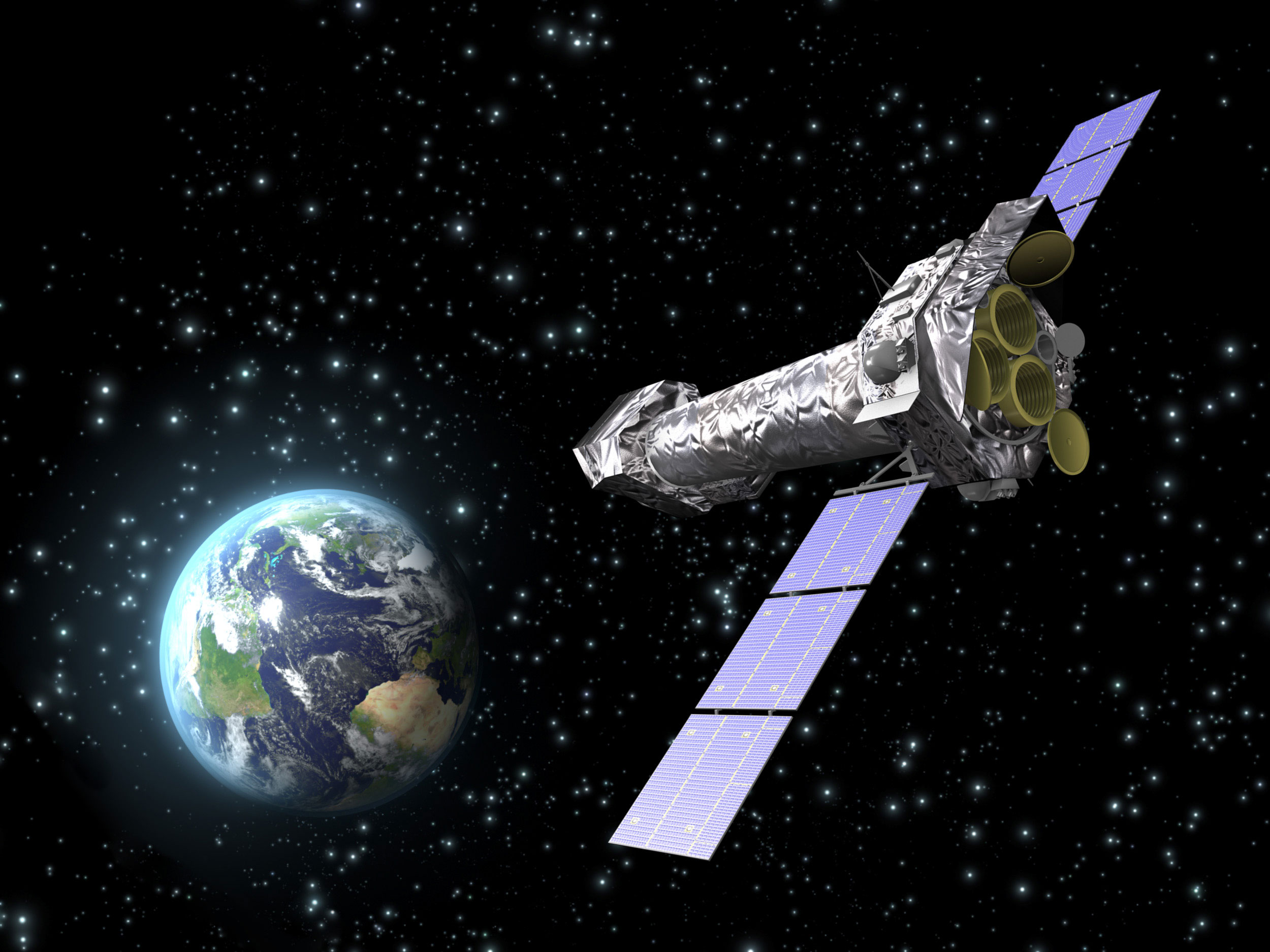
The European Space Agency’s XMM-Newton telescope is helping scientists study the longest and most powerful bursts of X-rays ever seen from a black hole that has recently come back to life. Observing this rare event as it happens gives researchers a unique chance to better understand how black holes behave and what drives these extreme outbursts.
Supermassive black holes, millions of times more massive than our Sun, are believed to sit at the center of most galaxies. But despite their size, they’re often hard to detect. Contrary to the common image of black holes constantly pulling in matter, many of them remain quiet and inactive for long stretches of time.
A Sudden Awakening in Virgo
That was the case with the black hole at the center of SDSS1335+0728, a fairly ordinary galaxy located about 300 million light-years away in the constellation Virgo. After decades of dormancy, this black hole suddenly flared to life and began emitting powerful, never-before-seen X-ray flashes.
The first signs of activity appeared in late 2019, when the galaxy unexpectedly began shining brightly, attracting the attention of astronomers. After studying it for several years, they concluded that the unusual changes they saw were probably the result of the black hole suddenly ‘switching on’ – entering an active phase. The bright, compact, central region of the galaxy is now classified as an active galactic nucleus, nicknamed ‘Ansky’.
Triggering Telescopes and Tracking Light
“When we first saw Ansky light up in optical images, we triggered follow-up observations using NASA’s Swift X-ray space telescope, and we checked archived data from the eROSITA X-ray telescope, but at the time we didn’t see any evidence of X-ray emissions,” says Paula Sánchez Sáez, a researcher at the European Southern Observatory, Germany, and leader of the team that first explored the black hole’s activation.
Bursts Detected in 2024
Then, in February 2024, a team led by Lorena Hernández-García, a researcher at the Valparaiso University, Chile, began to see bursts of X-rays from Ansky at nearly regular intervals.
“This rare event provides an opportunity for astronomers to observe a black hole’s behavior in real time, using X-ray space telescopes XMM-Newton and NASA’s NICER, Chandra and Swift. This phenomenon is known as a quasiperiodic eruption, or QPE. QPEs are short-lived flaring events. And this is the first time we have observed such an event in a black hole that seems to be waking up,” explains Lorena.
“The first QPE episode was discovered in 2019, and since then we’ve only detected a handful more. We don’t yet understand what causes them. Studying Ansky will help us to better understand black holes and how they evolve.”
XMM-Newton Reveals Hidden Energy Patterns
“XMM-Newton played a pivotal role in our study. It is the only X-ray telescope sensitive enough to detect the fainter X-ray background light between the bursts. With XMM-Newton we could measure how dim Ansky gets, which enabled us to calculate how much energy Ansky releases when it lights up and starts flashing.”

Unraveling Puzzling Behavior
The gravity of a black hole captures matter that gets too close and can rip it apart. The matter from a captured star, for example, would be spread into a hot, bright, rapidly spinning disc called an accretion disc. Current thinking is that QPEs are caused by an object (that could be a star or a small black hole) interacting with this accretion disc and they have been linked to the destruction of a star. But there is no evidence that Ansky has destroyed a star.
The extraordinary characteristics of Ansky’s recurring bursts prompted the research team to consider other possibilities. The accretion disc could be formed by gas captured by the black hole from its neighbourhood, and not a disintegrated star. In this scenario, the X-ray flares would be coming from highly energetic shocks in the disc, provoked by a small celestial object traveling through and disrupting the orbiting material, repeatedly.
A Black Hole Like No Other
“The bursts of X-rays from Ansky are ten times longer and ten times more luminous than what we see from a typical QPE,” says Joheen Chakraborty, a team member and PhD student at the Massachusetts Institute of Technology, USA.
“Each of these eruptions is releasing a hundred times more energy than we have seen elsewhere. Ansky’s eruptions also show the longest cadence ever observed, of about 4.5 days. This pushes our models to their limits and challenges our existing ideas about how these X-ray flashes are being generated.”
Watching the Cosmos Unfold in Real Time
Being able to watch Ansky evolving in real-time is an unprecedented opportunity for astronomers to learn more about black holes and the energetic events they power.
“For QPEs, we’re still at the point where we have more models than data, and we need more observations to understand what’s happening,” says ESA Research Fellow and X-ray astronomer, Erwan Quintin.
“We thought that QPEs were the result of small celestial objects being captured by much larger ones and spiraling down towards them. Ansky’s eruptions seem to be telling us a different story. These repetitive bursts are also likely associated with gravitational waves that ESA’s future mission LISA might be able to catch.”
“It’s crucial to have these X-ray observations that will complement the gravitational wave data and help us solve the puzzling behavior of massive black holes.”
References:
“Discovery of extreme quasi-periodic eruptions in a newly accreting massive black hole” by Lorena Hernández-García, Joheen Chakraborty, Paula Sánchez-Sáez, Claudio Ricci, Jorge Cuadra, Barry McKernan, K. E. Saavik Ford, Patricia Arévalo, Arne Rau, Riccardo Arcodia, Erin Kara, Zhu Liu, Andrea Merloni, Gabriele Bruni, Adelle Goodwin, Zaven Arzoumanian, Roberto J. Assef, Pietro Baldini, Amelia Bayo, Franz E. Bauer, Santiago Bernal, Murray Brightman, Gabriela Calistro Rivera, Keith Gendreau, David Homan, Mirko Krumpe, Paulina Lira, Mary Loli Martínez-Aldama, Mara Salvato and Belén Sotomayor, 11 April 2025, Nature Astronomy.
DOI: 10.1038/s41550-025-02523-9
“SDSS1335+0728: The awakening of a ∼106 M⊙ black hole” by P. Sánchez-Sáez, L. Hernández-García, S. Bernal, A. Bayo, G. Calistro Rivera, F. E. Bauer, C. Ricci, A. Merloni, M. J. Graham, R. Cartier, P. Arévalo, R. J. Assef, A. Concas, D. Homan, M. Krumpe, P. Lira, A. Malyali, M. L. Martínez-Aldama, A. M. Muñoz Arancibia, A. Rau, G. Bruni, F. Förster, M. Pavez-Herrera, D. Tubín-Arenas and M. Brightman, 15 August 2024, Astronomy & Astrophysics.
DOI: 10.1051/0004-6361/202347957
Dr. Lorena Hernandez-Garcia is also a researcher at the Millennium Institute of Astrophysics and Millennium Nucleus TITANS, Chile.
Never miss a breakthrough: Join the SciTechDaily newsletter.
Follow us on Google and Google News.
3 Comments
Way cool! Except, technically, this is not happening in real-time.
Yep, you are so right. It occurred a long, long time ago. The light is only now reaching us on Earth.
Please prevent confusion. The “Real Time” mentioned should be stated as “Local Real Time” as the black hole is 300 million light years away from us which means that the event that just occurred for us actually happened 300 million years ago. Mind boggling.