
Ancient DNA reveals how family bonds helped Andean communities survive climate crisis, disease, and the pressures of early farming.
A recent study published in Nature reconstructs more than 2,000 years of population history in Argentina’s Uspallata Valley (UV), a region at the southern edge of ancient Andean farming expansion. The research sheds new light on how agriculture transformed societies and how communities responded to environmental and health crises over time.
Using ancient human and pathogen DNA, isotopic analysis, archaeology, and paleoclimate records–and working closely with Huarpe Indigenous communities–researchers discovered that local hunter-gatherers gradually adopted farming practices rather than being replaced by incoming populations. The findings also reveal that later maize farming communities experienced prolonged hardship and that migration through extended family networks may have helped people survive periods of instability.
One major question surrounding the spread of agriculture is whether farming expanded mainly because farming populations moved into new areas or because local hunter-gatherers adopted crops and agricultural knowledge. Archaeological evidence alone often cannot clearly distinguish between these possibilities because both can leave similar traces behind. The Uspallata Valley offers a rare opportunity to study this transition because agriculture arrived there much later than in South America’s major domestication centers.
Researchers led by the Microbial Paleogenomics Unit (MPU) at Institut Pasteur analyzed genome-wide ancient DNA from 46 individuals spanning early hunter-gatherer societies through later farming populations. Their results revealed strong genetic continuity between hunter-gatherers living in the valley about 2,200 years ago and the farming communities that lived there more than 1,000 years later as maize cultivation–and other crops–expanded.
Deep Indigenous Genetic Roots in the Southern Andes
The study also provides important new insight into the long-term genetic history of southern Andean populations.
“Beyond the local story of Uspallata, we are also filling a gap in South American human genetic diversity by documenting a genetic component that was previously only suggested by analysing present-day populations, and that now proves to have a very deep divergence and current persistence in the region” explains Pierre Luisi, co-first author of the study, researcher in CONICET, Argentina, who started this work as postdoc in the MPU at Institut Pasteur, France.
“The persistence of this ancestral genetic component in populations today has important implications, since it argues against narratives claiming the extinction of indigenous descendants in the region since the establishment and growth of the Argentine state-nation.”
Stable Isotopes Reveal Diet and Migration Patterns
To better understand how people lived, the team combined genetic evidence with stable isotope analysis from bones and teeth. Carbon and nitrogen isotopes provide clues about long-term diet, while strontium isotopes can reveal where someone lived and whether they moved during their lifetime.
The results showed that maize consumption in UV varied over time, suggesting a flexible approach to farming rather than a constant increase in agricultural dependence. However, a different pattern appeared between ~800 and 600 years ago at a major cemetery site called Potrero Las Colonias. Many individuals there showed unusually heavy reliance on maize–among the highest levels documented in the southern Andes–and also displayed non-local strontium signatures, indicating they had migrated into the area.
Who were these migrants and where did they come from?
Researchers found that these movements occurred within a relatively limited geographic area rather than involving distant, unrelated populations. Genetic data showed that the migrants were closely related to local groups and belonged to the same broader population network. Still, genomic evidence also revealed that this group experienced a severe and long-lasting demographic decline, suggesting generations of persistent stress.
Climate Instability, Tuberculosis, and Population Decline
Several lines of evidence point to a complex crisis affecting these farming communities. Paleoclimate records indicate extended periods of climatic instability that coincided with the population decline. At the level of individual lives (individual’s lives), skeletal remains showed signs consistent with childhood malnutrition and infectious disease.
Ancient DNA also revealed tuberculosis at the site. The detected strain belonged to a lineage already known from pre-contact South America. Finding it this far south, beyond previously documented cases in Peru and Colombia, raises new questions about how the disease spread and what environmental conditions allowed it to persist.
“Detecting tuberculosis this far south in a pre-contact context is striking,” says Nicolás Rascovan, head of the Microbial Paleogenomics Unit at Institut Pasteur. “It expands the geographic frame for understanding how tuberculosis circulated in the past and highlights the value of integrating pathogen genomics into broader reconstructions of human history.”
Family Networks May Have Helped Communities Survive
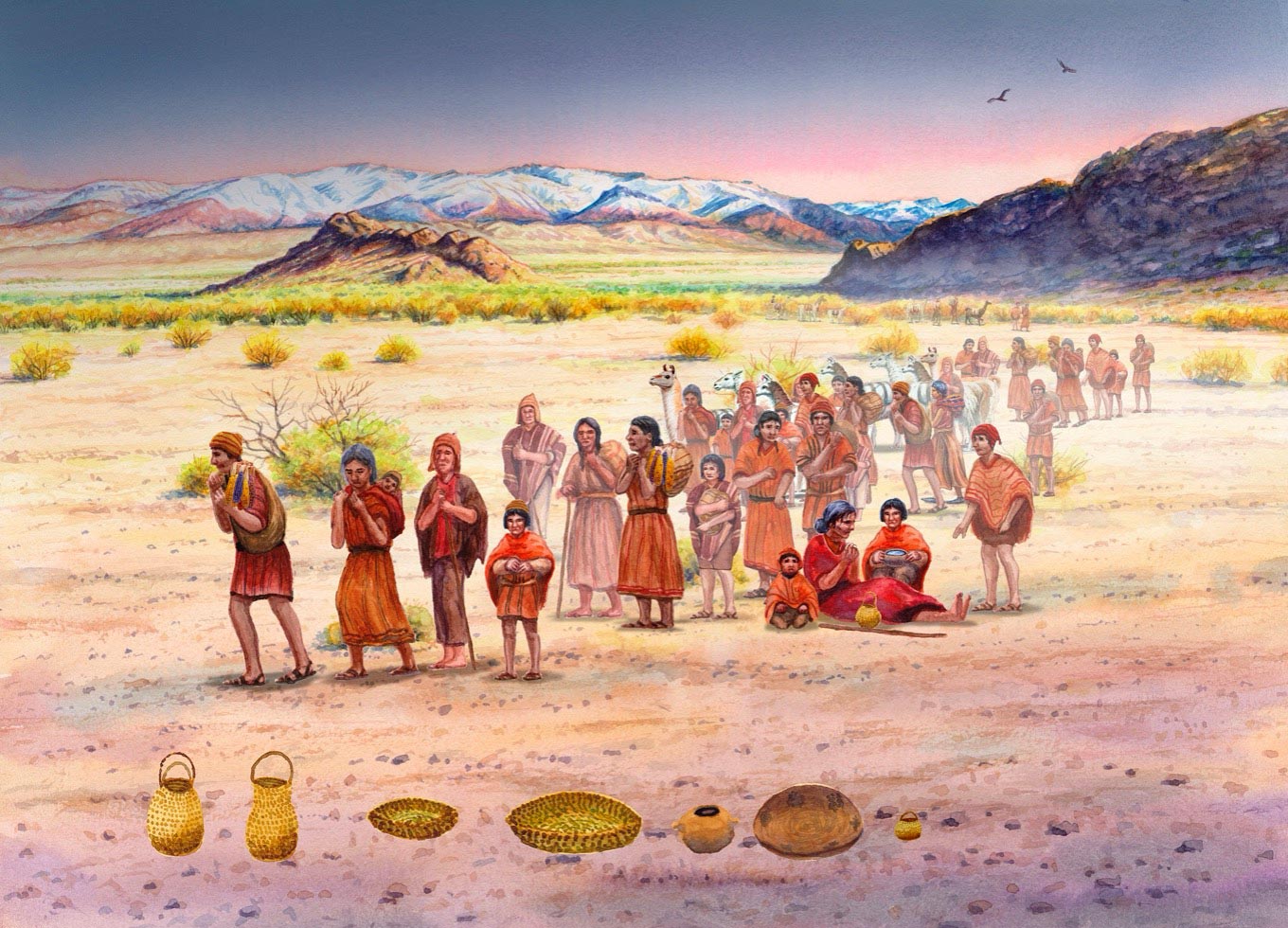
Genetic kinship analysis added another important layer to the story. Many of the migrants were closely related, although they were buried at different times. This pattern suggests organized, multi-generational movement into UV over several decades.
The kinship network was largely structured through maternal family lines, and one mitochondrial lineage appeared repeatedly among migrants. This points to a potentially central role for women in maintaining family continuity and coordinating movement between communities.
Researchers found no evidence of violent conflict. In some cases, migrants and local people were buried together, suggesting peaceful coexistence between groups in the region.
Together, the findings suggest that migration based on family ties served as a resilience strategy during overlapping pressures from environmental instability, food shortages, and disease.
“No farming community abandons fields and homes lightly,” says archaeologist and co-first author Ramiro Barberena, a researcher at CONICET. “Our results are most consistent with people moving under force majeure, relying on family networks to navigate crisis.”
Barberena adds: “Understanding how these transitions unfolded and what they meant for demography, economy, and health helps us better grasp the pathways that shaped today’s societies–and to think about risks and challenges of climate change and demographic pressures.”
Collaboration With Indigenous Communities
The study also highlights the importance of working closely with Indigenous communities throughout the research process. Members of the Huarpe community actively participated in the project, helped shape interpretations and narrative framing, and three community members co-authored the study (Claudia Herrera, Graciela Coz and Matías Candito).
Researchers and community members met regularly to discuss permissions, uncertainties, and communication of the findings. The study was also accompanied by a Spanish translation with non-specialist explanations to make the research more accessible locally.
“Archaeology and paleogenomics are not neutral when they involve the ancestors of living people,” says Rascovan. “Working with communities changes how we do science: it shapes the questions we ask, how we interpret evidence, and how we communicate what we can–and cannot–conclude.”
Lessons About Agriculture, Crisis, and Human Resilience
More broadly, the research shows that the adoption of agriculture, one of the most transformative developments in human history, did not happen in a single universal way. Instead, different communities followed distinct paths shaped by local environments and social networks.
By combining genetics, archaeology, isotopes, climate evidence, and pathogen data, the study reveals how ancient societies managed overlapping pressures from climate instability, food stress, and disease. Researchers say these long-term insights into cooperation, migration, and resilience may also help inform modern discussions about climate and public health challenges today.
Reference: “Local agricultural transition, crisis and migration in the Southern Andes” by Ramiro Barberena, Pierre Luisi, Paula Novellino, Augusto Tessone, Daniela Guevara, Angelina García, Elizabeth A. Nelson, Petrus le Roux, Claudia Herrera, Graciela Coz, Matías Candito, Maria Lopopolo, Maël Le Corre, Lorena Becerra-Valdivia, Miren Iraeta Orbegozo, Gaétan Tressières, Gustavo Lucero, Marcelo Cardillo, Julia Merler Carbajo, Gabriela Da Peña, Jorge Suby, Maguelonne Roux, María Eugenia de Porras, Candela Acosta Morano, Claudia Mallea, Lumila Menéndez, María Fernanda Quintana, María Laura López, Andrés Troncoso, Julie Luyt, Kerryn Gray, Francisca Santana-Sagredo, Ludovic Orlando, Víctor Durán, Judith Sealy, Etienne Patin, Lluis Quintana-Murci, Hannes Schroeder and Nicolás Rascovan, 18 March 2026, Nature.
DOI: 10.1038/s41586-026-10233-z
Never miss a breakthrough: Join the SciTechDaily newsletter.
Follow us on Google and Google News.