
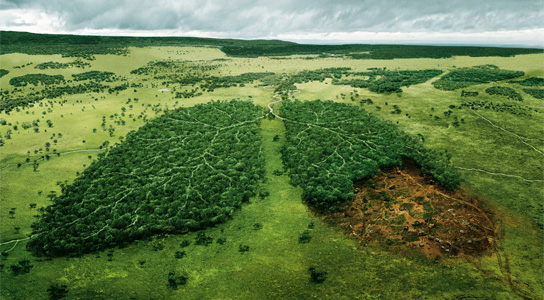
A new study published in the journal Science suggests that humans might have played a significant part in the sudden deforestation of rainforests from Central Africa. This work contradicts the prevailing view that the expansion of farming practices was the root cause as well as the increased incidence of long, severe dry spells.
Germain Bayon, a geochemist at the French Research Institute for Exploration of the Sea in Plouzané, and his colleagues examined the weathering of sediment samples that were drawn from the mouth of the Congo River. Deforestation intensifies weathering; therefore the clay samples would provide a continuous record of the climate for the past 40,000 years.
The sediment cores revealed that 3,000 years ago, there was a complete decoupling between rainfall and the rate of weathering. Bayon says that this indicates that the climate alone could not be a factor to explain this deforestation.
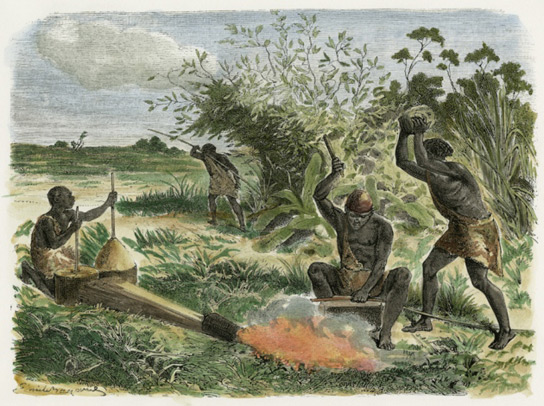
The research team suggests that the Bantu-speaking people from present-day Nigeria and Cameroon, known to have emigrated across Central Africa 4,000 years ago, had an impact on the rainforest, since they cleared land for farming and iron smelting.
Other researchers are skeptical that humans could have destroyed such large areas of forest using primitive tools. Even with today’s technology, it could be problematic to create such large areas of deforestation. Alfred Ngomanda, director of the Research Institute of Tropical Ecology in Libreville, Gabon, believes that Bantu farmers played a role in accelerating local forest degradation.
The study raises some questions about to which extent deforestation and other human activities might exacerbate the effects of climate change.
Reference: “Intensifying Weathering and Land Use in Iron Age Central Africa” by Germain Bayon, Bernard Dennielou, Joël Etoubleau, Emmanuel Ponzevera, Samuel Toucanne and Sylvain Bermell, 9 February 2012, Science.
DOI: 10.1126/science.1215400
Never miss a breakthrough: Join the SciTechDaily newsletter.
Follow us on Google and Google News.
9 Comments
Deforestation is not a good thing.
your mother.
What the
No doh
Are they able to discern whether those areas may have become infested with some type of pest or fungal disease?
Why does the picture look like lungs
The artist is making a comment –
rainforests via their enormous transpiration, exhale vast amounts of water vapor, & create their own self supporting rainfall.
Water vapor goes up, rsin comes down, the forest persists… &, as a side effect of all that vegetation, lots of O2 is created.
Hence, the 2 forest ateas, each shaped like a lung.
The loss of massive transpiration, plus the poor rainforest soils, which are clay & nearly devoid of tilth or fertility, are the reason that AMAZONIA may soon become a savannah landscape, dry seasonal grasslands with a few tough, scattered trees, as the next stable climax ecosystem.
I believe the illustration shows a blacksmith shop. The “lungs” are bellows.
It was an instinctive adaptation of the Earth for human settlements.
The same happened in Europe, which was covered in forests.