
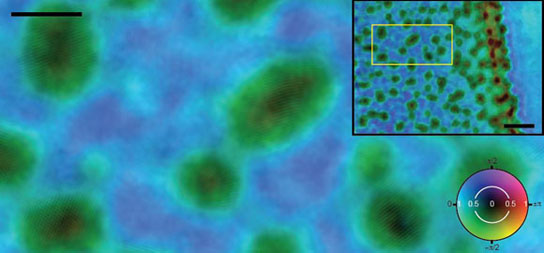
Electron ptychography is set to revolutionize the electron microscope. By doing away with the lens, electron ptychography forms the image by reconstructing the scattered electron waves after they have passed through the sample using computers, which could result in the highest resolution images ever seen.
Researchers at the University of Sheffield have revolutionized the electron microscope by developing a new method that could create the highest resolution images ever seen.
For over 70 years, transmission electron microscopy (TEM), which “looks through” an object to see atomic features within it, has been constrained by the relatively poor lenses which are used to form the image.
The new method, called electron ptychography, dispenses with the lens and instead forms the image by reconstructing the scattered electron-waves after they have passed through the sample using computers.
Scientists involved in the scheme consider their findings to be a “first step” in a “completely new epoch of electron imaging.” The process has no fundamental experimental boundaries and it is thought it will transform sub-atomic scale transmission imaging.
Project leader Professor John Rodenburg, of the University of Sheffield´s Department of Electronic and Electrical Engineering, said: “To understand how material behaves, we need to know exactly where the atoms are. This approach will enable us to look at how atoms sit next to one another in a solid object as if we´re holding them in our hands.
“We´ve shown we can improve upon the resolution limit of an electron lens by a factor of five. An extension of the same method should reach the highest resolution transmission image ever obtained; about one-tenth of an atomic diameter. No longer does TEM have to be bound by the paradigm of the lens, its Achilles´ heel since its invention in 1933.”
The technique is applicable to microscopes using any type of wave and has other key advantages over conventional methods. For example, when used with visible light, the new technology forms a type of image that means scientists can see living cells very clearly without the need to stain them, a process that usually kills the cells.
The new method also disposes of the need to put a lens very close to a living sample, meaning that cells can be seen through thick containers like petri dishes or flasks. This means that as they develop and grow over days or weeks, they do not have to be disturbed.
Plans are even being put into place with the European Space Agency to take the new, more robust, microscope technology to the moon in 2018 to examine the structure of moon soil.
Professor Rodenburg added: “We measure diffraction patterns rather than images. What we record is equivalent to the strength of the electron, X-ray or light waves that have been scattered by the object – this is called their intensity. However, to make an image, we need to know when the peaks and troughs of the waves arrive at the detector – this is called their phase.
“The key breakthrough has been to develop a way to calculate the phase of the waves from their intensity alone. Once we have this, we can work out backward what the waves were scattered from: that is, we can form an aberration-free image of the object, which is much better than can be achieved with a normal lens.
“A typical electron or X-ray microscope image is about one hundred times more blurred than the theoretical limit defined by the wavelength. In this project, the eventual aim is to get the best-ever pictures of individual atoms in any structure seen within a three-dimensional object.”
Reference: “Ptychographic electron microscopy using high-angle dark-field scattering for sub-nanometre resolution imaging” by M.J. Humphry, B. Kraus, A.C. Hurst, A.M. Maiden and J.M. Rodenburg, 6 March 2012, Nature Communications.
DOI: 10.1038/ncomms1733
The ground-breaking results were part of a three-year study costing £4.3 million which was funded by the Engineering and Physical Sciences Research Council (EPSRC).
The investigation was carried out with the help of Phase Focus Ltd, a University of Sheffield spin-out company, and Gatan Inc.
Never miss a breakthrough: Join the SciTechDaily newsletter.
Follow us on Google and Google News.
2 Comments
Is this based on the work done in “Quantitative atomic resolution mapping using high-angle annular dark field scanning transmission electron microscopy”
Ultramicroscopy (September 2009), 109 (10), pg. 1236-1244
S. Van Aert; J. Verbeeck; R. Erni; S. Bals; M. Luysberg; D. Van Dyck; G. Van Tendeloo ?
They didn’t mention any references in their press release, but they did list contact info.
Paul Mannion, Media Relations Officer, on 0114 2229851 or email [email protected]