
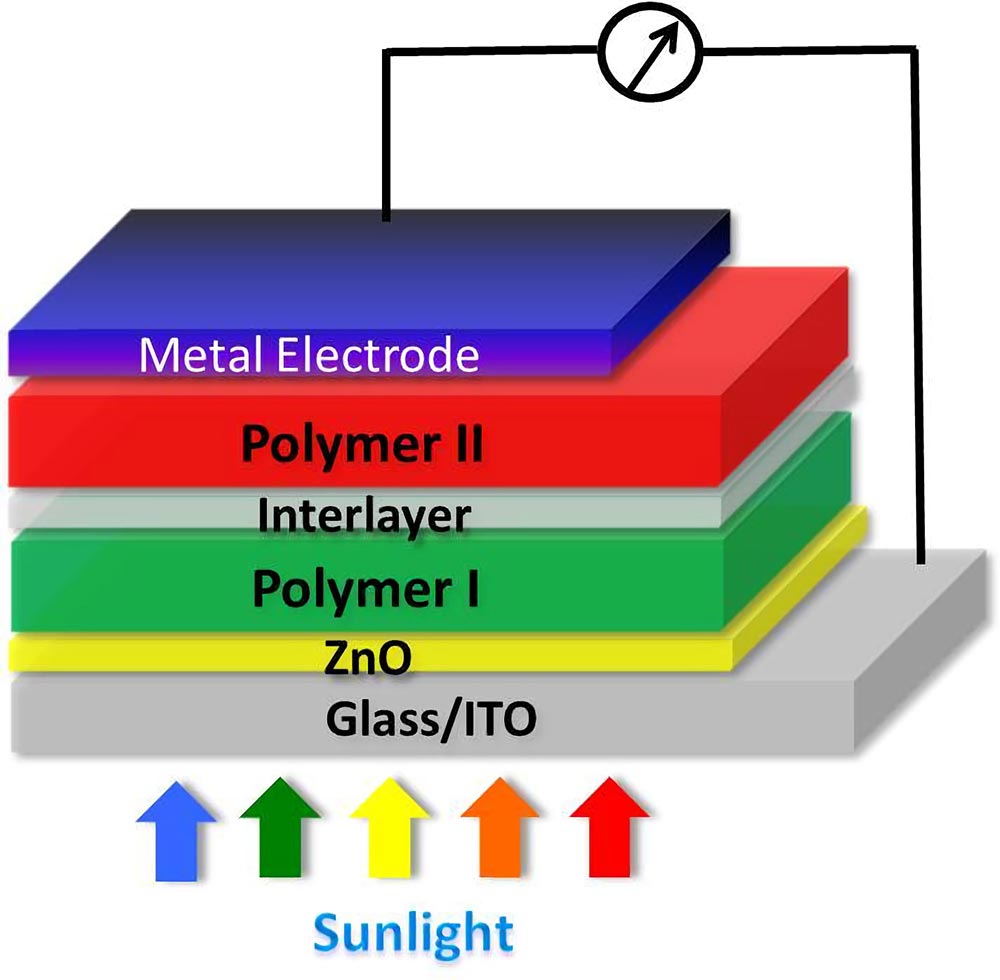
Improvements in polymer solar cell technology continue as a new report documents the highest independently measured efficiency for a polymer solar cell, 10.6+/-0.3% with respect to standard terrestrial reporting conditions.
Scientists boosted the significance of tandem polymer solar cells by successfully testing cells with low-bandgap polymers that achieved certified conversion efficiencies of 8.62 ± 0.3% with respect to standard terrestrial reporting conditions.
That’s the highest independently measured efficiency for a polymer solar cell, say researchers from the U.S. Department of Energy’s National Renewable Energy Laboratory (NREL) and the University of California, Los Angeles (UCLA), who co-authored a report in the February 12 issue of Nature Photonics.
That report, “Tandem polymer solar cells featuring a spectrally matched low-bandgap polymer,” notes that tandem solar cells by their design can harvest a broader spectrum of the sun’s rays than single solar cells. But polymer solar cells have lagged because it’s been difficult finding a suitable low-bandgap polymer.”
In sophisticated tests, the researchers were able to demonstrate highly efficient single and tandem polymer solar cells featuring a low-bandgap conjugated polymer (PBDTT-DPP: bandgap, 1.44 eV). When they tested a single-layer device with the polymer it converted the sun’s rays into electricity at an efficiency of about 6%. When the polymer was applied to tandem solar cells, the power conversion efficiency reached 8.62%.
The UCLA group recently improved on this result by incorporating a new infrared-absorbing polymer from Sumitomo Chemical in Japan. NREL measured the power conversion efficiency at 10.6+/-0.3% under standard terrestrial reporting conditions.
Stacking layers of different materials in a solar cell means multiple bandgaps, each of which captures a different part of the solar spectrum. The challenge is to achieve a high current by efficiently using the low-energy portion of the solar spectrum, and achieving a small energy bandgap – less than 1.5 eV. The successful test took place in NREL’s Spectrolab X-25 solar simulator, also called the One-Sun Solar Simulator, which has wide current and voltage ranges.
“Accurately measuring tandem cells is difficult. The NREL simulator provides unparalleled accuracy by precisely adjusting the spectrum, and did so in a fraction of the time that other simulators could do the job,” said NREL Principal Engineer Keith Emery. Each device junction must behave the same under the simulator spectrum as it would under the reference spectrum. It requires significant adjustment of the simulator spectrum, normally a very tedious process.
NREL’s One-Sun Solar Simulator was able to turn an ordeal that typically takes all day into a five-minute task. “We think it’s also more accurate because we can better adjust the spectrum,” Emery said.
Reference: “Tandem polymer solar cells featuring a spectrally matched low-bandgap polymer” by Letian Dou, Jingbi You, Jun Yang, Chun-Chao Chen, Youjun He, Seiichiro Murase, Tom Moriarty, Keith Emery, Gang Li and Yang Yang, 12 February 2012, Nature Photonics.
DOI: 10.1038/nphoton.2011.356
Never miss a breakthrough: Join the SciTechDaily newsletter.
Follow us on Google and Google News.