
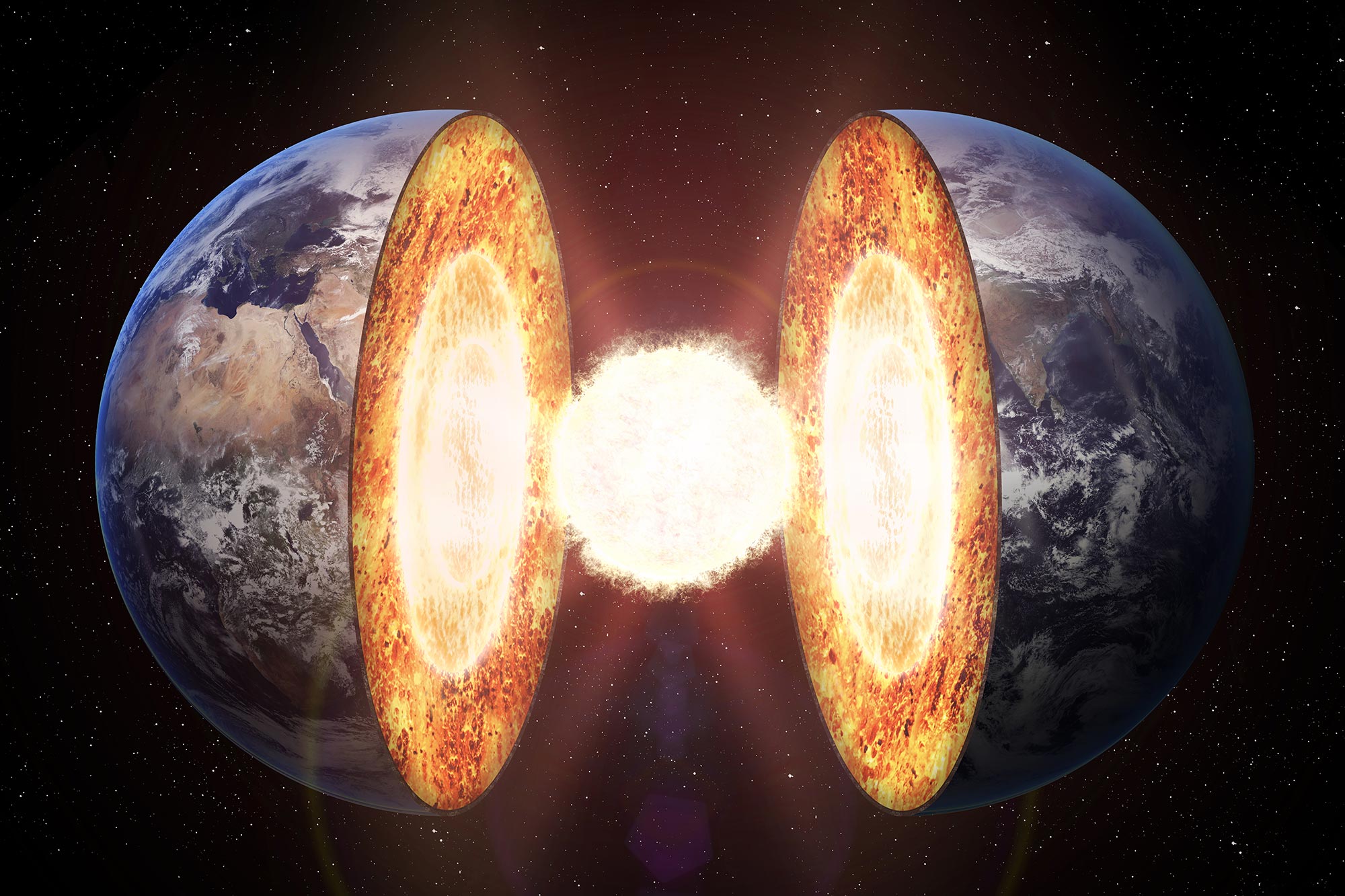
Deep within Earth’s core, scientists are uncovering signs of a hidden structure that challenges long-standing models of the planet’s interior.
Far below the surface, beyond the reach of drilling, Earth’s core may contain a previously unknown layer.
Scientists now believe Earth’s center is not a single uniform sphere but a more complex structure, with a distinct zone buried inside the solid inner core. Often referred to as the “innermost inner core,” this region is reshaping how researchers understand the planet’s deepest interior and may hold clues to how Earth formed billions of years ago.
Earth is traditionally divided into four layers: crust, mantle, outer core, and inner core. “Traditionally we’ve been taught the Earth has four main layers,” said lead author Joanne Stephenson, a PhD researcher at The Australian National University (ANU). “The idea of another distinct layer was proposed a couple of decades ago, but the data has been very unclear.”
A study published in 2020 by researchers at The Australian National University (ANU) in the Journal of Geophysical Research: Solid Earth identified signs of an additional layer within the inner core, pointing to a more complex structure at Earth’s center.
Probing the Inner Core With Seismic Waves
The inner core is a dense, solid sphere made mostly of iron and nickel, with temperatures exceeding 5,000 degrees Celsius (9,000 degrees Fahrenheit). Although it accounts for only about 1 percent of Earth’s volume, it provides important insights into the planet’s history. Because it cannot be directly observed, scientists study it using seismic waves from earthquakes. These waves travel at different speeds depending on the materials they pass through.
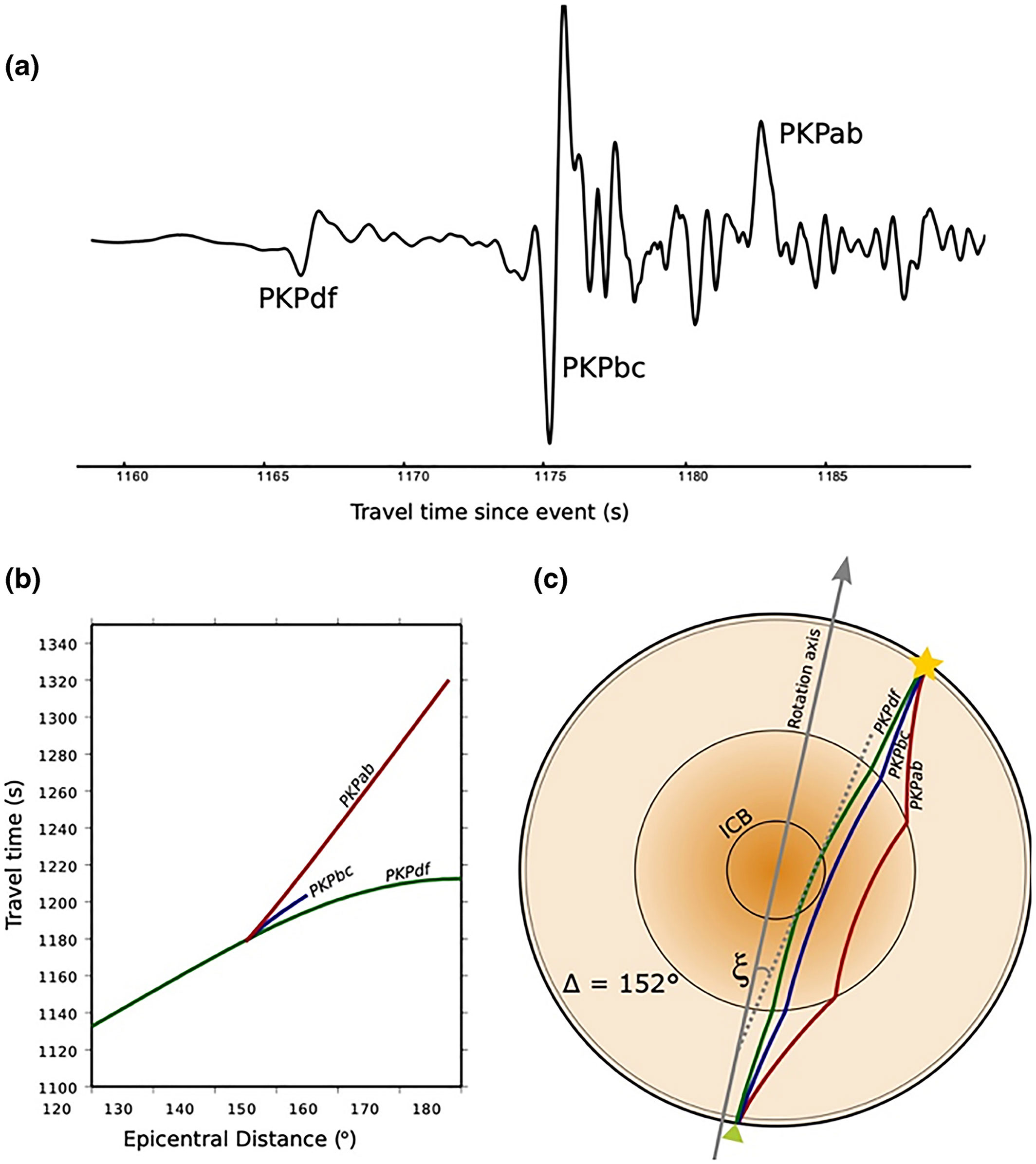
The ANU team analyzed decades of seismic data using an advanced algorithm that tested thousands of models. Instead of averaging the data, which can hide subtle features, they examined the wave patterns more closely. This approach revealed a shift in seismic behavior about 650 kilometers (roughly 400 miles) from Earth’s center, suggesting a boundary within the inner core.
Evidence for a Distinct Central Region
One important clue comes from anisotropy, meaning seismic waves move at different speeds depending on their direction. In many models, waves travel faster along Earth’s rotational axis than along the equator. In this newly identified central region, that pattern shifts.
The slowest wave speeds occur at an angle of about 54 degrees relative to the rotation axis, indicating a different alignment of iron crystals.
Lead author Joanne Stephenson explained that this difference may reflect major events in Earth’s past. “We found evidence that may indicate a change in the structure of iron, which suggests perhaps two separate cooling events in Earth’s history,” Stephenson said. She added that this hidden layer could reflect “an unknown, dramatic event in the Earth’s history,” though its exact nature remains uncertain.
Independent Confirmation From New Techniques
Further support came in 2023 from a study in Nature Communications that used a different seismic technique. Instead of focusing only on direct earthquake waves, researchers analyzed rare signals that bounce through Earth multiple times. Some of these waves pass through the core up to five times, providing more detailed information.
These repeated signals revealed a similar central region about 650 kilometers (roughly 400 miles) across. In this area, seismic waves again showed directional differences, with the slowest speeds occurring at about 50 degrees relative to Earth’s rotation axis. The surrounding part of the inner core appeared more uniform, with weaker directional variation.
These results could help resolve why some past experiments have not matched existing models of Earth’s interior.
Scientists have long suspected the presence of a deeper layer within the inner core, with earlier clues suggesting that the iron crystals there may be arranged in different ways.
Implications and Remaining Uncertainties
These findings could help resolve why some past experiments have not matched existing models of Earth’s interior. However, researchers acknowledge that there is still work to be done. “We are limited by the distribution of global earthquakes and receivers, especially at polar antipodes,” the ANU team wrote, noting that gaps in data can reduce confidence in some models.
Future studies may close these data gaps, giving researchers a clearer picture of the events recorded deep within Earth’s earliest history. But even with current data, the implications are massive.
“It’s very exciting—and might mean we have to re-write the textbooks!” Stephenson remarked.
References:
“Evidence for the Innermost Inner Core: Robust Parameter Search for Radially Varying Anisotropy Using the Neighborhood Algorithm” by J. Stephenson, H Tkalčić and M. Sambridge, 7 December 2020, Journal of Geophysical Research: Solid Earth.
DOI: 10.1029/2020JB020545
“Up-to-fivefold reverberating waves through the Earth’s center and distinctly anisotropic innermost inner core” by Thanh-Son Phạm, and Hrvoje Tkalčić, 21 February 2023, Nature Communications.
DOI: 10.1038/s41467-023-36074-2
Never miss a breakthrough: Join the SciTechDaily newsletter.
Follow us on Google and Google News.
1 Comment
Still no idea why it’s so hot & how it continues to be