
Close Menu
    Facebook X (Twitter) Instagram
    SciTechDaily
    • Biology
    • Chemistry
    • Earth
    • Health
    • Physics
    • Science
    • Space
    • Technology
    Facebook X (Twitter) Pinterest YouTube RSS
    SciTechDaily
    Home»Earth»Earthquake Doublets Reveal Changing Speed of the Earth’s Inner Core
    Earth

    Earthquake Doublets Reveal Changing Speed of the Earth’s Inner Core

    By Australian National UniversityMay 13, 2013No Comments3 Mins Read
    Facebook Twitter Pinterest Telegram LinkedIn WhatsApp Email Reddit
    Share
    Facebook Twitter LinkedIn Pinterest Telegram Email Reddit
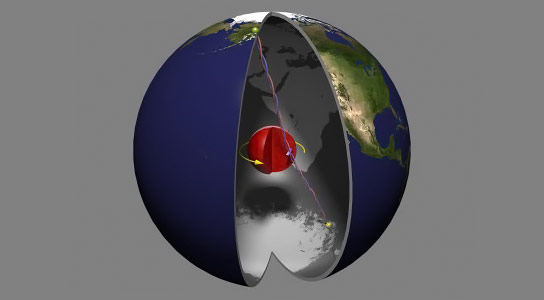
    Earthquake Doublets Reveal Shuffling Rotation of the Earths Inner Core
    Scientists found that the Earth’s inner core not only spins at a different rate than the mantle (the layer between the core and the crust), but its speed of rotation can vary. Credit: Australian National University

    A newly published study provides the first experimental evidence that the Earth’s inner core has rotated at a variety of different speeds and suggests that the Earth’s solid inner core rotates at a different rate than the mantle.

    We all know that the Earth rotates beneath our feet, but new research from ANU has revealed that the center of the Earth is out of sync with the rest of the planet, frequently speeding up and slowing down.

    Associate Professor Hrvoje Tkalcic from the ANU College of Physical and Mathematical Sciences and his team used earthquake doublets to measure the rotation speed of Earth’s inner core over the last 50 years.

    They discovered that not only did the inner core rotate at a different rate to the mantle – the layer between the core and the crust that makes up most of the planet’s interior – but its rotation speed was variable.

    “This is the first experimental evidence that the inner core has rotated at a variety of different speeds,” Associate Professor Tkalcic said.

    “We found that, compared with the mantle, the inner core was rotating more quickly in the 1970s and 1990s, but slowed down in the 80s. The most dramatic acceleration has possibly occurred in the last few years, although further tests are needed to confirm that observation.

    “Interestingly, Edmund Halley, namesake of Halley’s Comet, speculated that the inner shells of the Earth rotate with a different speed back in 1692.”

    Scientists have so far assumed the rotation rate of the inner core to be constant because they lacked adequate mathematical methods for interpreting the data, says Associate Professor Tkalcic. A new method applied to earthquake doublets – pairs of almost identical earthquakes that can occur a couple of weeks to 30 or 40 years apart – has provided the solution.

    “It’s stunning to see that even 10, 20, or 30 years apart, these earthquakes look so similar. But each pair differs very slightly, and that difference corresponds to the inner core. We have been able to use that small difference to reconstruct a history of how the inner core has rotated over the last 50 years,” he said.

    Associate Professor Tkalcic says this new method could help us understand the role of the inner core in creating the magnetic field that allowed life to evolve on Earth by acting as a shield from cosmic radiation.

    “What we have developed is a very powerful way to understand the internal structure and dynamics of our planet,” he said.

    The research was published in Nature Geoscience.

    Reference: “The shuffling rotation of the Earth’s inner core revealed by earthquake doublets” by Hrvoje Tkalčić, Mallory Young, Thomas Bodin, Silvie Ngo and Malcolm Sambridge, 12 May 2013, Nature Geoscience.
    DOI: 10.1038/ngeo1813

    Never miss a breakthrough: Join the SciTechDaily newsletter.
    Follow us on Google and Google News.

    Australian National University Earth Science Geophysics Geoscience Popular
    Share. Facebook Twitter Pinterest LinkedIn Email Reddit

    Related Articles

    Scientists Say a Hidden Structure May Exist Inside Earth’s Core

    Mysterious Structures Discovered Beneath Earth May Explain Why Our Planet Supports Life

    Unusual Seismic Signals Are Rippling Through Earth’s Core, Revealing Planetary Secrets

    The Unseen Spark: How Ancient Microorganisms Helped Cause Massive Volcanic Events

    100 Million Years Unveiled: The Most Detailed Model of Earth’s Surface Ever

    Arctic Sea Ice Loss is Impacting Atlantic Ocean Water Circulation System

    Yale Researchers Find a Soft Spot in the Nazca Plate

    CryoSat Satellite Shows Increased Volume of Arctic Sea Ice

    5-Mile Wide Buried Asteroid Crater Discovered in Canada

    Leave A Reply Cancel Reply

    • Facebook
    • Twitter
    • Pinterest
    • YouTube

    Don't Miss a Discovery

    Subscribe for the Latest in Science & Tech!

    Trending News

    Your Blood Pressure Reading Could Be Wrong Because of One Simple Mistake

    Astronomers Stunned by Ancient Galaxy With No Spin

    Physicists May Be on the Verge of Discovering “New Physics” at CERN

    Scientists Solve 320-Million-Year Mystery of Reptile Skin Armor

    Scientists Say This Daily Walking Habit May Be the Secret to Keeping Weight Off After Dieting

    New Therapy Rewires the Brain To Restore Joy in Depression Patients

    Giant Squid Detected off Western Australia in Stunning Deep-Sea Discovery

    Popular Sugar-Free Sweetener Linked to Liver Disease, Study Warns

    Follow SciTechDaily
    • Facebook
    • Twitter
    • YouTube
    • Pinterest
    • Newsletter
    • RSS
    SciTech News
    • Biology News
    • Chemistry News
    • Earth News
    • Health News
    • Physics News
    • Science News
    • Space News
    • Technology News
    Recent Posts
    • Hidden Warm Water Beneath Antarctica Could Rapidly Raise Global Sea Levels
    • Scientists Revive Ancient Chemistry Trick To Engineer Next-Generation Glass
    • Scientists Use AI To Supercharge Ultrafast Laser Simulations by More Than 250x
    • Scientists Just Found a Surprising Way To Destroy “Forever Chemicals”
    • Popular Supplement Ingredient Linked to Shorter Lifespan in Men
    Copyright © 1998 - 2026 SciTechDaily. All Rights Reserved.
    • Science News
    • About
    • Contact
    • Editorial Board
    • Privacy Policy
    • Terms of Use

    Type above and press Enter to search. Press Esc to cancel.