
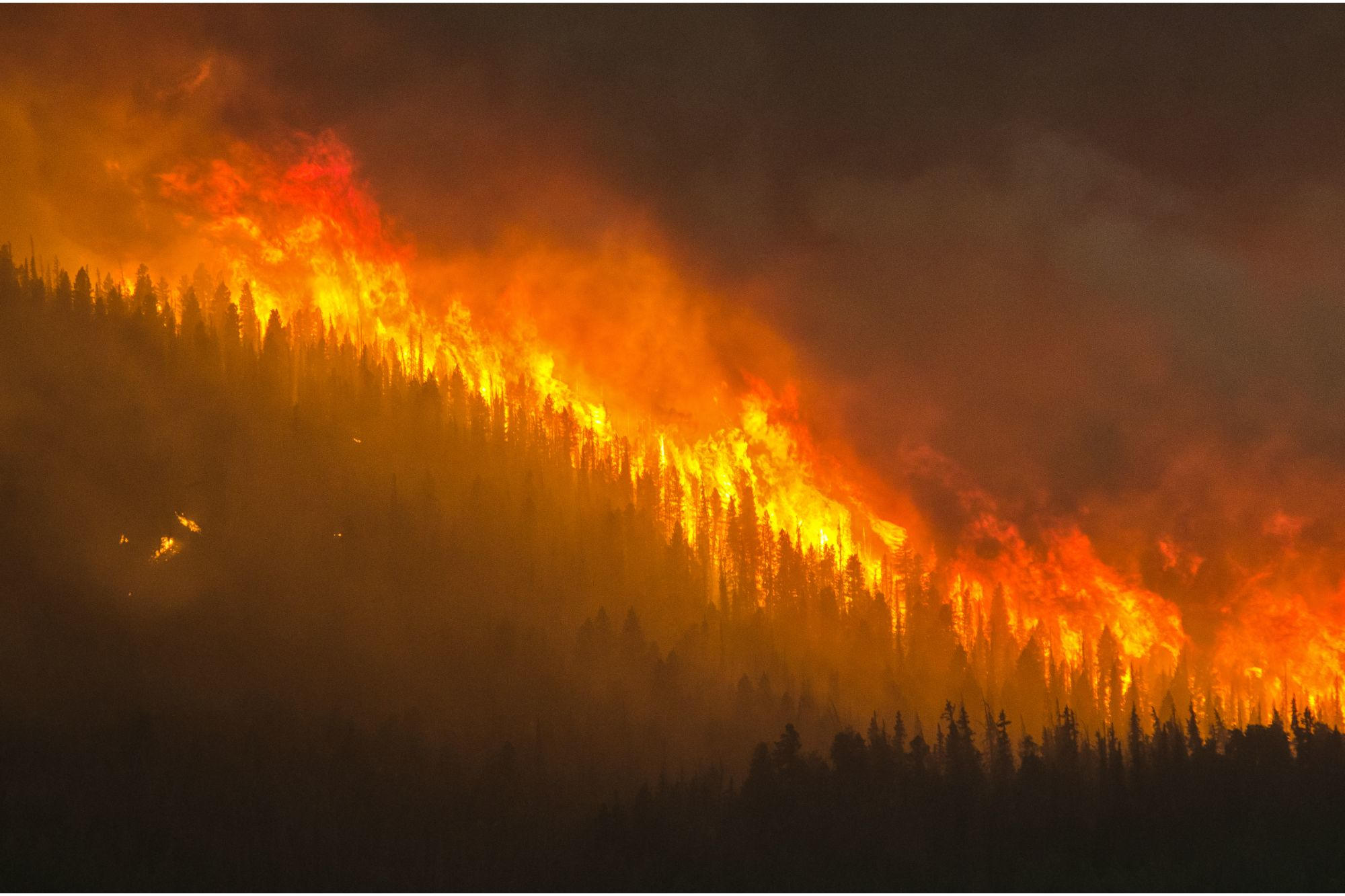
A study has found that contaminated mining sites increase the risks associated with fires.
The 2023 wildfire season in Canada was the most destructive ever recorded, and a new study suggests the impact was unprecedented. The research found that four wildfires in mine-impacted areas around Yellowknife, Northwest Territories, potentially contributed up to half of the global annual arsenic emissions from wildfires.
The work, led by researchers at the University of Waterloo and Nipissing University, is the first to calculate the amount of arsenic that was stored in areas at high risk of wildfires around Yellowknife. Looking at data from the past five decades, the team estimates the 2023 wildfires potentially released between 69 and 183 tonnes of arsenic.
Arsenic, a potent toxin, that the World Health Organization associates with diabetes, cardiovascular disease, various cancers, and infant mortality, can be transformed by wildfire and released into the environment from the soils that normally sequester it.
The Growing Risk of Wildfires
Given that the frequency and severity of wildfires are expected to increase because of climate change, the researchers caution that in any regions in the world where annual wildfires intersect with past or present mining and smelting operations, future fires could present a major risk for releasing stored toxins back into the environment.
“Yellowknife has a decades-long history of mining, which has led to an accumulation of arsenic in the surrounding landscape. However, Yellowknife is not unique in this regard, Canada has many industrially contaminated sites that are vulnerable to wildfire,” said Dr. Owen Sutton, a postdoctoral fellow in the Faculty of Environment at Waterloo.
The amount of arsenic released by wildfires depends on a multitude of factors, such as fire temperature, depth of the burn, and soil type, and the combination of these variables.
“While our research has raised the alarm on this issue, we will be the first to argue there is an urgent need for collaborative investigation by wildfire scientists, chemists, environmental scientists, and policy experts,” said Dr. Colin McCarter, professor in the Department of Geography at Nipissing University and Canada Research Chair in Climate and Environmental Change. “By integrating diverse fire management techniques, including Indigenous fire stewardship, we can hopefully mitigate these emerging risks to human and environmental health.”
The researchers found that arsenic emissions from wetlands were the most concerning because of their tendency to store contaminants compared to forests. Moving forward, they will continue quantifying the amount of toxins being stored by northern peatlands and study the potential release of other metals from those landscapes.
Reference: “Globally-significant arsenic release by wildfires in a mining-impacted boreal landscape” by O F Sutton, C P R McCarter and J M Waddington, 20 May 2024, Environmental Research Letters.
DOI: 10.1088/1748-9326/ad461a
Never miss a breakthrough: Join the SciTechDaily newsletter.
Follow us on Google and Google News.
1 Comment
From the linked paper, “…, we hypothesize that wildfire could potentially lead to a large transfer of arsenic to the atmosphere, lowland wetlands, and aquatic ecosystems in the Yellowknife region.”
This qualitative speculation seems typical of their concerns; however, unfortunately, the quantitative support seems scarce. Estimating the total arsenic released by a wild fire provides impressive large numbers, but are they germane? Where is the mention of the LD50 for the the various arsenic species? Is there evidence of current arsenic pathology where the As concentration is highest? What is the concentration of bio-available arsenic before and after a wildfire? Do wildfires reduce arsenic concentration in the immediate area of mines and smelters, and spread it over a larger area, thus reducing the peak concentration, and reduce the risk to animals and humans? This doesn’t seem to have been considered, with the results couched in the form of statements implying increased risks with no potential benefits being mentioned.
In the results, they provide an estimate of the concentration as milligrams per square-meter. However, that is meaningless as all the arsenic is not located in a thin film (negligible depth) at the surface. What is necessary to know is the concentration for a unit volume, and its distribution with depth, which doesn’t seem to have been considered. Albeit, they apparently are implying that those areas of concern have a maximum depth of 11 cm, corresponding to the depth of soil burning during wildfires.
While they speculate about the role of climate change and future burns, it seems that they don’t acknowledge that wildfires eliminate, or at least reduce fuel availability, for several decades. That is, what has recently burned is unlikely to burn again for decades. When it does burn again, will there be any anthropogenic bio-available arsenic left to be concerned about? They don’t speculate on that.
The authors state, “…, four wildfires near Yellowknife in 2023 was between 15%–59% of global annual arsenic wildfire emissions.” However, they haven’t demonstrated that the current global annual arsenic emissions rise to more than a theoretical concern.