
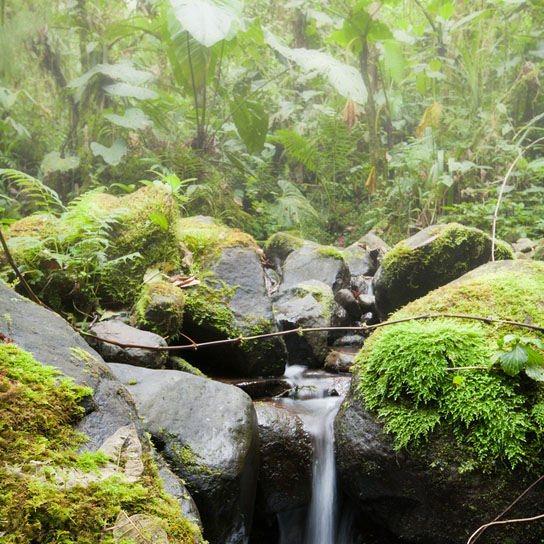
A new study warns that climate change resulting from human pressures could result in the near total loss of some of the world’s most delicate ecosystems. The scientists believe that the Mexican cloud forest and other cloud forests around the world could see the rate of annual decline doubled by global warming.
Many of the world’s most rare and rich forests, the tropical montane cloud forests, could be all but obliterated by 2080.
Researchers from The University of Queensland (UQ) and the ARC Center of Excellence for Environmental Decisions (CEED) cite the potential loss to the combined impact of man-made climate change and habitat destruction.
In the article ‘Vulnerability of cloud forest reserves in Mexico to climate change’, published in Nature Climate Change, the team has suggested, as a result of human pressures, of the near-total loss of one of the world’s most delicate ecosystems, the Mexican cloud forest, along with 70 percent of its plant and animal species.
Lead author of the article, UQ PhD candidate and researcher with the CEED Rocio Ponce-Reyes, explained the conclusion that only about 5557 square kilometers of the area studied would survive to 2080, are a result of an investigation of the specific impact of future global warming on Mexico’s 17,274 sq km of cloud forest.
“Cloud forests occur only at certain mid to high altitudes and their species are exceptionally vulnerable to the loss of the cool, moist environment that sustains them,” Ms. Ponce-Reyes said.
“Habitat loss and degradation by human encroachment are the main threats to cloud forests around the world at the moment,” Ms. Ponce-Reyes said.
“However, given the narrow environmental tolerance of cloud forests, the fear is that human-induced climate change could constitute an even greater peril in the near future.”
When the impact of potential human forest clearing and land use was added, the predicted surviving area could be less than one percent of its present extent or about 151 sq km.
While Australia has no cloud forest, the same fate could befall our highly diverse temperate rainforests in North Queensland, Director of CEED and UQ Professor with the Spacial Ecology Lab Dr. Hugh Possingham said.
On top of the mountains, Australia’s Wet Tropics rainforests are cool and temperate unlike the tropical forests below them. Like Mexico’s cloud forests, they harbor a highly specialized flora and fauna that occurs nowhere else in the world, Professor Possingham said.
While the clearing of such forests in Australia has all but stopped, this still leaves climate change as a significant remaining threat.
From the results, the researchers suggest that immediate action would be required to minimize cloud forests’ loss, as well as an expansion of the current protected space in areas of low climate vulnerability.
“At present, only about 12 percent of Mexico’s cloud forest is protected — and it is not clear how effective that protection will be by the latter part of this century,” Ms. Ponce-Reyes said.
The team identified the Sierra de Juarez, in the Oaxaca region, as a particular priority for rescue the cloud forest.
The study highlighted that this region supports 22 of Mexico’s most endangered species and is expected to retain relatively large fragments of cloud forest despite rapid climate change.
The researchers explain each year, the world loses about 1.1 percent of its total estate of cloud forest due to timber falling and land clearing alone and global warming is likely to more than double the rate of loss.
Because there are no new cool and high moist areas to which species can readily migrate, the scientists caution that loss of most of the world’s cloud forests means humans need to make the removal of carbon from the atmosphere a priority, Ms. Ponce-Reyes said.
At present, global carbon emissions are continuing to rise at the highest rate allowed for in the global climate scenario, administered by the Intergovernmental Panel on Climate Change (IPCC), pointing to overall warming of between five and six degrees Celsius by 2100.
“If bold measures are not taken very soon to reduce the concentration of greenhouse gases, these forests are unlikely to survive in their present form, with anything near their present diversity, very far into the twenty-first century,” Ms. Ponce-Reyes said.
Reference: “Vulnerability of cloud forest reserves in Mexico to climate change” by Rocío Ponce-Reyes, Víctor-Hugo Reynoso-Rosales, James E. M. Watson, Jeremy VanDerWal, Richard A. Fuller, Robert L. Pressey and Hugh P. Possingham, 18 March 2012, Nature Climate Change.
DOI: 10.1038/nclimate1453
Never miss a breakthrough: Join the SciTechDaily newsletter.
Follow us on Google and Google News.