
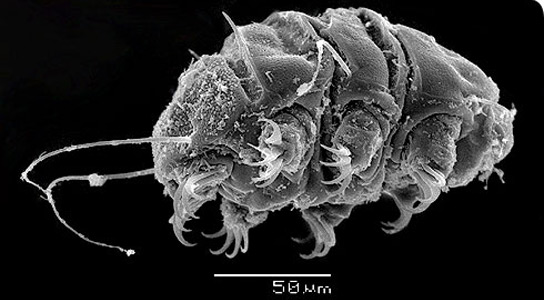
Tardigrades are microscopic animals, which are among the few lifeforms on Earth capable of surviving the intense radiation, temperature extremes, and complete vacuum of outer space. Their eggs can also survive the depths of space, possibly hatching on other planets after having traveled interstellar distances.
Astrobiologists published their findings on April 10th in the journal Astrobiology.
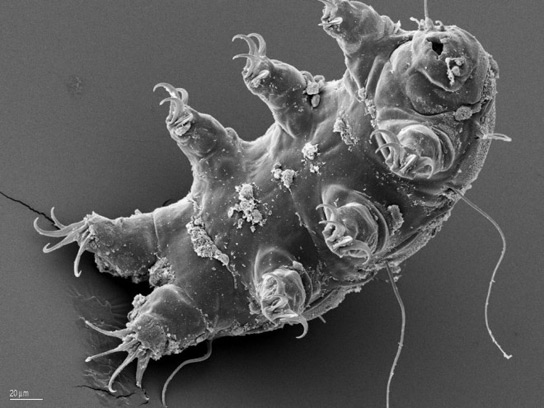
Tardigrades are also known as water bears, and thrive in wet conditions. They eat algae, bacteria or single-celled animals. When their puddles dry up, they enter a state of total metabolic shutdown, known as anhydrobiosis. They can remain like this for over 10 years, and get back to life when it becomes wet again.
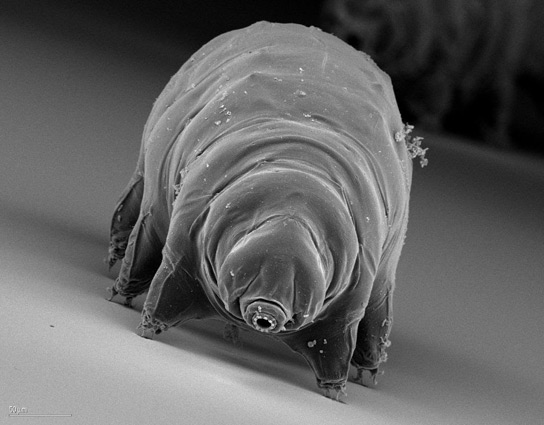
Tardigrades have already shown that they can survive exposure to space and they’re also able to survive in absolute zero, heat exceeding 300˚F, pressures dozens of times greater than at the bottom of the Marianas Trench as well as intense blasts of radiation.
Astrobiologists were curious to find out how tardigrade eggs would fare in similar conditions. They put Ramazzottius varieornatus, a species of tardigrade, under extreme stresses. The eggs were capable of surviving low temperatures, -320˚F and as high as 122˚F. Eggs were capable of surviving the exposure to space and 1,690 Grays of radiation. Humans die in days when exposed to 1% of that dose.
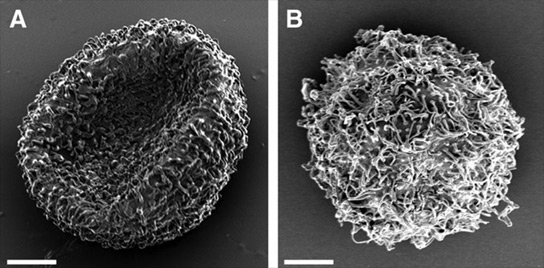
Reference: “Tolerance of Anhydrobiotic Eggs of the Tardigrade Ramazzottius varieornatus to Extreme Environments” by Daiki D. Horikawa, Ayami Yamaguchi, Tetsuya Sakashita, Daisuke Tanaka, Nobuyuki Hamada, Fumiko Yukuhiro, Hirokazu Kuwahara, Takekazu Kunieda, Masahiko Watanabe, Yuichi Nakahara, Seiichi Wada, Tomoo Funayama, Chihiro Katagiri, Seigo Higashi, Shin-Ichi Yokobori, Mikinori Kuwabara, Lynn J. Rothschild, Takashi Okuda, Hirofumi Hashimoto and Yasuhiko Kobayashi, 20 April 2012, Astrobiology.
DOI: 10.1089/ast.2011.0669
Never miss a breakthrough: Join the SciTechDaily newsletter.
Follow us on Google and Google News.
2 Comments
Survival of the fittest..
Tardigrades are remarkably resistant eight-legged microscopic animals, able to withstand extreme temperatures, vacuum forces, and cosmic radiation. Named “il Tardigrado” (“slow stepper”) in 1777 by Lazzaro Spallanzani, an Italian physiologist and professor, these microscopic multicellular organisms became the first animals to survive outer space in a September 2007 European Space Agency Foton-M3 science mission aboard a Russian capsule.
Fossils indicate that tardigrades existed over 500 million years ago. Their diet consists of smaller organisms that include algae, rotifers, and fungi. Via a process of dehydration, these “moss piglets” (also described by German naturalist Johann August Ephraim Goeze in 1773 as “little water bears”) are able to enter into a suspended metabolic state of “cryptobiosis” (wherein the tardigrade may shrivel into a tiny “tun” ball as a unique survival technique). A glass-like substance remains, retaining the remaining liquid inside, as their cells are flooded with a special protective protein. Even after enduring extremely challenging conditions for several years, these hardy animals usually can exit cryptobiosis, rehydrating themselves under proper conditions.
Researchers at University of Michigan have found that specific tardigrade proteins may lead to greater biological storage methods. This could allow transportation of medicines at room temperature (rather than via frozen or refrigerated means). According to an article on May 6th, 2026, by Jim Lynch (“Death-defying protein found in tardigrades preserves synthetic cells”), “Constructed from cell building blocks like lipids, proteins and nucleic acids, the potential of synthetic cells includes producing medicines in less expensive facilities, delivering medicines to specific parts of the body, and detecting or consuming pollutants in the environment. However, they need to be kept cold when not in use.”
Studying the amazing resiliency of tardigrades is certainly worthwhile. Thoroughly researching their unique proteins may provide extraordinary medical benefits, helping bolster defenses in human cancer patients to better tolerate radiation treatments. According to James Byrne, a physician-scientist at the University of Iowa, “This is an entirely novel approach for protecting healthy tissue and may eventually offer a way to optimize radiation therapy for patients while minimizing these debilitating side effects.”