
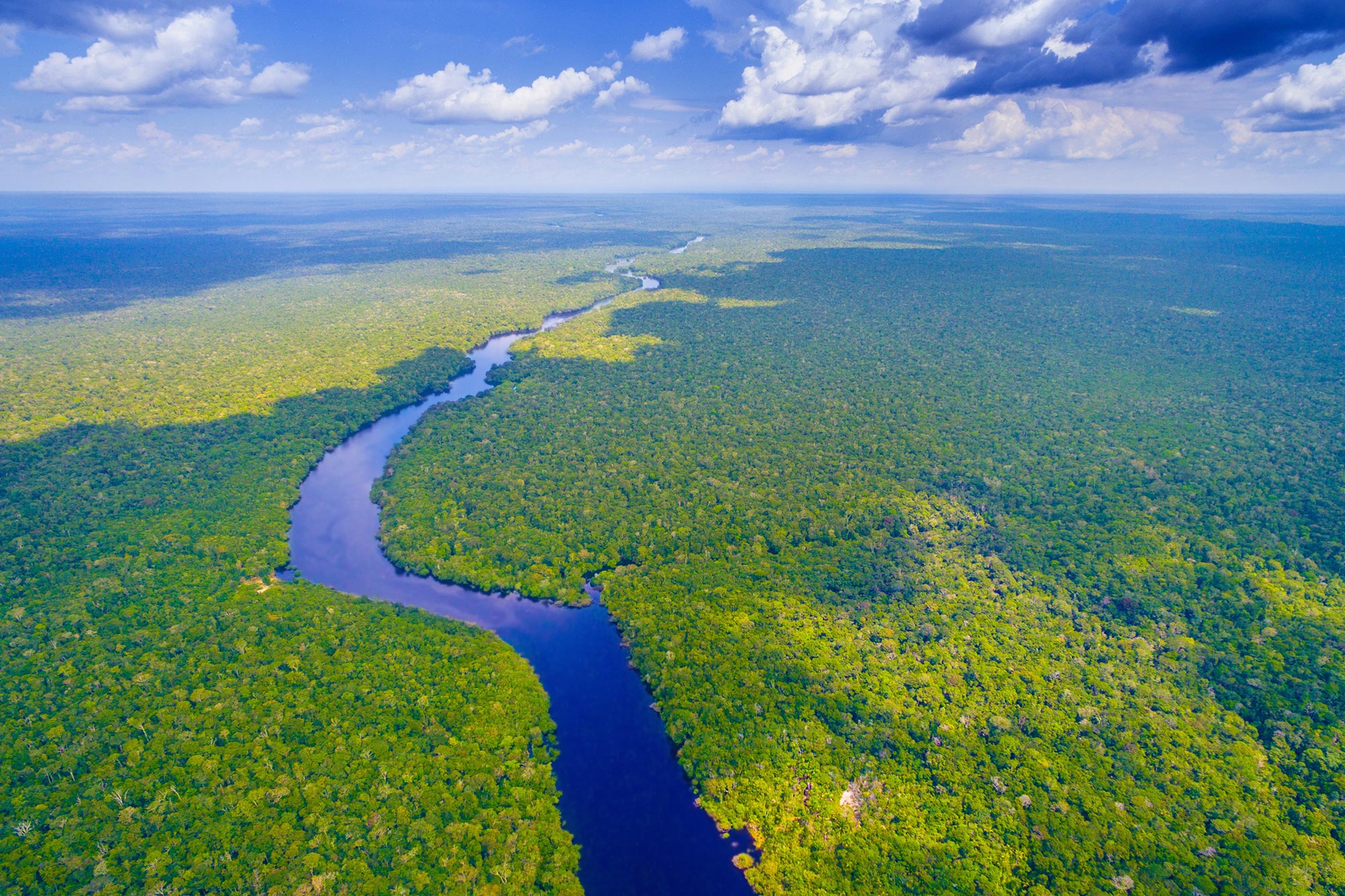
The Amazon rainforest could approach a tipping point, which could lead to a large-scale collapse with serious implications for the global climate system. A new Nature study by an international research team including scientists from the Potsdam Institute for Climate Impact research (PIK) reveals that up to 47 percent of the Amazonian forest is threatened and identifies climatic and land-use thresholds that should not be breached to keep the Amazon resilient.
“The Southeastern Amazon has already shifted from a carbon sink to a source –meaning that the current amount of human pressure is too high for the region to maintain its status as a rainforest over the long term. But the problem doesn’t stop there. Since rainforests enrich the air with a lot of moisture which forms the basis of precipitation in the west and south of the continent, losing forest in one place can lead to losing forest in another in a self-propelling feedback loop or simply ‘tipping’,” states PIK scientist Boris Sakschewski, one of the authors of the study.
Threats to the Amazon
Recent stress from increased temperatures, droughts, deforestation, and fires even in central and remote parts is weakening the Amazon’s natural resilience mechanisms, pushing this system towards a critical threshold. The study finds that by the year 2050, 10-47 percent of the Amazonian forests will be threatened by increasing disturbances, risking to cross a tipping point.
Based on a large body of scientific results, the researchers identify five critical drivers connected to this tipping point: global warming, annual rainfall amounts, the intensity of rainfall seasonality, dry season length, and accumulated deforestation. For each of these drivers, they suggest safe boundaries to keep the Amazon resilient.
“We found for example that for mean annual rainfall below 1000 mm per year, the Amazon rainforest cannot exist. However, below 1800 mm per year, abrupt transitions from rainforest to a Savanna-like vegetation become possible. This can be triggered by individual droughts or forest fires, which both have become more frequent and more severe in recent years,” states Da Nian, scientist at PIK and also author of the study.
Precipitation and Carbon Storage
The impact of forest loss does not stop at the borders of the Amazon. The moisture transported via Amazons´ so called “flying rivers” is an critical part of the South American Monsoon and hence essential for rainfall in vast parts of the continent. Moreover, the Amazon as a whole stores carbon equivalent to 15-20 years of current human CO2 emissions. Amazon forest loss therefore further drives global warming and intensifies the consequences.
Ecosystem Resilience and Degradation
The study also analyses examples of disturbed forests in various parts of the Amazon to understand what could happen to the ecosystem. In some cases, the forest may recover in the future, but still remain trapped in a degraded state, dominated by opportunistic plants, such as lianas or bamboos. In other cases, the forest does not recover anymore, and remains trapped in an open-canopy, flammable state. The expansion of open, flammable ecosystems throughout the core of the Amazon forest is particularly concerning because they can spread fires to adjacent forests.
Urgent Call for Action
“To maintain the Amazon forest within safe boundaries, local and global efforts must be combined. Deforestation and forest degradation have to end and restoration has to expand. Moreover, much more needs to be done to stop greenhouse-gas emissions worldwide,” concludes co-author Niklas Boers, leader of the Future Lab ‘Artificial Intelligence in the Anthropocene’ at PIK and professor of Earth System Modelling at the Technical University of Munich.
Reference: “Critical transitions in the Amazon forest system” by Bernardo M. Flores, Encarni Montoya, Boris Sakschewski, Nathália Nascimento, Arie Staal, Richard A. Betts, Carolina Levis, David M. Lapola, Adriane Esquível-Muelbert, Catarina Jakovac, Carlos A. Nobre, Rafael S. Oliveira, Laura S. Borma, Da Nian, Niklas Boers, Susanna B. Hecht, Hans ter Steege, Julia Arieira, Isabella L. Lucas, Erika Berenguer, José A. Marengo, Luciana V. Gatti, Caio R. C. Mattos and Marina Hirota, 14 February 2024, Nature.
DOI: 10.1038/s41586-023-06970-0
Never miss a breakthrough: Join the SciTechDaily newsletter.
Follow us on Google and Google News.