
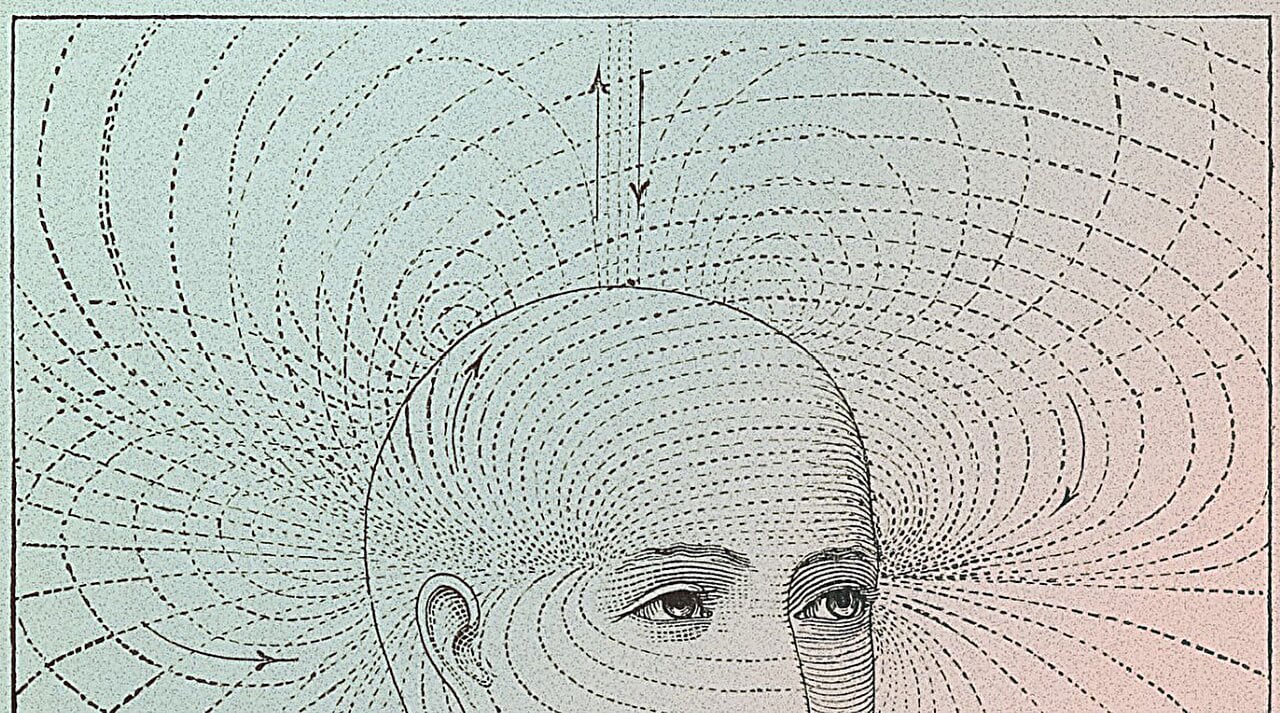
New research questions whether memory reliably reflects reality.
What if your entire past never actually happened?
That unsettling idea is at the center of a new study by SFI Professor David Wolpert, SFI Fractal Faculty member Carlo Rovelli, and physicist Jordan Scharnhorst. They revisit the “Boltzmann brain” hypothesis, a thought experiment that has challenged physicists for over a century. Named after 19th century physicist Ludwig Boltzmann, the idea comes from his work on entropy, a measure of disorder that tends to increase over time according to the second law of thermodynamics.
In a universe that exists for an extremely long time, random fluctuations in entropy could occasionally produce highly organized structures. In principle, that could include something as complex as a functioning brain complete with detailed memories and perceptions. If that is the case, then what we experience as a coherent past might not be real. It could instead be a brief, random event that only appears meaningful.
The issue stems from a deeper conflict within statistical physics. A key principle used to explain why time appears to move in one direction is Boltzmann’s H theorem, which plays a central role in statistical mechanics. At the same time, the theorem itself is symmetric with respect to time.
Because of this symmetry, it is, in a strict mathematical sense, more probable for complex structures such as memories and observations to arise randomly from fluctuations in entropy than to serve as accurate records of a real past. This leads to a troubling implication that our experiences could be misleading, formed by chance rather than grounded in actual events. This is the core of the Boltzmann brain hypothesis.
Assumptions shape how time is interpreted
To better understand this problem, the researchers developed a formal framework that examines how the Boltzmann brain hypothesis, the second law of thermodynamics, and the related “past hypothesis” depend on underlying assumptions about time. Some approaches analyze the universe by fixing its present state, while others begin with the assumption of a low-entropy starting point, such as the Big Bang. Current physical theories do not determine which of these perspectives is correct.
Building on what the authors describe as the “entropy conjecture,” the study shows that many familiar arguments in this area depend on subtle forms of circular reasoning. In these cases, assumptions about the past are used to justify conclusions such as the reliability of memory or the direction of entropy, and those same conclusions are then used to support the original assumptions.
Rather than attempting to settle these debates, the researchers clarify how they are structured. By distinguishing between physical laws and the choices made in interpreting them, the work provides a more transparent foundation for examining long-standing questions about time and entropy.
Reference: “Disentangling Boltzmann Brains, the Time-Asymmetry of Memory, and the Second Law” by David Wolpert, Carlo Rovelli and Jordan Scharnhorst, 2 December 2025, Entropy.
DOI: 10.3390/e27121227
Never miss a breakthrough: Join the SciTechDaily newsletter.
Follow us on Google and Google News.
26 Comments
I wonder who pays these people to study such useless questions?
Imagine if these smart people pursued problems that could actually help humanity!
Nah they aint never doing that it wouldnt make them money and keeps the smart people occupied
Very interesting topics discussed!
What kind of weed are smoking? Just joking! 🙃
I have recently found letters my grandmother wrote in 1949, when I was 4. They mention some things I have remembered and told to other people over the years. So they are real and not an illusion.
It helps the human race with our usage of cosmological models. If a computer model shows us that mpst are rand9mly generated it then contradicts our reality. By studyijg this and understanding its principles, it furthers our abilities to create models.much more connected to real.life. This helps in many ways, as all satellites, space vessels, mathematic systems to help us understand the universes movt .our place amomg the stars , finding alien life, photoghraphing far away galaxies all start at the cosmogical model first. I hope this helps illstrate how one, seemingly random and useless bit of knowledge can help all of us.
They are doing science, observably of immense value and help to humanity.
Theoretical problems like this lead to insights in mathematics, physics, psychology, and cosmology, and don’t count a tremendous amount of money to research.
Exactly
Riemannian geometry is a branch of differential geometry studying smooth manifolds equipped with a Riemannian metric, which enables measuring distances, angles, and volumes in curved, higher-dimensional spaces. Founded by Bernhard Riemann, it generalizes Euclidean geometry to non-flat spaces and serves as the mathematical foundation for Einstein’s general relativity.
But was seen as totally useless until it wasn’t. These kind of studies may seem useless at the moment but may turn out to be astonishingly important in the future.
General relativity is important in many ways including GPS systems.
Exactly I think\nThe change comes because the natural harmony of the world and the energy will pull some information towards its purpose.Because it is only one direction with the natural order.And the rest is our useless ego trying to define ourselves
Apparently, you never heard that you can just scroll past these without making insulting comments about things you know nothing about.
Apparently, you didn’t learn the lesson that you just scroll past things you don’t understand.. You are not in a position to criticize. You don’t understan the science you’ll never understand the science..
Gaslightings final boss
If all of this is just a simulation then anything is possible. God would be a programmer; time his algorithm.
Magic is never a possibility in a natural universe, which a simulation would be an unlikely variant of.
Any sufficiently advanced technology is indistinguishable from magic.
Memory serves to advance and compile information, suggestive that transformation is supported, as evolution suggests. The actual “importance” of what is decided to be “useful” is questionable, since it is obvious that time-related and larger issues are concerned with the utility of what, from the human perspective, is “happening.” Perhaps our present “science” needs further interrogation and review, from a more distanced and larger perspective. The concept of “time” needs review as well.
As one could suspect, they are arguing against that paper that found analysis of “Boltzmann Brains” useless (“cognitively unstable”): Why Boltzmann Brains Are Bad, arXiv:1702.00850. “Some modern cosmological models predict the appearance of Boltzmann Brains: observers who randomly fluctuate out of a thermal bath rather than naturally evolving from a low-entropy Big Bang. A theory in which most observers are of the Boltzmann Brain type is generally thought to be unacceptable, although opinions differ. I argue that such theories are indeed unacceptable: the real problem is with fluctuations into observers who are locally identical to ordinary observers, and their existence cannot be swept under the rug by a choice of probability distributions over observers. The issue is not that the existence of such observers is ruled out by data, but that the theories that predict them are cognitively unstable: they cannot simultaneously be true and justifiably believed.”
The way they do that is to assume that entropy isn’t increasing (assuming a Markov model without memory). In cosmology, entropy of the expansion process – which constitutes a memory – is constant, since the Friedmann equation describes it as an adiabatic process. (Either you consider a local homogeneous and isotropic volume or you consider the entire compact spacetime, it will not exchange work with anything else.) But entropy of fluctuations is observably increasing from a low value. So there is no problem, unless you accept unstable theories.
I shortened that hole explanation quite a bit and said it in three sentences, Of course , I didn’t use any names or previous experimentation or theories , just common sense
As one could suspect, they are arguing against that paper that found analysis of “Boltzmann Brains” useless (“cognitively unstable”): Why Boltzmann Brains Are Bad. “the theories that predict them are cognitively unstable: they cannot simultaneously be true and justifiably believed.”
The way they do that is to assume that entropy isn’t increasing (assuming a Markov model without memory). In cosmology, entropy of the expansion process – which constitutes a memory – is constant, since the Friedmann equation describes it as an adiabatic process. (Either you consider a local homogeneous and isotropic volume or you consider the entire compact spacetime, it will not exchange work with anything else.) But entropy of fluctuations is observably increasing from a low value. So there is no problem, unless you accept unstable theories.
Fascinating article. I wonder if this might be useful in treating PTSD. It made me think of the random memories I experience that seem to hold important experiences from my past.
What a giant pantload. I don’t think I have ever seen such a massive amount of overthinking before. It’s pretty simple… photos and videos and recordings and written accounts and physical remains/evidence, etc. all prove our memories are real. End of discussion.
Rachel had photographs.
Another woke disgusting article that is trying to convince and brainwash the people that most innocents, babies, are not human beings. Disgusting and evil.
What if this article never existed?
Not provable one way or the other so pretty much irrelevant.