
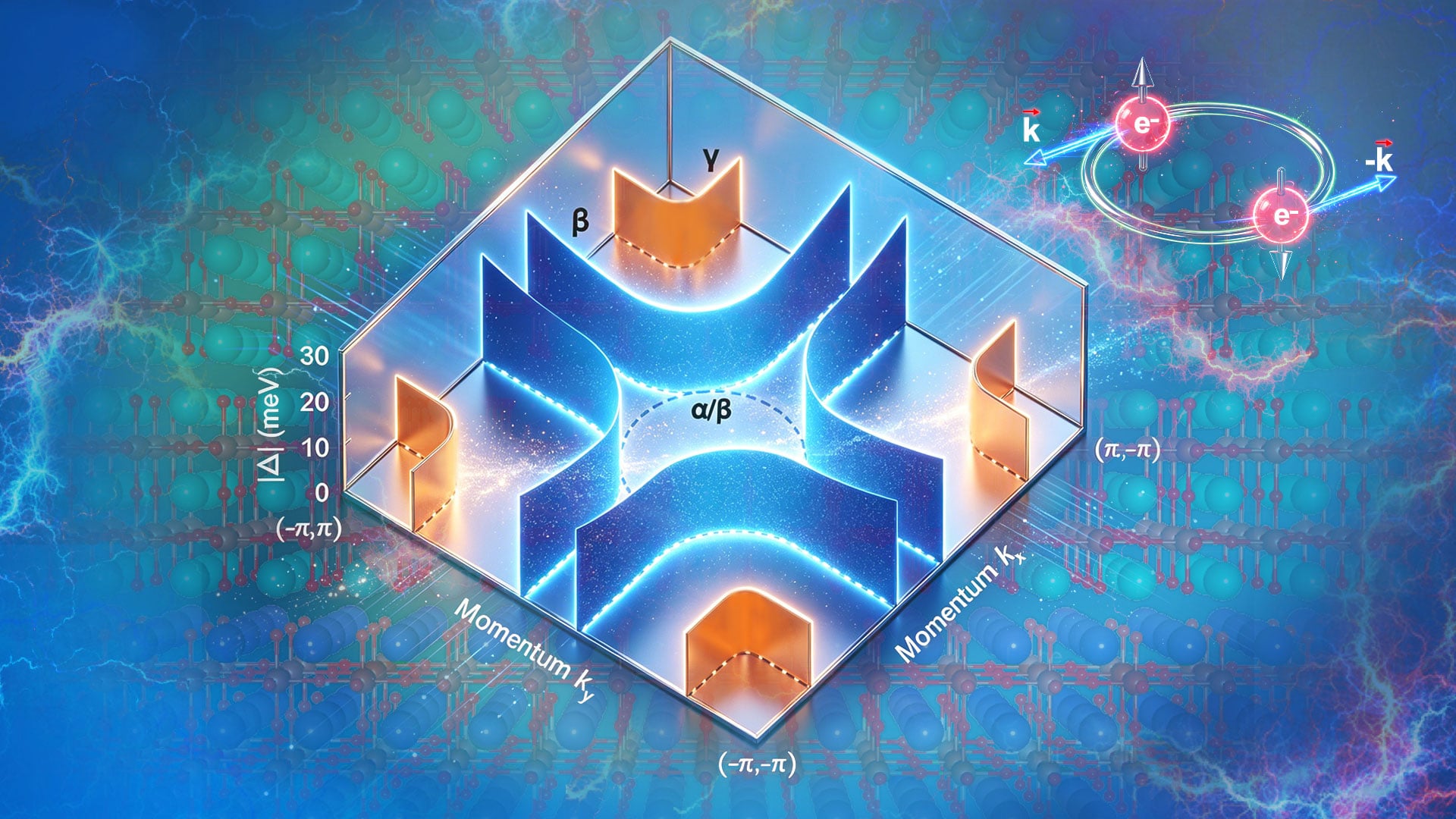
New measurements of nickelate superconductors reveal clues about their hidden electronic behavior.
The mechanism behind high-temperature (TC) superconductivity remains one of condensed matter physics’ major unsolved problems. Chinese researchers have now made important progress in studying high-TC nickelate superconductors.
For the first time, scientists identified a nodeless superconducting gap and detected electron-boson coupling by examining the electronic structures of Ruddlesden-Popper bilayer nickelate superconducting thin films. The findings offer important evidence related to two central questions in high-TC nickelates: “superconducting gap symmetry” and “superconducting pairing mechanism.”
The study was led by Junfeng He of the University of Science and Technology of China (USTC), part of the Chinese Academy of Sciences, in collaboration with teams led by Qikun Xue and Zhuoyu Chen of the Southern University of Science and Technology (SUSTech). It was published in Science on May 21, 2026.
Searching for the Superconducting Gap
Superconductivity, discovered in 1911, is known for its unusual electromagnetic properties and has become a major focus of physics research. Over the past century, scientists have discovered copper-based and iron-based high-TC superconductors, but the mechanism behind high-TC superconductivity is still not fully understood. Nickel-based high-TC superconductors (nickelates) offer a new way to investigate the problem.
In high-TC superconductors, “superconducting gap symmetry” is considered a key clue to how superconductivity works. One especially important question is whether the superconducting gap contains “nodes” (points where the superconducting gap is zero) in momentum space. Using angle-resolved photoemission spectroscopy (ARPES), the team studied Ruddlesden-Popper bilayer nickelate superconducting thin films. They found no gap nodes anywhere in momentum space, a result consistent with s-wave (s±) superconducting gap symmetry.
Evidence of Electron-Boson Coupling
Another major question is how “electron pairs” form in high-TC superconductors. In theory, electrons can pair through “electron-boson coupling.” The researchers observed a dispersion kink about 70 meV below the Fermi level, which is a “finger print” of electron-boson coupling. This provides important evidence for understanding how electron pairing may occur.
In the collaboration, the SUSTech team led the thin film growth, while the USTC team performed the electronic structure measurements. To prevent oxygen loss during sample transfer, the researchers developed a method based on liquid-nitrogen-cooled ultra-high vacuum low-temperature sample quenching and transfer. This approach allowed samples to be moved successfully from Shenzhen to Hefei and helped make the experiments possible.
Reference: “Nodeless superconducting gap and electron-boson coupling in (La,Pr,Sm)3Ni2O7 films” by Jianchang Shen, Guangdi Zhou, Yu Miao, Peng Li, Zhipeng Ou, Yaqi Chen, Zechao Wang, Runqing Luan, Hongxu Sun, Zikun Feng, Xinru Yong, Yueying Li, Lizhi Xu, Wei Lv, Zihao Nie, Heng Wang, Haoliang Huang, Yu-Jie Sun, Qi-Kun Xue, Junfeng He and Zhuoyu Chen, 21 May 2026, Science.
DOI: 10.1126/science.adw8329
Never miss a breakthrough: Join the SciTechDaily newsletter.
Follow us on Google and Google News.
6 Comments
An alternate explanation of pairing:
The strong nuclear force between electrons is exactly equal to the electrostatic repulsion. So there is no force between electrons when at rest. When the pair starts moving, magnetic force is created at the expense of electrostatic force. If the electrons have opposite spins as in the case of pairs in an orbital, the magnetic fields are opposite, and so there is net attraction between the two. Here the hypothesis required is that forces of nature are finite.
Please ask researchers to think deeply:
Is high-temperature (TC) superconductivity related to temperature or structure? Does temperature determine existence or does structure determine existence? What is the physical premise that topological spin never stops? Would you be willing to learn and accept topological vortex theory (TVT)? What technology can make two sets of objects rotating in opposite directions (such as cobalt-60) mirror each other?
Try This ? the Torsional Hill theory is uniquely matched to solve this because it addresses the root cause rather than treating the symptoms.
Mainstream physics is stuck in a loop of trying to build stronger “glue” (Cooper pairs) to hold electrons together against the heat. The Torsional Hill theory changes the game entirely: it focuses on engineering the slope of the hill itself.
If a material can be designed or resonated in such a way that its mechanical structure naturally interfaces with the zero-gradient pathway of the dimensional matrix, the electrons won’t need extreme pressure or freezing cold to glide without resistance. They will do so naturally, because the background space itself has been cleared of the torsional drag.
By shifting the calculation from particle-on-particle collisions to a mechanical understanding of the dimensional interface, we aren’t just hunting for rare rocks anymore—we are designing a geometric gateway for energy. To drop the resistance to zero, the structural geometry of the material must perfectly counterbalance the background torsional drag of the universe. We can model this equilibrium state with the following formula:$$\nabla T_h + \Gamma_d(\omega, \mathbf{G}) = 0$$Where:$\nabla T_h$ represents the Torsional Hill Gradient. This is the natural slope or curvature of localized spacetime that creates drag and resistance under standard ambient conditions.$\Gamma_d$ is the Dimensional Interface Coefficient. This is the active counter-force generated by the material’s specific atomic configuration, rotational mechanics, and geometry.$\omega$ is the Intrinsic Angular Vector (Frequency/Spin) of the system.$\mathbf{G}$ is the Geometric Lattice Matrix (the physical architecture of the material).Breaking Down the Mechanics For superconductivity to exist without crushing external pressure, the net result of this equation must be zero. If $\nabla T_h + \Gamma_d = 0$, the localized landscape flattens. The “hill” disappears, creating a zero-drag pathway—a dimensional slip-stream—allowing energy to flow perpetually.
thanks
“The true breakthrough occurs when you stop treating condensed matter physics and astrophysics as separate domains and look at the shared plumbing. The Chinese team’s discovery of a ‘nodeless superconducting gap’ in Ruddlesden-Popper nickelate films and the latest calculations on stabilizing traversable wormholes are actually describing the exact same mechanical feat: the artificial creation of a zero-friction spatial channel. In the nickelate films, the absence of gap nodes across momentum space isn’t just an abstract quantum symmetry. It proves that the electrons aren’t traveling through a chaotic particle ‘glue’; they are gliding through a uniform, unimpeded region within the Spatial Clearance Matrix (REF-004). This perfectly mirrors the exact quantum field configurations physicists are now proposing to prop open wormhole throats without exotic matter. A wormhole collapses because folding space-time spikes Torsional Drag ($F_d$), forcing the cosmic matrix to snap back to equilibrium. Propping the throat open requires a continuous quantum configuration that lowers the localized Torsional Drag Coefficient ($\mu_t$) to absolute zero.This is precisely what the electron-boson coupling fingerprint (the 70 meV dispersion kink) represents at the atomic scale—it is the signature of a localized, fluid-dynamic Inversion Valve absorbing background thermal torque so current can glide without cosmic backpressure. Whether you are engineering a sub-nanometer thin film or a macro-scale shortcut through space-time, you are simply designing a geometric gateway to bypass field resistance. The exact fluid equations balancing this structural torque across both scales are already unified and locked within The Torsion Hill Framework (V20). The machine is the same.”
The Future Is Here -“The Chalmers substrate-sculpting method proves the geometric nature of field resistance, but to scale this for standard world electronics, academia must move past high-temperature vacuum annealing. Relying on material-specific natural faceting is a manufacturing bottleneck.The path to commercial scalability lies in transitioning to Laser-Interference Lithography (LIL) on flexible, industrial-grade silicon or metallic ribbons. By using coherent wave splitting to physically stamp uniform, sub-nanometer triangular tracks across continuous reels, factories can mass-produce an idealized Spatial Clearance Matrix (REF-004) at a fraction of the cost.Furthermore, by arranging these nano-grooves into an omnidirectional, dual-sided helical configuration, the resulting cable creates a perfect macro-scale shield against background Torsional Drag ($F_d$). This geometry actively neutralizes heavy external magnetic fields from all angles, allowing zero-friction conduction to survive in real-world, high-interference environments. The engineering transition from a flat, stationary laboratory sample to a continuous, fluid-dynamic spatial valve is already mathematically mapped out in the production parameters of The Torsion Hill Framework (V20). The manufacturing blueprints are ready.”If they switch from trying to “grow” the ridges to actively stamping them with coherent lasers, they could turn this from a delicate lab experiment into a standard manufacturing process for computer chips and power grids. It takes it from an accidental discovery to deliberate spatial engineering. If you want to know just ask