
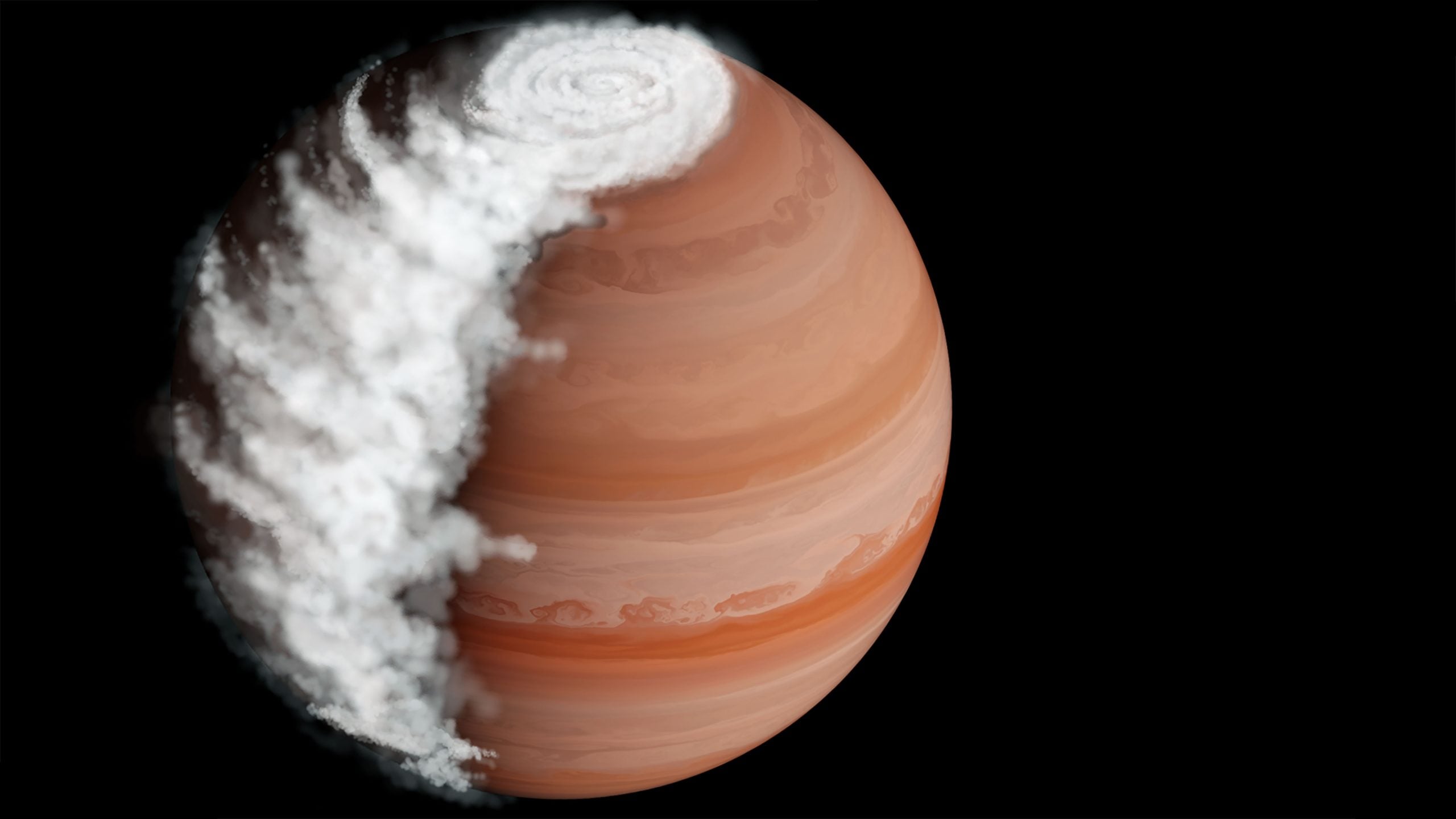
JWST has revealed a surprising daily cloud cycle on a distant hot Jupiter, giving scientists a clearer look at its atmosphere.
On WASP-94A b, the forecast changes fast. Clouds made from rock-forming minerals gather in the planet’s morning skies, then vanish by evening as the atmosphere sweeps into hotter territory.
This world is a hot Jupiter, a giant planet that orbits extremely close to its star. Located nearly 700 light-years from Earth in the constellation Microscopium, WASP-94A b is far too distant to image in everyday detail. Instead, scientists used the James Webb Space Telescope (JWST) to read subtle changes in starlight as the planet crossed in front of its star.
The result is one of the clearest detections yet of a daily cloud cycle on this type of exoplanet. By separating cloudy regions from clearer parts of the atmosphere, the team was able to refine its view of the planet’s chemistry and overturn an earlier puzzle about its composition.
“I’ve been looking at exoplanets for 20 years, and general cloudiness has been a thorn in our side. We’ve known for quite a while that clouds are pervasive on Hot Jupiter planets, which is annoying because it’s like trying to look at the planet through a foggy window,” said co-author and program PI, David Sing, a Bloomberg Distinguished Professor of Earth and Planetary Sciences at Johns Hopkins. “Not only have we been able to clear the view, but we can finally pin down what the clouds are made out of and how they’re condensing and evaporating as they move around the planet.”
The findings were published in the journal Science.
JWST Reveals a Planet’s Daily Weather Cycle
To investigate WASP-94A b, Sing and his colleagues studied the planet as it passed in front of its star. JWST allowed them to measure the planet’s leading edge as it began the transit and its trailing edge as it moved off the star’s face.
Those two edges represent different times of day on the planet. At the leading edge, air moves from the nightside into the dayside, creating morning conditions. At the trailing edge, air moves from day to night, representing evening.
The contrast was striking. WASP-94A b’s mornings are filled with clouds made of magnesium silicate, a rock-forming mineral, while its evenings appear cloud-free.
The team sees two possible explanations. Strong winds may push clouds high into the atmosphere on the cooler side of the planet, then drive them downward on the hotter dayside, hiding them deep inside the planet before evening.
Another possibility is similar to morning fog burning off on Earth, but under far more extreme conditions. Clouds may form in the darkness of the nightside and then vaporize as they enter the dayside, where temperatures exceed 1,000 degrees (1,832 degrees Fahrenheit).
“It was a huge surprise. People have expected some differences, like its cooler in the morning than the evening—that’s something natural that we experience here on Earth,” Sing said. “But what we saw was a real dichotomy between the weather on both sides of the planet, and huge differences in cloud coverage, and that changes our whole picture of the planet.”
A Clearer Look at the Atmosphere
Because the evening side is clear, researchers could study that part of the atmosphere in detail, something Hubble could not do.
“With the Hubble telescope, when we used to do this type of observation, we got an average view of the whole planet with data from the clouds and the atmosphere squished together and indistinguishable,” said first author Sagnick Mukherjee, a postdoctoral fellow at Arizona State University who was a student at Johns Hopkins and UC Santa Cruz at the time of the research. “This approach with the JWST lets us localize our observations, which helped us see the cloud cycle.”
The clearer evening view showed that WASP-94A b is more Jupiter-like than earlier data suggested. Previous measurements, which mixed cloudy and clear regions together, indicated that the planet had hundreds of times more oxygen and carbon than Jupiter. That was difficult to explain with planet formation models.
The new analysis shows that WASP-94A b has only about five times as much oxygen and carbon as Jupiter.
Similar Cloud Cycles May Exist Elsewhere
Hot Jupiters orbit extremely close to their stars, even closer than Mercury orbits the sun. As a result, they are intensely heated and exposed to strong radiation, making them useful places to study atmospheric chemistry and cloud behavior.
Using WASP-94A b as a reference point, the team examined eight other hot gas giants. They found the same type of cloud cycle on two more planets, WASP-39 b and WASP-17 b.
Sing and his team will next use data from a large new JWST program to examine cloud cycles across many types of exoplanets, including an eccentric gas giant planet in the habitable zone.
Reference: “Cloudy mornings and clear evenings on a gas giant exoplanet” by Sagnick Mukherjee, David K. Sing, Guangwei Fu, Kevin B. Stevenson, Stephen P. Schmidt, Harry Baskett, Mei Ting Mak, Patrick McCreery, Natalie H. Allen, Katherine A. Bennett, Duncan A. Christie, Carlos Gascón, Jayesh Goyal, Éric Hébrard, Joshua D. Lothringer, Mercedes López-Morales, Jacob Lustig-Yaeger, Erin M. May, L. C. Mayorga, Nathan Mayne, Lakeisha M. Ramos Rosado, Henrique Reggiani, Zafar Rustamkulov, Kevin C. Schlaufman, Kristin S. Sotzen, Daniel Thorngren, Le-Chris Wang and Maria Zamyatina, 21 May 2026, Science.
DOI: 10.1126/science.adx5903
Funding: U.S. National Science Foundation, John Templeton Foundation, Heising-Simons Foundation, Science and Technology Facilities Council, UKRI, National Aeronautics and Space Administration, EU Horizon Program
Never miss a breakthrough: Join the SciTechDaily newsletter.
Follow us on Google and Google News.
1 Comment
I see a lot of handwaving here.
Is anybody testing this hypothesis? No?