

Astronomers may be able to identify possible Dyson swarms by looking for unusually cold, clean infrared signals around long-lived stars.
Since physicist Freeman Dyson introduced the idea in 1960, the “Dyson sphere” has become one of the most sought-after possible technosignatures in the search for advanced alien civilizations.
The basic idea is that a civilization far beyond our own could surround its star with a “sphere” (or, in our more modern understanding, a “swarm” of smaller components) designed to capture nearly all of the star’s energy. Such a structure is theoretically possible, but astronomers still face a key question: what would it look like from Earth?
A new preprint on arXiv by Amirnezam Amiri of the University of Arkansas examines that question and identifies the kinds of stars where Dyson swarms may be most worth searching for.
Small stars make better targets
One promising category is the red dwarf. These stars are the most common in the Milky Way, and they consume their nuclear fuel very slowly, allowing them to last for extraordinary lengths of time. Some are expected to survive for trillions of years, much longer than the current age of the universe.
Because they are also much smaller than the Sun, a Dyson swarm could be placed about 0.05 to 0.3 AU from the star’s surface, reducing the amount of material needed to build it.
White dwarfs may be even more attractive from an engineering standpoint. These are the dense, cooled remains of stars like the Sun, compressed to tiny sizes with radii about 1% of their original star. Around a white dwarf, a Dyson swarm could orbit only a few million kilometers from the surface, making the construction of an enormous energy-collecting structure far less demanding than it would be around a larger star. White dwarfs can also emit energy steadily for billions of years, making them potentially reliable long-term power sources.
Starlight would become heat
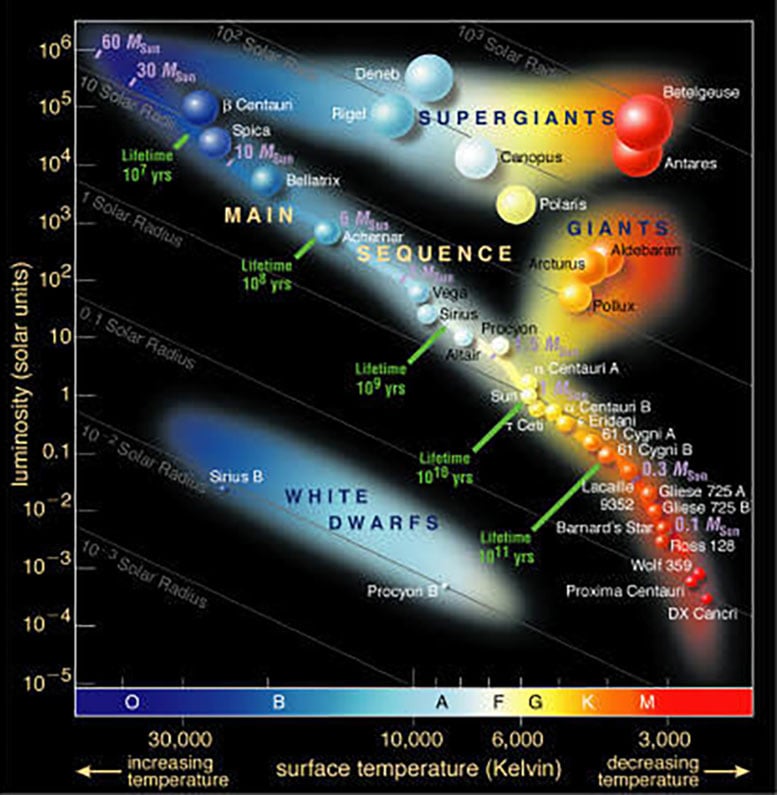
But what would stars surrounded by such megastructures actually look like? Astronomers typically use a tool called the Hertzsprung-Russell (H-R) diagram to classify stars based on their temperature and luminosity. However, since a Dyson sphere would block all of a star’s natural light, it would completely change where on the diagram it would fall.
Energy can neither be created nor destroyed, so the sphere itself would have to emit the exact same amount of radiation away from itself as the star is putting into it. It just does it in the form of heat, or infrared light instead. So a Dyson sphere can really be thought of as a shell that absorbs a star’s light, does something useful with that energy, and then emits it as heat.
In doing so, it is shifting the location of the star entirely to the right – where lower temperatures are mapped on the diagram. The luminosity itself doesn’t change at all, it is simply shifted to the infrared, and since H-R diagrams use bolometric luminosity (i.e. the luminosity over all of the spectra), it would appear in the same vertical place on the diagram as whatever its host star is, whether that’s a red or white dwarf.

But the key takeaway is how much further on the right the star would go. A typical red dwarf, which inhabits the lower right-hand corner of a H-R diagram, has a surface temperature of around 3000K degrees. A Dyson sphere surrounding a star would have a temperature down to 50K – two orders of magnitude lower. There are no natural stars in this area, making any such object highly interesting as a potential Dyson swarm candidate.
Strange signals could stand out
One further factor contributing to the possibility of an object being a Dyson swarm is a lack of dust. A star without a Dyson sphere would typically show a spectral line for silicate emission that is commonly associated with dusky disks. However, radiator panels don’t have any dust surrounding them, so they would look remarkably “clean” to a spectrograph monitoring them.
One thing to note – in the “swarm” methodology, there would likely be gaps between some of the solar collectors, or varying thickness in certain parts of the swarm. This is intended to make the material requirements actually physically possible – modern calculations show that, even with relatively small radii, an actual full Dyson sphere is physically impossible. In the case where there were these small gaps, the star would behave exceedingly erratically, with non-natural light curves as the structure rotates.
Telescopes already have candidates
Since infrared is the specialty of the James Webb Space Telescope, it is well placed to monitor for these kinds of structures. But even older telescopes like WISE are being actively used to search for them.
In May 2024, a paper highlighting work from Project Hephaistos identified seven strong Dyson sphere candidates (all red dwarfs) out of a catalog of 5 million stars. One was eliminated as a possible source, as there was a supermassive black hole aligned perfectly in the background around the star, explaining the anomalous readings.
But that still leaves five more potential candidates that are worth some closer observation. This new paper will add another tool to astronomers’ understanding of what to search for to one day find one of these elusive technosignatures.
Reference: “Dyson spheres on H-R diagram” by Aminrezam Amiri, 26 February 2026, arXiv.
DOI: 10.48550/arXiv.2602.23270
Adapted from an article originally published in UniverseToday.
Never miss a breakthrough: Join the SciTechDaily newsletter.
Follow us on Google and Google News.
7 Comments
thanks for this
Very interesting 👍
Mental noise distracting us from the true sciences. Dyson sphere theory is 2D thinking.
I love Dyson….but it is still wildly impossible to build any such structure in 3D.
This is not science. Wut are you all thinking?
Just hope we never meet any beings who can do this.
We could learn a lot from them.