
Close Menu
    Facebook X (Twitter) Instagram
    SciTechDaily
    • Biology
    • Chemistry
    • Earth
    • Health
    • Physics
    • Science
    • Space
    • Technology
    Facebook X (Twitter) Pinterest YouTube RSS
    SciTechDaily
    Home»Space»Binary Star QU Carinae, A Possible Supernova Progenitor
    Space

    Binary Star QU Carinae, A Possible Supernova Progenitor

    By Carnegie Institution for ScienceAugust 3, 2012No Comments4 Mins Read
    Facebook Twitter Pinterest Telegram LinkedIn WhatsApp Email Reddit
    Share
    Facebook Twitter LinkedIn Pinterest Telegram Email Reddit
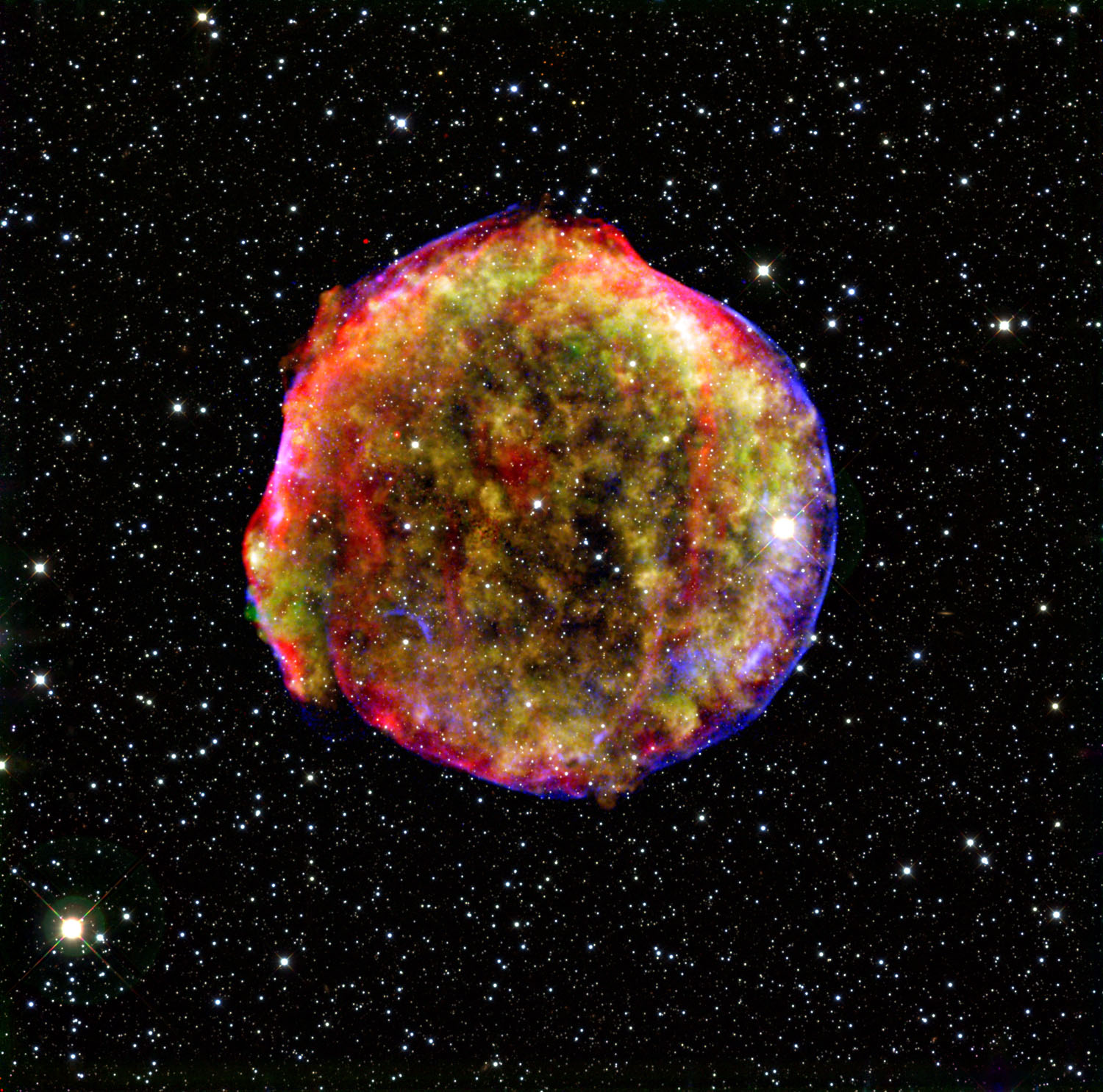
    image of the Tycho supernova
    This composite image of the Tycho supernova remnant combines infrared and X-ray observations obtained with NASA’s Spitzer and Chandra space observatories, respectively, and the Calar Alto observatory, Spain. It shows the scene more than four centuries after the brilliant star explosion witnessed by Tycho Brahe and other astronomers of that era. Credit: MPIA/NASA/Calar Alto Observatory

    Using sodium gas signatures, which have been recognized as being associated with type Ia supernovae, a team of scientists from the Carnegie Institution for Science was able to identify a binary star called QU Carinae as a possible supernova progenitor.

    Type Ia supernovae are violent stellar explosions. Observations of their brightness are used to determine distances in the universe and have shown scientists that the universe is expanding at an accelerating rate. But there is still too little known about the specifics of the processes by which these supernovae form. New research led by Carnegie’s Stella Kafka identifies a star, prior to explosion, which will possibly become a type Ia supernova. The work will be published by the Monthly Notices of the Royal Astronomical Society.

    The widely accepted theory is that type Ia supernovae are thermonuclear explosions of a white dwarf star that’s part of a binary system—two stars that are physically close and orbit around a common center of mass. This white dwarf has mass gradually donated to it by its companion. When the white dwarf mass eventually reaches 1.4 times the sun, it explodes to produce a type Ia supernova. The crucial questions are: What is the nature of the donor star and how does this white dwarf increase its mass. Also, how would that process affect the properties of the explosion?

    With these questions in mind, scientists have been searching for candidate systems that could become type Ia supernovae. There are thousands of possibilities in the candidate pool, none of which have yet been observed to produce an explosion. Recent studies, some of which involved scientists at Carnegie observatories, have identified sodium gas associated with type Ia supernovae. This gas, might be ejected from the binary’s donor star, and linger around the system to be detected after the white dwarf explodes. This provides a clue to the progenitor. Even so, Kafka still compared the search to “looking for a needle in a stellar haystack.”

    Using these gas signatures Kafka and her team—Kent Honeycutt of Indiana University and Bob Williams of the Space Telescope Science Institute—were able to identify a binary star called QU Carinae as a possible supernova progenitor. It contains a white dwarf, which is accumulating mass from a giant star, and sodium has been detected around the system.

    This star belongs to a small category of binaries that are very bright and in which the white dwarf accretes material from its companion at very high rates. Sodium should be produced in the atmosphere of the mass-donor giant star, and it can be ejected from the system via a stellar wind. If the white dwarf of this binary explodes into a supernova, the sodium would be detected with the same sort of signature as those found in other type Ia supernovae.

    “We are really excited to have identified such a system,” Kafka said. “Understanding these systems, the nature of the two stars, the manner in which mass is exchanged, and their long-term evolution will give us a comprehensive picture on how binaries can create one of the most important explosions in the universe.”

    Reference: ” QU Carinae: Type Ia supernova in the making?” by S. Kafka, R. K. Honeycutt and R. Williams, 11 September 2012, Monthly Notices of the Royal Astronomical Society.
    DOI: 10.1111/j.1365-2966.2012.21618.x

    Never miss a breakthrough: Join the SciTechDaily newsletter.
    Follow us on Google and Google News.

    Astrobiology Astronomy Astrophysics Carnegie Institution for Science Supernova
    Share. Facebook Twitter Pinterest LinkedIn Email Reddit

    Related Articles

    Cosmic Mistaken Identity: “Supernova” Is Actually Something Much Rarer

    Carbon-Rich Stardust Grains Unlock Astrophysical Mysteries

    Astronomers Discover First Evidence of Water Ice Clouds Outside Our Solar System

    Supernova Shock Wave Breaks Through a Cocoon of Gas

    Origins of Type Ia Supernovae

    Possible Evidence of Hadron Acceleration in Tycho Supernova Remnant

    Links Between Core Collapse Supernovae and Star Formation Established

    Lasers Mimic Supernova to Explain Cosmic Magnetic Fields

    SN Primo Is Farthest Type Ia Supernova Discovered

    Leave A Reply Cancel Reply

    • Facebook
    • Twitter
    • Pinterest
    • YouTube

    Don't Miss a Discovery

    Subscribe for the Latest in Science & Tech!

    Trending News

    Largest-Ever Study Finds Medicinal Cannabis Ineffective for Anxiety, Depression, PTSD

    250-Million-Year-Old Egg Solves One of Evolution’s Biggest Mysteries

    Living With Roommates Might Be Changing Your Gut Microbiome Without You Knowing

    Century-Old Cleaning Chemical Linked to 500% Increased Risk of Parkinson’s Disease

    What if Your Memories Never Happened? Physicists Take a New Look at the Boltzmann Brain Paradox

    One of the Universe’s Largest Stars May Be Getting Ready To Explode

    Scientists Discover Enzyme That Could Supercharge Ozempic-Like Weight Loss Drugs

    Popular Sweetener Linked to DNA Damage – “It’s Something You Should Not Be Eating”

    Follow SciTechDaily
    • Facebook
    • Twitter
    • YouTube
    • Pinterest
    • Newsletter
    • RSS
    SciTech News
    • Biology News
    • Chemistry News
    • Earth News
    • Health News
    • Physics News
    • Science News
    • Space News
    • Technology News
    Recent Posts
    • Could Humans Regrow Limbs? New Study Reveals Promising Genetic Pathway
    • Black Hole Jets Pack Power of 10,000 Suns, Stunning New Study Reveals
    • A Cosmic Crash Turned This Nearby Galaxy Into Chaos
    • This Alien Solar System Doesn’t Follow the Rules – and Scientists Are Intrigued
    • What Did Prehistoric Europeans Eat? Scientists Uncover Surprising Answers
    Copyright © 1998 - 2026 SciTechDaily. All Rights Reserved.
    • Science News
    • About
    • Contact
    • Editorial Board
    • Privacy Policy
    • Terms of Use

    Type above and press Enter to search. Press Esc to cancel.