
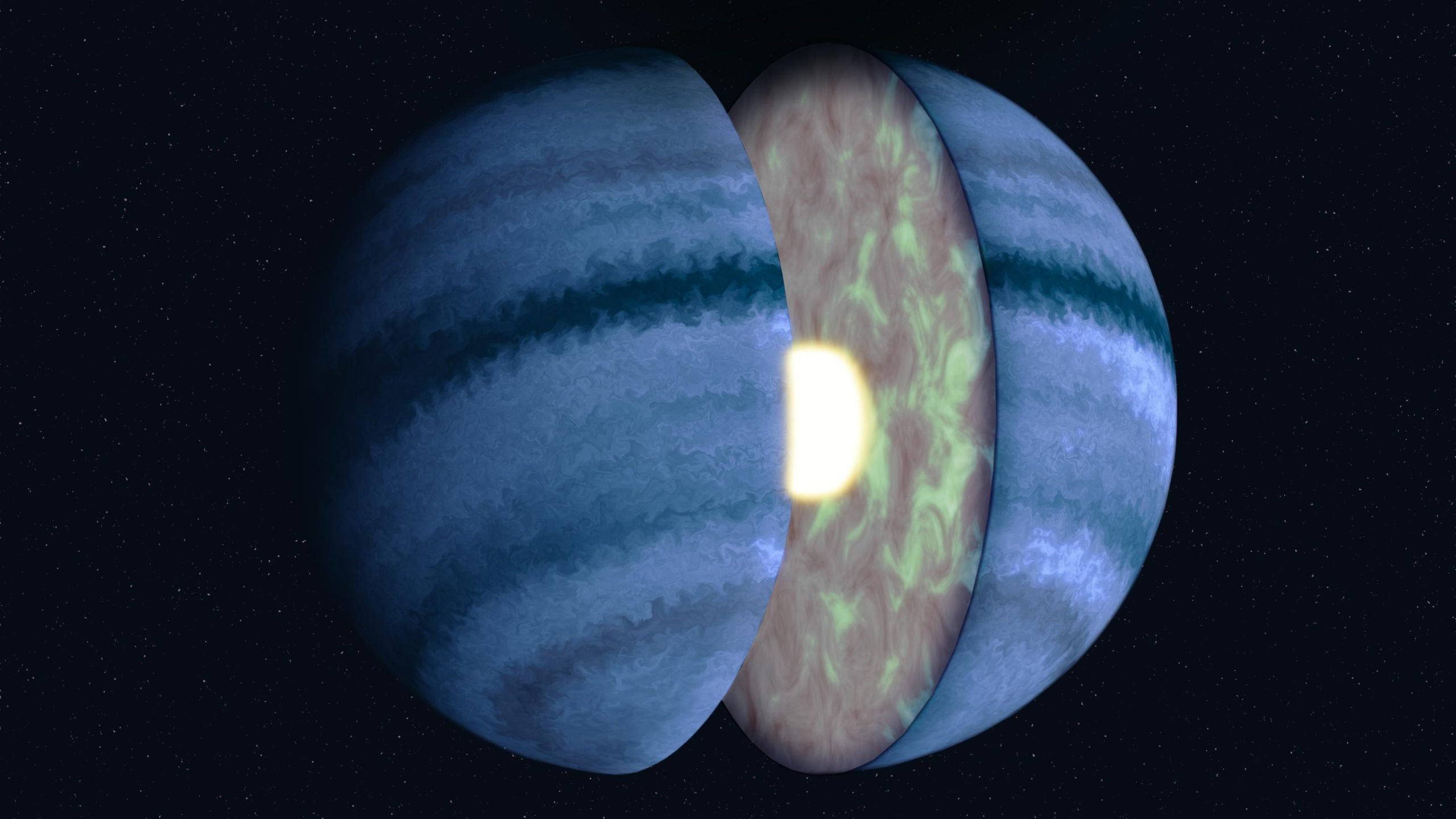
James Webb Space Telescope data reveals WASP-107 b has significantly less methane than expected and a surprisingly large core, providing key insights into its atmospheric chemistry and internal dynamics.
A surprisingly low amount of methane and a super-sized core hide within the cotton candy-like planet WASP-107 b.
The revelations, based on data obtained by the James Webb Space Telescope, mark the first measurements of an exoplanet’s core mass and will likely underpin future studies of planetary atmospheres and interiors, a key aspect in the search for habitable worlds beyond our solar system.
“Looking into the interior of a planet hundreds of light-years away sounds almost impossible, but when you know the mass, radius, atmospheric composition, and hotness of its interior, you’ve got all the pieces you need to get an idea of what’s inside and how heavy that core is,” said lead author David Sing, a Bloomberg Distinguished Professor of Earth and Planetary Sciences at Johns Hopkins University. “This is now something we can do for lots of different gas planets in various systems.”
Published recently in Nature, the research shows the planet has a thousand times less methane than expected and a core 12 times more massive than Earth’s.

Planetary Composition and Potential for Habitability
A giant planet wrapped by a scorching atmosphere as fluffy as cotton, WASP-107 b orbits a star about 200 light-years away. It is puffy because of its build: a Jupiter-sized world with only a tenth of that planet’s mass.
Even though it has methane—a building block of life on Earth—the planet is not considered habitable because of its proximity to its parent star and lack of a solid surface. But it could hold important clues about late-stage planetary evolution.
Methane Mysteries and Chemical Dynamics
In a separate study published in Nature, other scientists also spotted methane with the Webb telescope and provided similar insights about the planet’s size and density.
“We want to look at planets more similar to the gas giants in our own solar system, which have a lot of methane in their atmospheres,” Sing said. “This is where the story of WASP-107 b got really interesting, because we didn’t know why the methane levels were so low.”
The new methane measurements suggest the molecule transforms into other compounds as it flows upward from the planet’s interior, interacting with a concoction of other chemicals and starlight in the upper atmosphere. The team also measured sulfur dioxide, water vapor, carbon dioxide, and carbon monoxide—and found WASP-107 b has more heavy elements than Uranus and Neptune.
Observational Studies and Future Research
The profile of the planet’s chemistry is starting to reveal key pieces in the puzzle of how planetary atmospheres behave in extreme conditions, Sing said. His team will conduct similar observations over the next year on an additional 25 planets with the Webb telescope.
“We had never been able to study this mixing process in an exoplanet atmosphere in detail, so this will go a long way in understanding how these dynamic chemical reactions operate,” Sing said. “It’s something we definitely need as we start looking at rocky planets and biomarker signatures.”
Internal Heat Sources and Atmospheric Effects
Scientists had speculated that the planet’s overinflated radius resulted from a source of heat inside, said Zafar Rustamkulov, a Johns Hopkins doctoral student in planetary science who co-led the research. By combining atmospheric and interior physics models with Webb’s data of WASP-107 b, the team accounted for how the planet’s thermodynamics influence its observable atmosphere.
“The planet has a hot core, and that heat source is changing the chemistry of the gases deeper down, but it’s also driving this strong, convective mixing bubbling up from the interior,” Rustamkulov said. “We think this heat is causing the chemistry of the gases to change, specifically destroying methane and making elevated amounts of carbon dioxide and carbon monoxide.”
Ongoing Investigations and Future Experiments
The new findings also represent the clearest connection scientists have been able to make between the interior of an exoplanet and the top of its atmosphere, Rustamkulov said. Last year the Webb telescope spotted sulfur dioxide about 700 light-years away in a different exoplanet called WASP-39, providing the first evidence of an atmospheric compound created by starlight-driven reactions.
The Johns Hopkins team is now focusing on what might be keeping the core hot and expects forces might be in play similar to those causing high and low tides in Earth’s oceans. They plan to test whether the planet is being stretched and pulled by its star and how that might account for the core’s high heat.
References:
“A warm Neptune’s methane reveals core mass and vigorous atmospheric mixing” by David K. Sing, Zafar Rustamkulov, Daniel P. Thorngren, Joanna K. Barstow, Pascal Tremblin, Catarina Alves de Oliveira, Tracy L. Beck, Stephan M. Birkmann, Ryan C. Challener, Nicolas Crouzet, Néstor Espinoza, Pierre Ferruit, Giovanna Giardino, Amélie Gressier, Elspeth K. H. Lee, Nikole K. Lewis, Roberto Maiolino, Elena Manjavacas, Bernard J. Rauscher, Marco Sirianni and Jeff A. Valenti, 20 May 2024, Nature.
DOI: 10.1038/s41586-024-07395-z
“A high internal heat flux and large core in a warm neptune exoplanet” by Luis Welbanks, Taylor J. Bell, Thomas G. Beatty, Michael R. Line, Kazumasa Ohno, Jonathan J. Fortney, Everett Schlawin, Thomas P. Greene, Emily Rauscher, Peter McGill, Matthew Murphy, Vivien Parmentier, Yao Tang, Isaac Edelman, Sagnick Mukherjee, Lindsey S. Wiser, Pierre-Olivier Lagage, Achrène Dyrek and Kenneth E. Arnold, 20 May 2024, Nature.
DOI: 10.1038/s41586-024-07514-w
Other study authors are Daniel P. Thorngren and Elena Manjavacas of Johns Hopkins University; Joanna K. Barstow of the Open University; Pascal Tremblin of Université Paris-Saclay; Catarina Alves de Oliveira, Stephan M. Birkmann, and Pierre Ferruit of the European Space Agency; Tracy L. Beck, Néstor Espinoza, Amélie Gressier, Marco Sirianni, and Jeff A. Valenti of the Space Telescope Science Institute; Ryan C. Challener of Cornell University; Nicolas Crouzet, Giovanna Giardino, and Nikole K. Lewis of Leiden University; Elspeth K. H. Lee; Roberto Maiolino of University of Cambridge; and Bernard J. Rauscher of NASA Goddard Space Flight Center.
This research is based on data obtained from the Space Telescope Science Institute, which is operated by the Association of Universities for Research in Astronomy Inc., under NASA contract NAS 5-03127.
Never miss a breakthrough: Join the SciTechDaily newsletter.
Follow us on Google and Google News.
3 Comments
Disclosure of exoplanet is surprising and wonderful! I only wish an earthly person could walk the exoplanets! I’m excited about what will come next.
Artist concepts should be dispensed with as soon as humanly possible.
They are helpful for many.