

Astronomers find a range of molecules that are among the building blocks for rocky planets.
Space is a harsh environment, but some areas are even harsher than others. A star-forming region, known as the Lobster Nebula, is host to some of the most massive stars in our galaxy. Massive stars are hotter, and therefore emit more ultraviolet (UV) light. That UV light bathes planet-forming disks around nearby stars. Astronomers would expect the UV to break apart many chemical molecules. However, the James Webb Space Telescope has detected a variety of molecules in one such disk, including water, carbon monoxide, carbon dioxide, hydrogen cyanide, and acetylene. Such molecules are among the building blocks of rocky planets.
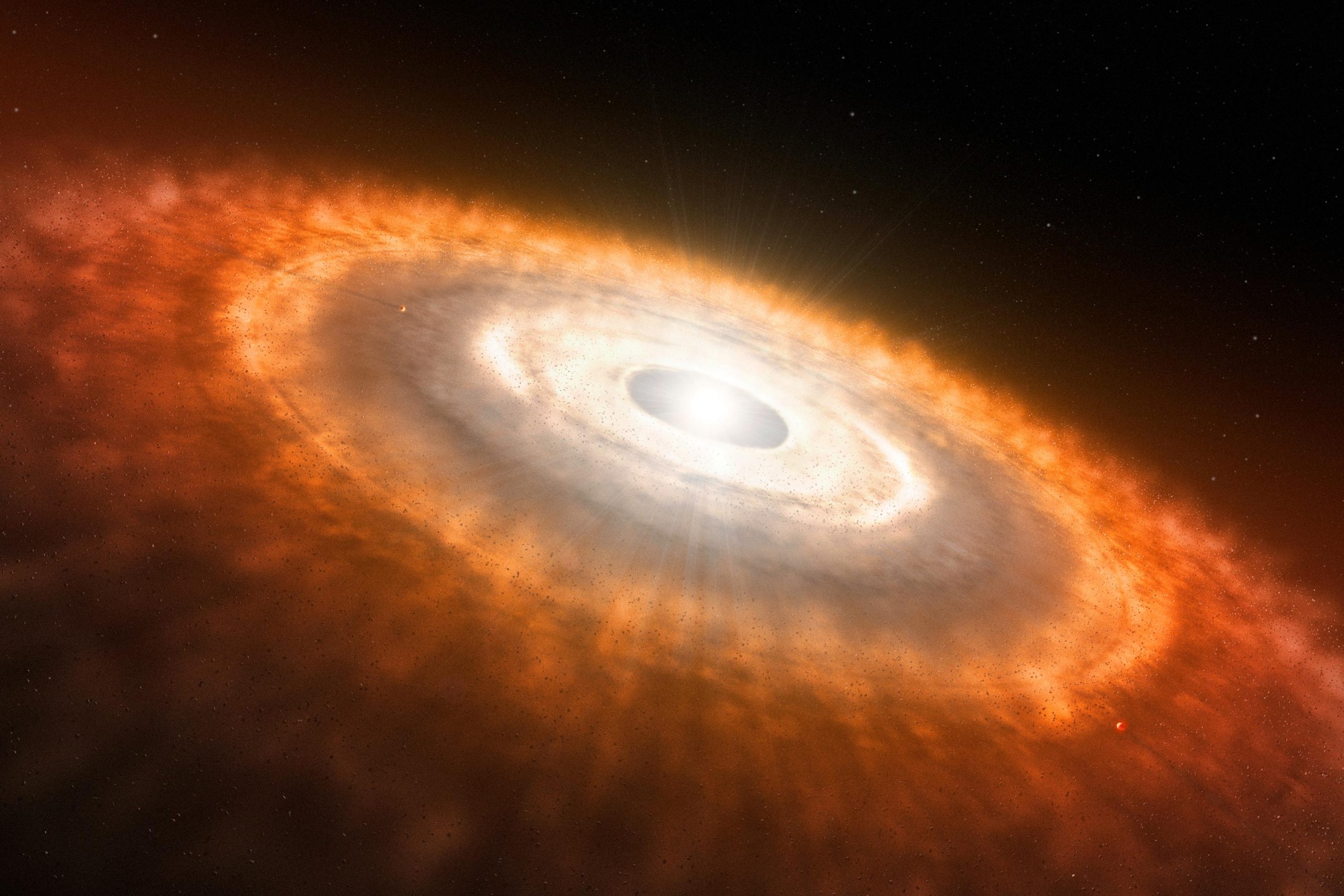
Webb Space Telescope Reveals Rocky Planets Can Form in Extreme Environments
An international team of astronomers has used NASA’s James Webb Space Telescope to provide the first observation of water and other molecules in the highly irradiated inner, rocky-planet-forming regions of a disk in one of the most extreme environments in our galaxy. These results suggest that the conditions for rocky planet formation can occur in a possible broader range of environments than previously thought.
First Results From XUE Program
These are the first results from the eXtreme Ultraviolet Environments (XUE) James Webb Space Telescope program, which focuses on the characterization of planet-forming disks (vast, spinning clouds of gas, dust, and chunks of rock where planets form and evolve) in massive star-forming regions. These regions are likely representative of the environment in which most planetary systems formed. Understanding the impact of environment on planet formation is important for scientists to gain insights into the diversity of the different types of exoplanets.
Study of the Lobster Nebula
The XUE program targets a total of 15 disks in three areas of the Lobster Nebula (also known as NGC 6357), a large emission nebula roughly 5,500 light-years away from Earth in the constellation Scorpius. The Lobster Nebula is one of the youngest and closest massive star-formation complexes, and is host to some of the most massive stars in our galaxy. Massive stars are hotter, and therefore emit more ultraviolet (UV) radiation. This can disperse the gas, making the expected lifetime of the disk as short as a million years. Thanks to Webb, astronomers can now study the effect of UV radiation on the inner terrestrial-planet forming regions of protoplanetary disks around stars like our Sun.
Webb’s Unique Capabilities
“Webb is the only telescope with the spatial resolution and sensitivity to study planet-forming disks in massive star-forming regions,” said team lead María Claudia Ramírez-Tannus of the Max Planck Institute for Astronomy in Germany.
Astronomers aim to characterize the physical properties and chemical composition of the rocky-planet-forming regions of disks in the Lobster Nebula using the Medium Resolution Spectrometer on Webb’s Mid-Infrared Instrument (MIRI). This first result focuses on the protoplanetary disk termed XUE 1, which is located in the star cluster Pismis 24.
“Only the MIRI wavelength range and spectral resolution allow us to probe the molecular inventory and physical conditions of the warm gas and dust where rocky planets form,” added team member Arjan Bik of Stockholm University in Sweden.
Due to its location near several massive stars in NGC 6357, scientists expect XUE 1 to have been constantly exposed to high amounts of ultraviolet radiation throughout its life. However, in this extreme environment the team still detected a range of molecules that are the building blocks for terrestrial planets.
“We find that the inner disk around XUE 1 is remarkably similar to those in nearby star-forming regions,” said team member Rens Waters of Radboud University in the Netherlands. “We’ve detected water and other molecules like carbon monoxide, carbon dioxide, hydrogen cyanide, and acetylene. However, the emission found was weaker than some models predicted. This might imply a small outer disk radius.”
“We were surprised and excited because this is the first time that these molecules have been detected under these extreme conditions,” added Lars Cuijpers of Radboud University. The team also found small, partially crystalline silicate dust at the disk’s surface. This is considered to be the building blocks of rocky planets.
Implications for Rocky Planet Formation
These results are good news for rocky planet formation, as the science team finds that the conditions in the inner disk resemble those found in the well-studied disks located in nearby star-forming regions, where only low-mass stars form. This suggests that rocky planets can form in a much broader range of environments than previously believed.
The team notes that the remaining observations from the XUE program are crucial to establishing the commonality of these conditions.
“XUE 1 shows us that the conditions to form rocky planets are there, so the next step is to check how common that is,” says Ramírez-Tannus. “We will observe other disks in the same region to determine the frequency with which these conditions can be observed.”
These results have been published in The Astrophysical Journal.
Reference: “XUE: Molecular Inventory in the Inner Region of an Extremely Irradiated Protoplanetary Disk” by María Claudia Ramírez-Tannus, Arjan Bik, Lars Cuijpers, Rens Waters, Christiane Göppl, Thomas Henning, Inga Kamp, Thomas Preibisch, Konstantin V. Getman, Germán Chaparro, Pablo Cuartas-Restrepo, Alex de Koter, Eric D. Feigelson, Sierra L. Grant, Thomas J. Haworth, Sebastián Hernández, Michael A. Kuhn, Giulia Perotti, Matthew S. Povich, Megan Reiter, Veronica Roccatagliata, Elena Sabbi, Benoît Tabone, Andrew J. Winter, Anna F. McLeod, Roy van Boekel and Sierk E. van Terwisga, 30 November 2023, The Astrophysical Journal Letters.
DOI: 10.3847/2041-8213/ad03f8
The James Webb Space Telescope is the world’s premier space science observatory. Webb is solving mysteries in our solar system, looking beyond to distant worlds around other stars, and probing the mysterious structures and origins of our universe and our place in it. Webb is an international program led by NASA with its partners, ESA (European Space Agency) and the Canadian Space Agency.
Never miss a breakthrough: Join the SciTechDaily newsletter.
Follow us on Google and Google News.