

New findings recently presented at the annual meeting of the Radiological Society of North America (RSNA) links soccer heading, a technique where players strike the ball with their heads, and a notable decrease in both the microstructure and functionality of the brain over a span of two years.
“There is enormous worldwide concern for brain injury in general and in the potential for soccer heading to cause long-term adverse brain effects in particular,” said senior author Michael L. Lipton, M.D., Ph.D., professor of radiology at Columbia University’s Vagelos College of Physicians and Surgeons and affiliate professor of biomedical engineering at Columbia University. “A large part of this concern relates to the potential for changes in young adulthood to confer risk for neurodegeneration and dementia later in life.”
Innovative Study Methodology and Findings
While previous research has examined adverse effects on the brain related to soccer heading at a single point in time, this new study looked at brain changes over two years.
The study included 148 young adult amateur soccer players (mean age 27, 26% women). The research team developed a specialized questionnaire for players to determine how often they hit the soccer ball with their heads.
“When we first started, there was no method for assessing the number of head impacts a player experienced,” Dr. Lipton said. “So, we developed a structured, epidemiological questionnaire that has been validated in multiple studies.”
The questionnaire consists of a series of questions about how often an individual plays, practices, and heads the ball, and in what type of situations. Two-year heading exposure was categorized as low, moderate, or high.
The players were assessed for verbal learning and memory and underwent diffusion tensor imaging (DTI), an MRI technique, at the time of enrollment and two years later. DTI characterizes the microstructure of the brain by tracking the microscopic movement of water molecules through the tissue.
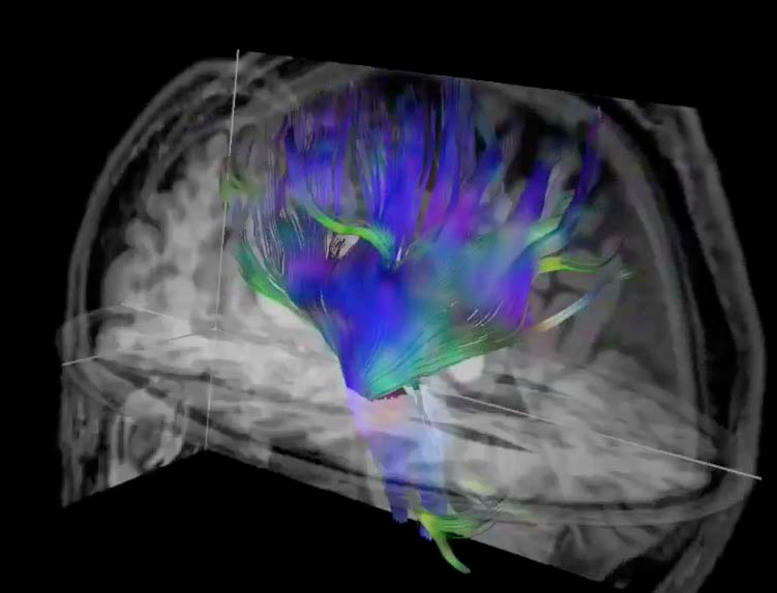
Compared to the baseline test results, the high-heading group (over 1,500 headers in two years) demonstrated an increase of diffusivity in frontal white matter regions, and a decrease of orientation dispersion index (a measure of brain organization) in certain brain regions after two years of heading exposure. The analysis adjusted for variables including age, sex, education, and concussion history.
“Our analysis found that high levels of heading over the two-year period were associated with changes in brain microstructure similar to findings seen in mild traumatic brain injuries,” Dr. Lipton said. “High levels of heading were also associated with a decline in verbal learning performance. This is the first study to show a change of brain structure over the long term related to sub-concussive head impacts in soccer.”
A New Perspective on Brain Injury Assessment
Dr. Lipton and colleagues also presented another study in which they used DTI to investigate the association between repetitive head impacts from soccer heading and verbal learning performance.
For the second study, researchers analyzed heading over 12 months prior to DTI and verbal learning performance testing in 353 amateur soccer players (age 18-53, 27% female). Unlike previous research that has focused on deep white matter regions, this study employed a new technique, using DTI parameters to evaluate the integrity of the interface between the brain’s gray and white matter closer to the skull.
“Importantly, our new approach addresses a brain region that is susceptible to injury but has been neglected due to limitations of existing methods,” Dr. Lipton said. “Application of this technique has potential to disclose the extent of injury from repetitive heading, but also from concussion and traumatic brain injury to an extent not previously possible.”
The researchers found that the normally sharp gray matter-white matter interface was blunted in proportion to high repetitive head impact exposure.
“We used DTI to assess the sharpness of the transition from gray matter to white matter,” Dr. Lipton said. “In various brain disorders, what is typically a sharp distinction between these two brain tissues becomes a more gradual, or fuzzier transition.”
He added that gray matter-white matter interface integrity may play a causal role in the adverse association between repetitive head impacts and cognitive performance.
“These findings add to the ongoing conversation and contentious debate as to whether soccer heading is benign or confers significant risk,” he said.
Meeting: 109th Scientific Assembly and Annual Meeting of the Radiological Society of North America
Co-authors on the first study are Molly F. Charney, M.D., Kenny Ye, Ph.D., Roman Fleysher, Ph.D., Liane E. Hunter, M.D., Ph.D., Shimon Garrel, B.S., Bluyé Demessie, A.B., M.S., Joan Y. Song, B.S.E., M.S., Molly E. Zimmerman, Ph.D., Walter F. Stewart, Ph.D., Mimi Kim, Sc.D., and Richard B. Lipton, M.D.
Co-authors on the second study are Joan Y. Song, B.S.E., M.S., and Roman Fleysher, Ph.D.
Never miss a breakthrough: Join the SciTechDaily newsletter.
Follow us on Google and Google News.
1 Comment
What about boxers?