
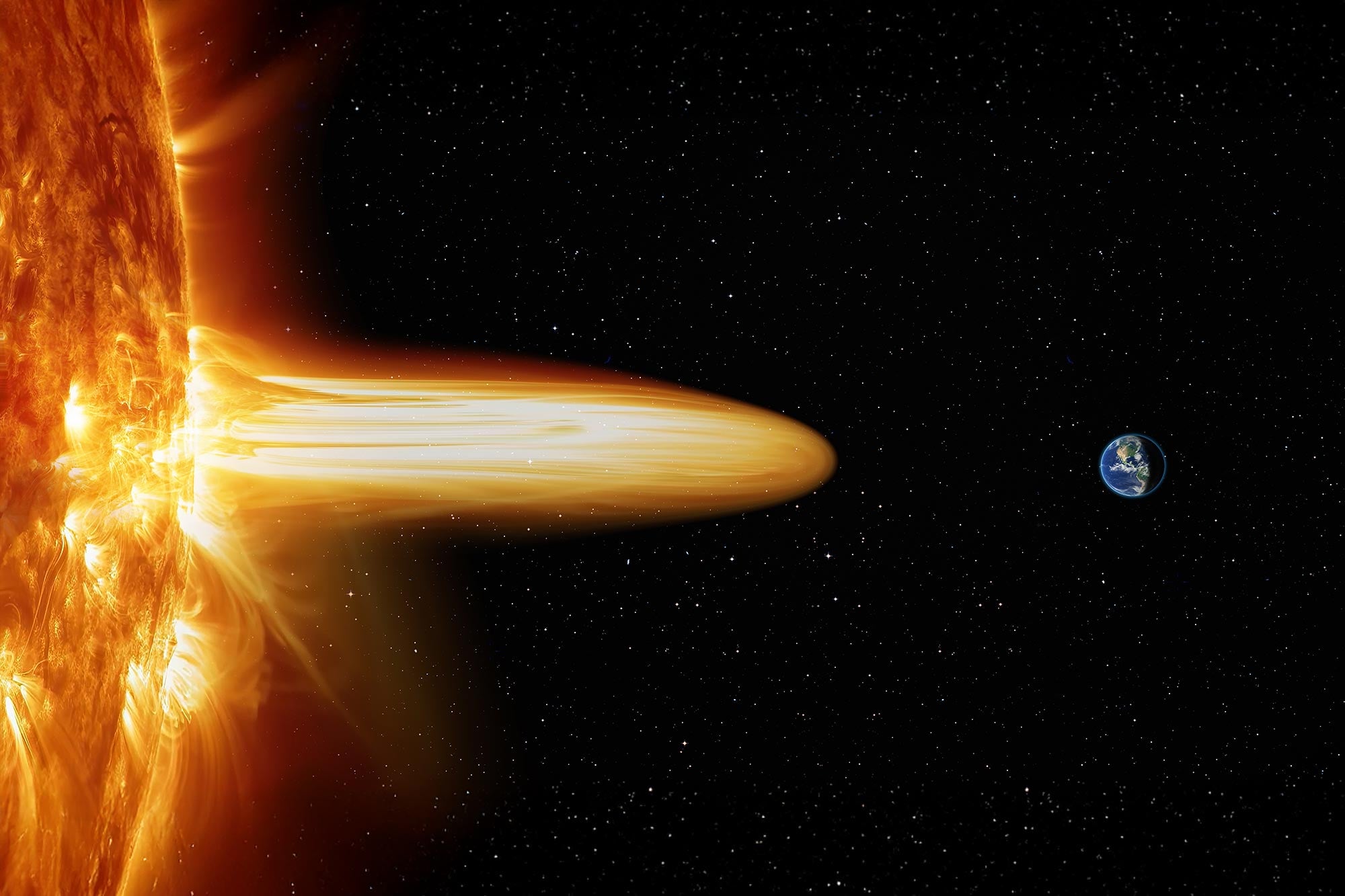
Scientists have uncovered surprising behavior inside a powerful solar eruption that challenges existing models and could change how researchers predict space weather.
A massive eruption on the Sun sent a cloud of magnetized plasma racing toward Earth, where it underwent an extraordinary transformation. Over a distance of just 13 million miles, the cloud expanded by 21% as the plasma inside became three times hotter, defying expectations about how these solar structures evolve.
Researchers led by the University of Iowa documented the rapid growth using observations from two spacecraft positioned along the cloud’s path. Their findings challenge existing models of solar storms and could improve predictions of space weather events capable of disrupting satellites, navigation systems, and electrical grids.
A Rare Alignment Captures a Changing Solar Cloud
The cloud originated from a coronal mass ejection on November 4 and 5, 2021. These powerful solar eruptions release enormous quantities of hot, electrically charged gas threaded with magnetic fields. Some form magnetic clouds containing twisted bundles of magnetic field lines that travel through interplanetary space.
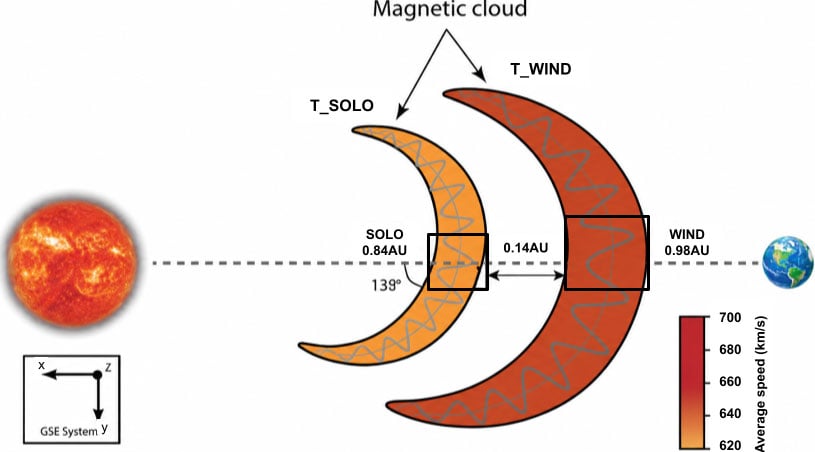
As the crescent-shaped cloud approached Earth, the Solar Orbiter spacecraft recorded its structure approximately 78 million miles from the Sun. The Wind spacecraft later measured the same cloud about 91 million miles from the Sun. Both spacecraft happened to lie along nearly the same line, allowing scientists to compare the cloud’s properties at two relatively close points in its journey. The eruption also produced a major geomagnetic storm on Earth.
“First, it’s rare these two spacecraft would be aligned on a Sun-Earth axis,” says Shirsh Soni, a postdoctoral research fellow in physics and astronomy at the University of Iowa. “Then, second, for them to be aligned like that during an interplanetary coronal mass ejection is so much rarer.”
Solar Wind Triggers Unexpectedly Rapid Expansion
The measurements showed that the magnetic cloud expanded at approximately 192 kilometers per second (119 miles per second), substantially faster than the typical range of 50 to 100 kilometers per second (31 to 62 miles per second). The researchers called this unusually rapid growth a “super expansion.”
The process began when the cloud encountered the surrounding solar wind, a continuous stream of charged particles flowing outward from the Sun at speeds that can reach approximately 1 million mph. The interaction initially compressed the cloud, but its internal plasma subsequently heated to three times its earlier temperature, driving the dramatic expansion.
“In a typical interplanetary coronal mass ejection, when it encounters the solar wind, it could decelerate or accelerate,” Soni explains. “In this case, it expanded a lot.”
Findings Challenge Existing Solar Storm Models
The team also discovered that the cloud’s magnetic field pressure remained unchanged despite its substantial growth. This behavior differed from predictions produced by existing models, suggesting that magnetic clouds may undergo more complex changes during their journeys through the solar system than previously recognized.
Because the two spacecraft observed the same cloud along its path, the researchers could directly track changes that would have been difficult to distinguish using a single observation point. Such measurements are particularly valuable for understanding how coronal mass ejections develop before reaching Earth, where their magnetic fields can interact with Earth’s magnetosphere and trigger geomagnetic disturbances.
“We have assumed that magnetic clouds from interplanetary coronal mass ejections will evolve in the same way,” says Soni, the study’s corresponding author. “In this study, we show the magnetic cloud can expand dramatically in a short period of time and space, which could have impacts to Earth that we wouldn’t have known about.”
Reference: “Superexpansion of interplanetary coronal mass ejection observed by Solar Orbiter and Wind spacecraft within 0.14 au radial separation” by Shirsh Lata Soni, Ankush Bhaskar, R Selva Kumaran and David Miles, 24 April 2026, Monthly Notices of the Royal Astronomical Society.
DOI: 10.1093/mnras/stag350
Soni’s research was funded through a previous fellowship provided by the University of Michigan.
Never miss a breakthrough: Join the SciTechDaily newsletter.
Follow us on Google and Google News.