
Close Menu
    Facebook X (Twitter) Instagram
    SciTechDaily
    • Biology
    • Chemistry
    • Earth
    • Health
    • Physics
    • Science
    • Space
    • Technology
    Facebook X (Twitter) Pinterest YouTube RSS
    SciTechDaily
    Home»Space»Two Coronal Mass Ejections Strongly Compressed the Magnetopause
    Space

    Two Coronal Mass Ejections Strongly Compressed the Magnetopause

    By Karen C. Fox, NASA Goddard Space Flight CenterJune 19, 2012No Comments3 Mins Read
    Facebook Twitter Pinterest Telegram LinkedIn WhatsApp Email Reddit
    Share
    Facebook Twitter LinkedIn Pinterest Telegram Email Reddit
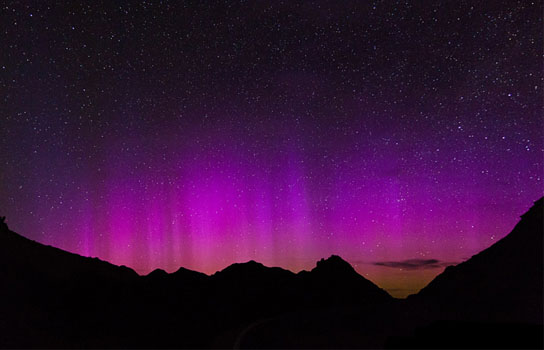
    aurora in Badlands, South Dakota
    A European visitor captured this aurora in Badlands, South Dakota. Credit: Marko Korosec

    Simulations show that on June 16, 2012, the combined effects of two coronal mass ejections from AR 1504 compressed the magnetopause to a minimum of approximately 24,000 miles from Earth’s surface, causing bright aurora to be seen at lower latitudes than normal.

    On June 16, 2012, at 4:55 a.m. EDT (1:55 a.m. PDT), the combined effects of two coronal mass ejections from AR 1504, passed NASA’s Advanced Composition Explorer (ACE) spacecraft on the way toward Earth’s protective magnetic bubble, the magnetosphere. ACE is approximately 900,000 miles from Earth and can detect such incoming shocks about 30-45 minutes before they hit the magnetosphere.

    Simulations performed at NASA Goddard’s Space Weather Center indicate that the disturbance strongly compressed the magnetopause, ultimately to a minimum of approximately 24,000 miles from Earth’s surface at 6:28 PM EDT. This is an altitude some 2,000 miles lower than spacecraft in geosynchronous orbit.
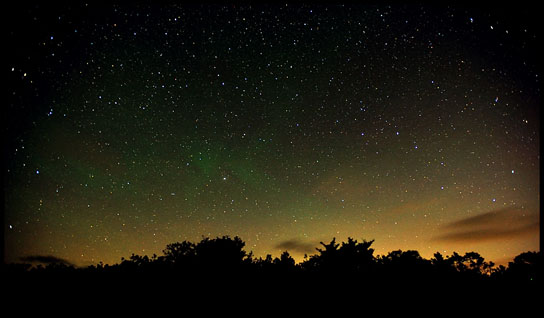
    Aurora
    Aurora were seen as far south as Ocean City, Maryland. This photo was taken by a camper on the shores of Assateague Island, facing North. Credit: Jeff Berkes

    The changing shape of Earth’s magnetopause also influenced the aurora, causing bright aurora to be seen at lower latitudes than normal, as low as Iowa, Nebraska, and Maryland.


    This movie from the Solar Dynamics Observatory (SDO) shows the M class flare on June 14, 2012, from 9:15 AM to 2:00 PM EDT. The sun is shown here in teal as this is the color typically used to represent light in the 131 Angstrom wavelength, a wavelength particularly good for observing flares. Credit: NASA/SDO

    An active region on the sun, numbered AR 1504, rotated into view over the left side of the sun on June 10, 2012. The region fired off two M-class flares and two coronal mass ejections (CMEs) on June 13 and June 14, 2012. The first flare lasted for a relatively long three hours, peaking on June 13, 2012, at 9:17 AM EDT. The associated CME traveled at approximately 375 miles (603 kilometers) per second and is directed toward Earth, though due to its slow speed, the effect on Earth is expected to be minimal.
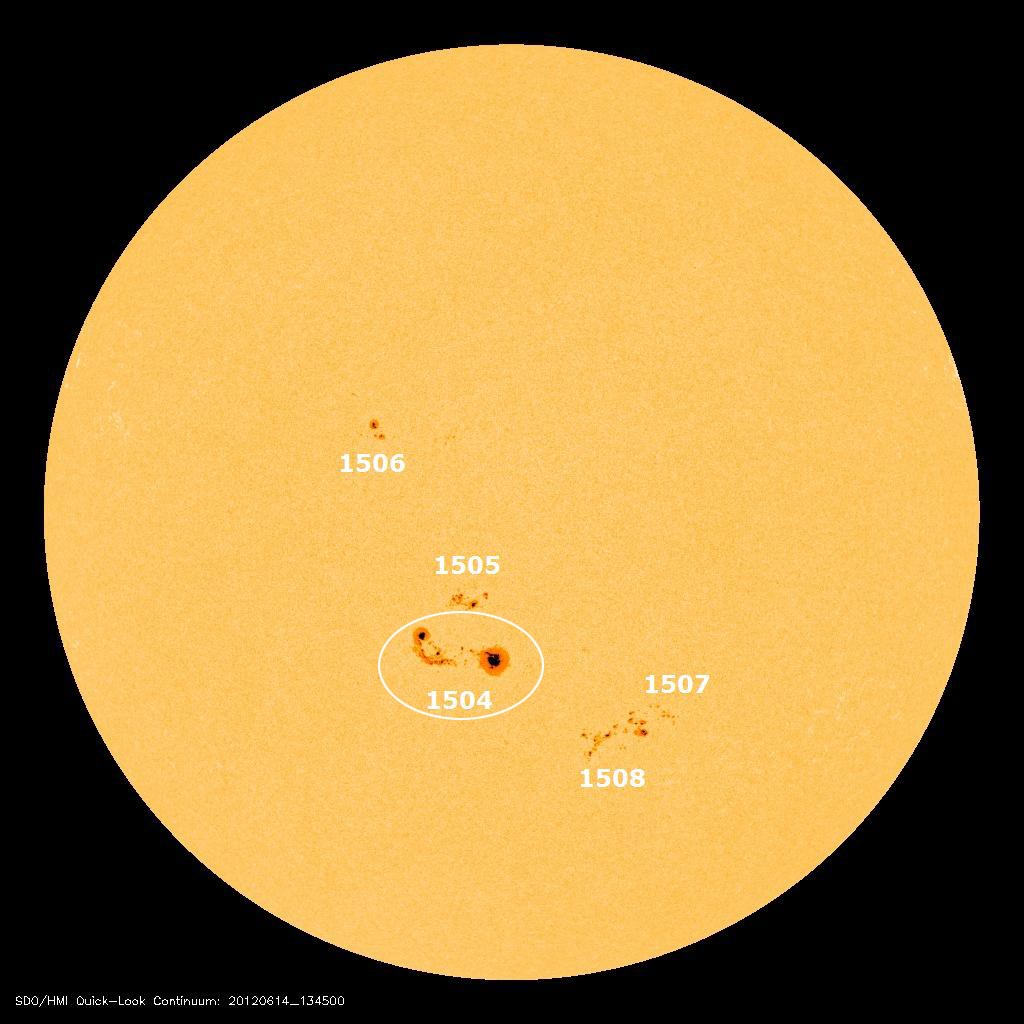
    Active Region 1504
    Active Region 1504 has been active since rotating into view. Credit: SDO/HMI

    The second M-class flare was also a long-duration flare, and it peaked on June 14, 2012, at 10:08 AM EDT. The CME associated with this flare is traveling much faster – preliminary analysis at Goddard’s Space Weather Center indicates it is traveling at speeds of approximately 800 miles per second. It is traveling toward Earth, and could also impact Mars and the Spitzer spacecraft.
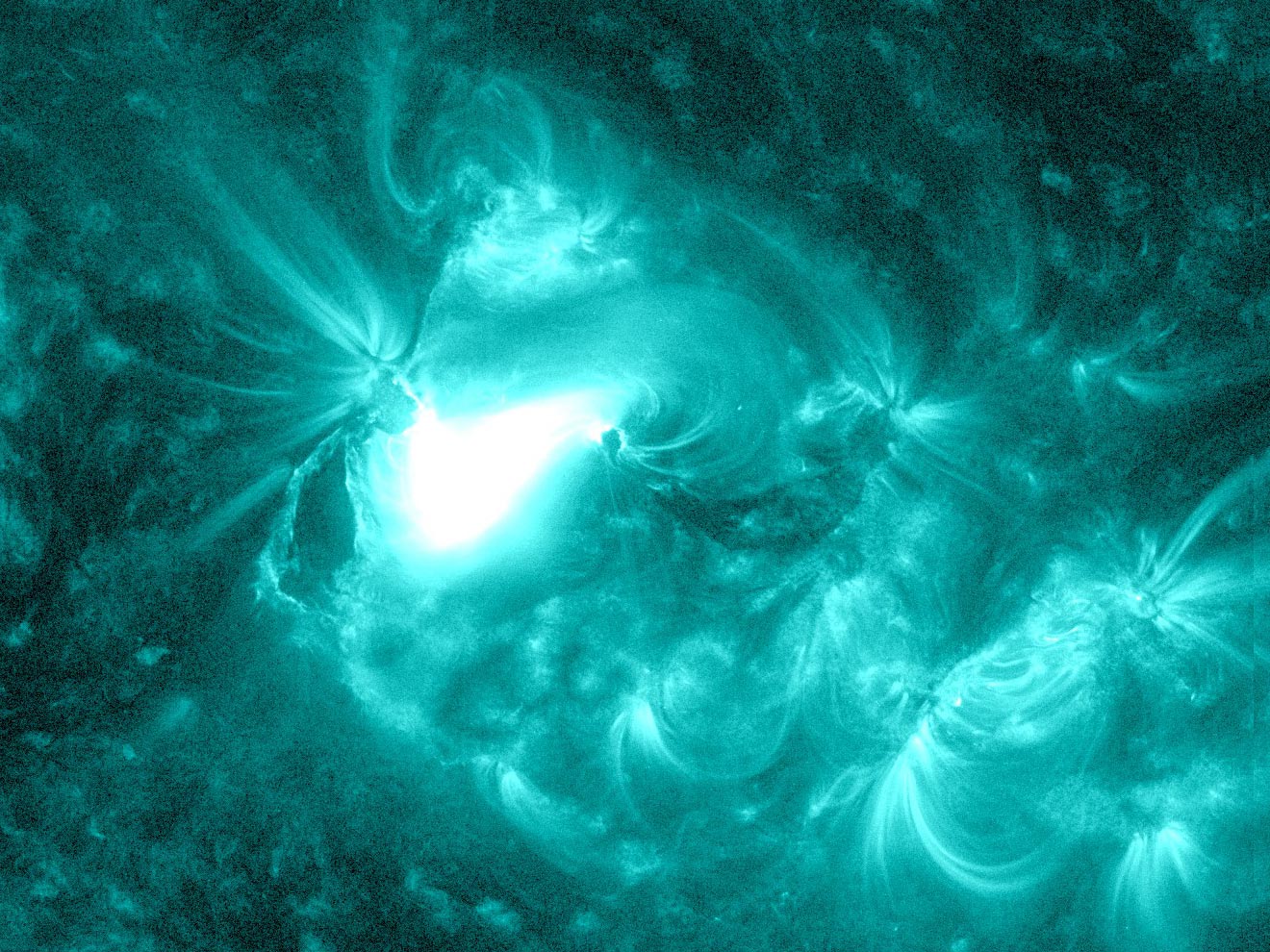
    SDO M1.2 Class Flare 2012
    The Solar Dynamics Observatory captured this image of an M1.2 class flare on June 13, 2012. The sun is shown here in teal as this is the color typically used to represent light in the 131 Angstrom wavelength, a wavelength particularly good for observing flares. Credit: NASA/SDO

    Never miss a breakthrough: Join the SciTechDaily newsletter.
    Follow us on Google and Google News.

    Astronomy Aurora Coronal Mass Ejections NASA Space Weather
    Share. Facebook Twitter Pinterest LinkedIn Email Reddit

    Related Articles

    NASA Looks at the Impacts of Strong Solar Flares

    NASA Captures Image of an M6.5 Class Flare

    Image of Magnetic Loops on the Sun

    NASA’s Solar Dynamics Observatory Captures Filament Explosion

    Earth’s Van Allen Radiation Belt to be Probed by NASA Satellites

    Geotail Satellite Still Sending Back Crucial Information After 20 Years of Service

    NASA’s Cassini Spots Lightning in Saturn’s Northern Hemisphere

    New Light Shed on the Origins of Extreme Space Storms

    Strong Geomagnetic Storms a Possibility After Active Sunspot 1401 Erupted

    Leave A Reply Cancel Reply

    • Facebook
    • Twitter
    • Pinterest
    • YouTube

    Don't Miss a Discovery

    Subscribe for the Latest in Science & Tech!

    Trending News

    Even Occasional Binge Drinking May Triple Liver Damage Risk

    Liftoff! NASA’s Artemis II Launch Sends Astronauts Around the Moon for First Time in 50 Years

    Scientists Discover New Way To Eliminate “Zombie Cells” Driving Aging

    This New Quantum Theory Could Change Everything We Know About the Big Bang

    This One Vitamin May Help Protect Your Brain From Dementia Years Later

    Stopping Weight-Loss Drugs Like Ozempic Can Quickly Erase Heart Benefits

    A 500-Million-Year-Old Surprise Is Forcing Scientists to Rethink Spider Evolution

    Coffee and Blood Pressure: What You Need To Know Before Your Next Cup

    Follow SciTechDaily
    • Facebook
    • Twitter
    • YouTube
    • Pinterest
    • Newsletter
    • RSS
    SciTech News
    • Biology News
    • Chemistry News
    • Earth News
    • Health News
    • Physics News
    • Science News
    • Space News
    • Technology News
    Recent Posts
    • Atomic Chains Turn Electric Fields into Measurable Quantum Signals
    • 12,000-Year-Old Native American Dice Rewrite the History of Gambling
    • Researchers Break a 150-Year-Old Math Law With a Surprising Donut Discovery
    • Are You Adding Too Much Salt? New Study Identifies Who’s Most at Risk
    • Scientists Finally Crack Decades-Old Mystery Behind Statins’ Painful Side Effects
    Copyright © 1998 - 2026 SciTechDaily. All Rights Reserved.
    • Science News
    • About
    • Contact
    • Editorial Board
    • Privacy Policy
    • Terms of Use

    Type above and press Enter to search. Press Esc to cancel.