
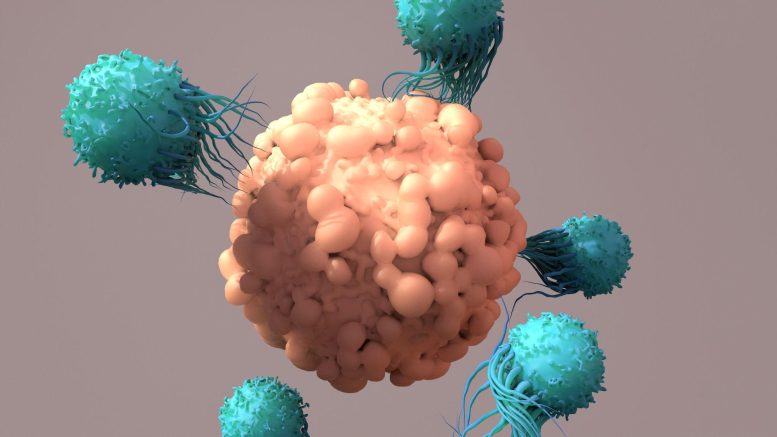
According to researchers from the UNIGE and LMU, the effectiveness of the immune system’s anti-tumor activity and cancer immunotherapies is tied to the time of day. This means that the same treatment may be more or less effective depending on when it is administered.
The body’s immune system plays a crucial role in its ability to fight off tumors and prevent cancer from taking hold and growing. Immunotherapy treatments work by strengthening the immune response to better target and attack cancer cells. Previous research from the University of Geneva and the Ludwig-Maximilians University of Munich has shown that the effectiveness of the immune system varies according to the time of day, with a peak of efficiency in the morning for humans.
Now, the research team demonstrates that the rhythmicity of the immune system – and in particular that of dendritic cells, its key sentinels – has a hitherto unsuspected impact on tumor growth, as well as on the effectiveness of immunotherapeutic treatments. These results, published in the journal Nature, indicate that simply changing the time of administration of a treatment could tremendously enhance its effectiveness.
Biological clocks regulate most physiological processes in living beings on a rhythm of about 24 hours. And the immune system is no exception.
‘‘By studying the migration of dendritic cells in the lymphatic system, one of the most essential elements of the immune response, we had highlighted the fact that immune activation oscillates throughout the day, with a peak in the late behavioural resting phase,” summarizes Christoph Scheiermann, professor at the Department of Pathology and Immunology and the Geneva Centre for Inflammation Research (GCIR) and the Centre for Translational Research in Onco-Hematology (CRTOH) at the UNIGE Faculty of Medicine, who led this work.
In the current study, the group focussed on cancer to assess how this temporal modulation affected tumors.
Temporal Profiling of Dendritic Cells
The scientists injected groups of mice with melanoma cells at six different times of the day and then monitored tumor growth for a fortnight.
‘‘By varying only the time of injection, we observed very surprising results: tumors implanted in the afternoon grew little, while those implanted at night grew much faster, in accordance with the rhythm of activation of the mice’s immune system’’, indicates Chen Wang, a researcher in Christoph Scheiermann’s lab and first author of this study. The research team then reproduced the experiment with mice that had no immune system. ‘‘There was no longer any difference related to the time of day, thus confirming that the latter is indeed induced by the immune response: the first immune cells activated are the dendritic cells of the skin, which are found 24 hours later in the lymph node. The T cells are then activated and attack the tumor.”
Moreover, by suppressing the internal clocks of the dendritic cells, the rhythm of activation of the immune system disappears, confirming their key role.
Lastly, the researchers administered an immunotherapy treatment at different times of the day to mice whose tumor implantation had taken place at the same time. ‘‘This therapeutic vaccine consisted of a tumor-specific antigen, very similar to what is used to treat patients. When administered in the afternoon, the beneficial effect was again increased.’’
What About Human Beings?
In order to find out whether these results were repeated in humans, the scientists re-examined the data of patients treated with cancer vaccines for melanoma. Melanoma-specific T cells in these patients responded better to treatments administered early in the morning, which corresponds to the human circadian profile, reversed in comparison with mice, which are nocturnal animals. ‘‘This is very encouraging, but it is only a retrospective study of a small cohort of ten people,’’ Christoph Scheiermann points out.
The researchers now want to confirm and refine these initial findings through clinical studies. However, the very idea that a treatment can become more potent depending on the time of day opens up some surprising possibilities.
Reference: “Dendritic cells direct circadian anti-tumor immune responses” by Chen Wang, Coline Barnoud, Mara Cenerenti, Mengzhu Sun, Irene Caffa, Burak Kizil, Ruben Bill, Yuanlong Liu, Robert Pick, Laure Garnier, Olga A. Gkountidi, Louise M. Ince, Stephan Holtkamp, Nadine Fournier, Olivier Michielin, Daniel E. Speiser, Stéphanie Hugues, Alessio Nencioni, Mikaël J. Pittet, Camilla Jandus and Christoph Scheiermann, 5 December 2022, Nature.
DOI: 10.1038/s41586-022-05605-0
Never miss a breakthrough: Join the SciTechDaily newsletter.
Follow us on Google and Google News.