
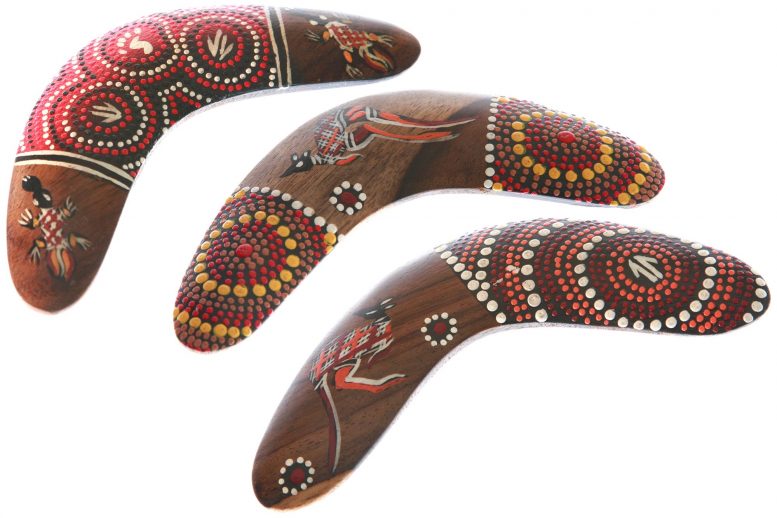
Study of medical studies reveals ancient aboriginal memory technique superior.
Australian scientists have compared an ancient Greek technique of memorizing data to an even older technique from Aboriginal culture, using students in a rural medical school.
The study found that students using a technique called the memory palace, in which they memorized facts by placing them into a memory blueprint of their childhood home, could revisit certain rooms to recapture that data. Another group of students were taught a technique developed by Australian Aboriginal people over more than 50,000 years of living in a custodial relationship with the Australian land.
The students who used the Aboriginal method of remembering had a significantly improved retention of facts compared to the control and the “memory palace” group.
The study led by Dr. David Reser, from the Monash University School of Rural Health, and Dr. Tyson Yunkaporta, from Deakin University’s NIKERI Institute, has just been published in PLOS One.
Medical students, and doctors, need to retain large amounts of information from anatomy to diseases and medications.
Because one of the main stressors for medical students is the amount of information they have to rote learn, we decided to see if we can teach them alternate, and better, ways to memorize data,” Dr. Reser said.
Memory Palace: Classical and Clerical Roots
The memory palace technique dates back to the early Greeks and was further utilized by Jesuit priests. Handwritten books were scarce and valuable, and one reading would have to last a person’s lifetime, so ways to remember the contents were developed.
In Aboriginal culture, which relies on oral history, important facts like navigation, food sources, tool use, and inter and intra tribal political relationships are important for survival. Aboriginal methods of memorizing also used the idea of attaching facts to the landscape, but with added stories that describe the facts and the placement to facilitate recall.
Working with Dr. Yunkaporta, formerly at the Monash School of Rural Health, the research team randomly divided 76 medical students attending Monash’s Churchill Campus, in rural Victoria, into three groups. The students were given 30 minutes of training in the memory palace, Aboriginal techniques, or were in a control group who watched a video rather than undergo training. The students were then asked to memorize 20 common butterfly names (to dissociate from medical curriculum).
They were then tested on their recalls at 10 minutes and then 30 minutes after using their assigned techniques to memorize the list.
Aboriginal Technique Outperforms
The researchers found the students who used the Aboriginal technique for remembering ie a narrative plus locations from around the campus were almost three times more likely to correctly remember the entire list than they were prior to training (odds ratio: 2.8). The students using the memory palace technique were about twice as likely to get a perfect score after training (2.1), while the control group improved by about 50% (1.5) over their pre-training performance.
Importantly a qualitative survey found the students using the Aboriginal technique found it more enjoyable, “both as a way to remember facts but also as a way to learn more about Aboriginal culture,” Dr. Reser said.
Dr. Reser said the Monash School of Rural Health is considering incorporating these memory tools into the medical curriculum once teaching returns to a post-COVID normal. “This year we hope to offer this to students as a way to not only facilitate their learning but to reduce the stress associated with a course that requires a lot of rote learning,” he said.
Reference: “Australian Aboriginal techniques for memorization: Translation into a medical and allied health education setting” by David Reser, Margaret Simmons, Esther Johns, Andrew Ghaly, Michelle Quayle, Aimee L. Dordevic, Marianne Tare, Adelle McArdle, Julie Willems and Tyson Yunkaporta, 18 May 2021, PLOS ONE.
DOI: 10.1371/journal.pone.0251710
Never miss a breakthrough: Join the SciTechDaily newsletter.
Follow us on Google and Google News.
2 Comments
The researchers do not seem to understand the memory techniques they are using. If you use a journey to remember things you are moving through a mind palace.
Dominic O’Brien remembers his calendar using a mind palace of a country walk however each month is a different journey so same locations however different information is stored there.
It almost sounds like they are using a peg board so they are just attaching the names to a place. If I use my home as a mind palace I do not just go kitchen sink equals red admiral. I would go to my front door and Odette Annable would be dressed as a Russian Admiral however if it my shopping list she is drinking a bottle of milk. Item 2 on the list would be inside my porch and it would be Sigourney Weaver from Ghostbusters telling me that these are not the droids I am looking for and so on in a pre-thought out journey through my mind palace house. Odette Annable is the person who equals 01 in my Person Action Object system so I know the list is over 10 or more. Obi One Kenobi is 02 however it is his action which is being used. Sigourney Weaver from Ghostbusters because when I think Gatekeeper, I think of her in that role. I would have Brendan O’Carroll fighting a butterfly in my front garden as I walk down the path starting the journey so I know the list is only 20 items long.
What is sad about this article is indeed that the researchers don’t seem to understand their topic, or if they do, they have no idea how to share it with the audience. They seem to only be focused on mind and conceptualisation… Storytelling and rituals or, embodied enactment and practices are a lived somatic experience. Something generating sensations and emotions. Something mapping data not only within our mind but within our cells, our emotional body and soul. Because a lived experience is not a belief but a reality to those who live it. Something that westerners have progressively forgotten a long time ago with the rise of the alphabet, leading us to using our left brain and to conceptualise everything.