
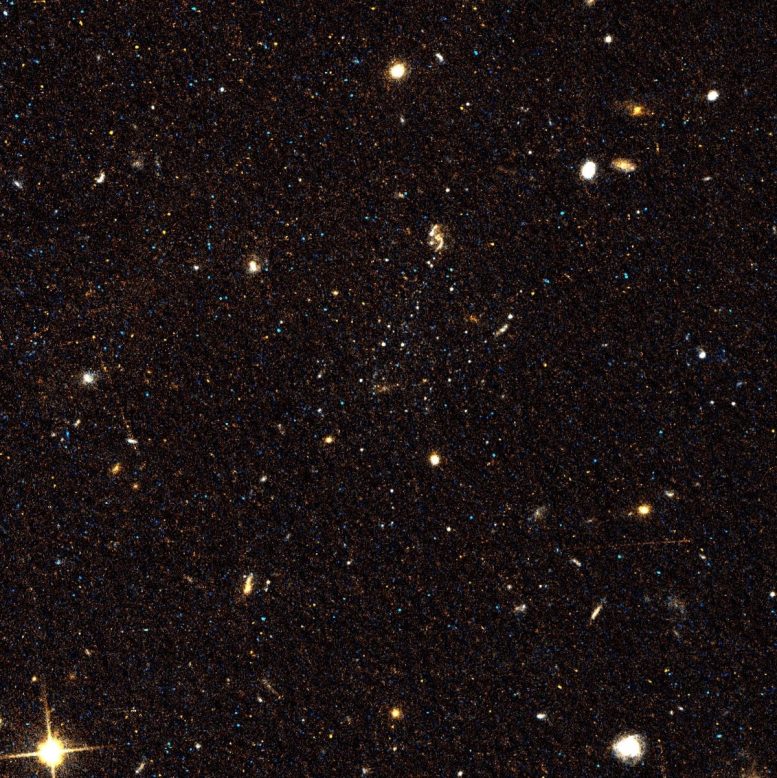
Ultra-faint dwarf galaxies have been discovered for the first time surrounding a Milky Way-sized galaxy, similar to those found within the Milky Way’s neighborhood.
According to findings recently presented at the 241st meeting of the American Astronomical Society, the identification of the faintest galaxies known to exist beyond the Milky Way’s vicinity could aid researchers in creating universal models for the formation of the universe’s earliest galaxies.
A team of scientists, headed by Burçin Mutlu-Pakdil, who is now a professor of physics and astronomy at Dartmouth College, have uncovered three ultra-faint dwarf galaxies (UFDs) that are considered among the faintest galaxies found outside of the Local Group. The Local Group is a cluster of galaxies that includes the Milky Way and Andromeda. The newly discovered galaxies are located approximately 11.4 million light-years away from Earth and are believed to be around 12 billion years old, with nearly all of their stars having formed during the early universe, according to a report in The Astrophysical Journal.
The galaxies are the first UFDs to be found around a spiral galaxy with a mass of the Milky Way, orbiting a galaxy known as NGC253, or the Sculptor Galaxy. Yet, their characteristics are consistent with UFDs within the Local Group, which could help scientists develop more accurate models of UFDs overall. Most known examples of UFDs are within the Local Group, but different environments can affect their formation and evolution, Mutlu-Pakdil said.
“Our work is the necessary first step toward further understanding the faintest galaxies beyond the Local Group, and toward more robustly constraining the demographics of ultra-faint dwarf galaxies,” Mutlu-Pakdil said. “We still do not know whether the Local Group UFDs are typical or unusual. To answer this fundamental question, we need to discover more UFDs beyond our local environment and study them in detail.”
Characteristics of UFDs
UFDs are the least luminous and least chemically evolved galaxies known. Yet, they are the most dominated by dark matter, which is the mysterious form of matter thought to constitute most of the universe. For these reasons, astronomers consider UFDs to be pristine fossils of the early universe that could provide the best opportunities for studying the composition of the universe and the formation of its first galaxies.
“Dwarf galaxies are the building blocks of larger galaxies,” Mutlu-Pakdil said. “UFDs are the best place to study galaxy formation on the smallest scales and learn how the smallest dark matter clumps get populated with stars and turn into galaxies.”
Meeting: 241st meeting of the American Astronomical Society
Reference: “Hubble Space Telescope Observations of NGC 253 Dwarf Satellites: Three Ultra-faint Dwarf Galaxies” by Burçin Mutlu-Pakdil, David J. Sand, Denija Crnojević, Michael G. Jones, Nelson Caldwell, Puragra Guhathakurta, Anil C. Seth, Joshua D. Simon, Kristine Spekkens, Jay Strader and Elisa Toloba, 15 February 2022,
This study was conducted as part of the Panoramic Imaging Survey of Centaurus and Sculptor (PISCeS) project, which is a Magellan+Megacam survey aimed at finding new faint satellite galaxies, including UFDs.
The study was funded by the National Science Foundation, an NSF Astronomy and Astrophysics Postdoctoral Fellowship, the Packard Foundation, and the Natural Sciences and Engineering Research Council of Canada.
Never miss a breakthrough: Join the SciTechDaily newsletter.
Follow us on Google and Google News.
3 Comments
Those should be the laws of mens; expanding knowledge of the universe NOT to kill each others like crazy monkey’s how’s happens today. Those political monkeys shouldn’t be walking free around with their psico ideas and their ambitions of economical power. Those monkey’s should be on a sanatorium for mentally ill animals. The power of humanity should be based on the arts sciences and technologist or there will be no salvation but only monkeys destruction for us all…
Evolution is a gradual process.
I do accept as true with all of the ideas you have offered for your post. They are very convincing and can certainly work. Still, the posts are too brief for novices. Could you please prolong them a little from next time? Thank you for the post.