
Close Menu
    Facebook X (Twitter) Instagram
    SciTechDaily
    • Biology
    • Chemistry
    • Earth
    • Health
    • Physics
    • Science
    • Space
    • Technology
    Facebook X (Twitter) Pinterest YouTube RSS
    SciTechDaily
    Home»Physics»Using a Single Oxygen Atom as a Sensor to Study Surfaces As Gently as Possible on an Atomic Scale
    Physics

    Using a Single Oxygen Atom as a Sensor to Study Surfaces As Gently as Possible on an Atomic Scale

    By Vienna University of TechnologyJune 8, 2020No Comments4 Mins Read
    Facebook Twitter Pinterest Telegram LinkedIn WhatsApp Email Reddit
    Share
    Facebook Twitter LinkedIn Pinterest Telegram Email Reddit
    Surface Oxygen Adsorbates
    High-resolution picture of the surface: The oxygen adsorbates are clearly visible (orange). Credit: TU Wien

    Oxygen is highly reactive. It accumulates on many surfaces and determines their chemical behavior. At the Vienna University of Technology, scientists study the interaction between oxygen and metal oxide surfaces, which play an important role in many technical applications — from chemical sensors and catalysts to electronics.

    However, it is extremely difficult to study oxygen molecules on the metal oxide surface without altering them. At TU Wien, this has now been achieved with a special trick: a single oxygen atom is attached to the tip of an atomic force microscope and then it is gently guided across the surface. The force between the surface and the oxygen atom is measured, and an image is taken with extremely high resolution. The results have now been published in the journal PNAS.

    Different Kinds of Oxygen

    “In recent years, quite a bit of research has been done on how oxygen attaches to metal oxide surfaces,” says Prof. Martin Setvin from the Institute of Applied Physics at TU Wien. “Do O2 molecules remain intact, or are they broken down into single atoms? Or could it be possible that so-called tetraoxygen forms, a complex of four atoms? Such questions are important to understand chemical reactions on the metal oxide surface.”

    Unfortunately, it is not easy to take a picture of these atoms. Scanning tunneling microscopes are often used to image surfaces atom by atom. A fine tip is passed over the sample at an extremely short distance, so that individual electrons can pass between the sample and tip. The tiny electrical current that results is measured. However, this method cannot be used for oxygen molecules — they would become electrically charged and completely change their behavior.
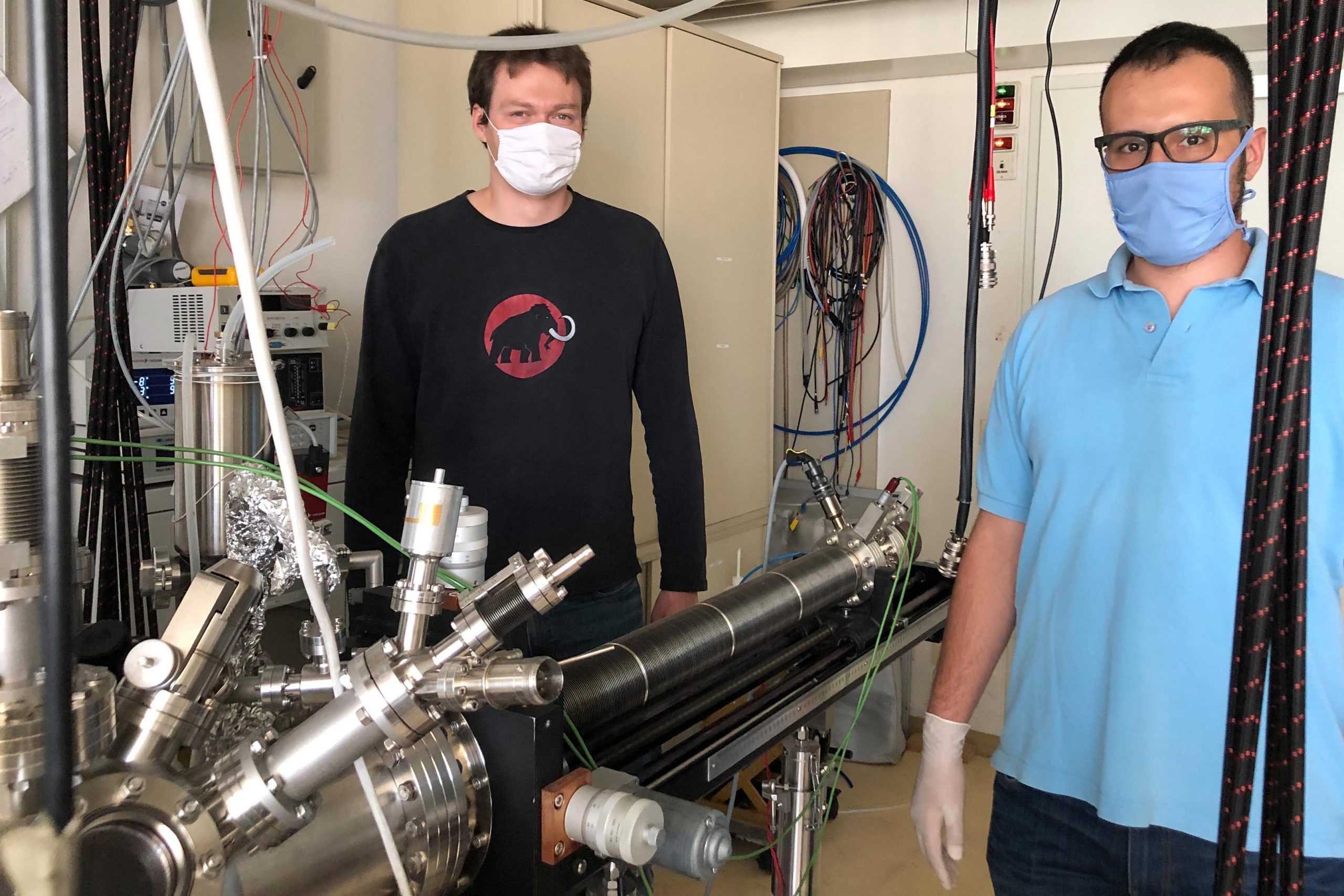
    Martin Setvin and Igor Sokolovic
    It is extremely difficult to study oxygen molecules on the metal oxide surface without altering them. At TU Wien, this has now been achieved with a special trick: a single oxygen atom is attached to the tip of an atomic force microscope and then it is gently guided across the surface. The force between the surface and the oxygen atom is measured, and an image is taken with extremely high resolution. Credit: TU Wien

    The Vienna scientists used an atomic force microscope instead. Here too, a thin tip is moved across the surface. In this case, no current flows, but the force that acts between the tip and the surface is measured. A special trick was decisive — the functionalization of the tip: “A single oxygen atom is first captured by the tip of the atomic force microscope and then moved across the surface,” explains Igor Sokolovic. The oxygen atom thus serves as a highly sensitive probe to examine the surface point by point.

    Since no current flows and the oxygen atom never comes into full contact with the surface, this method is extremely gentle and does not change the atoms on the metal oxide surface. In this way, the geometry of the oxygen deposits on the metal oxide can be examined in detail.

    A Versatile Method

    “This functionalization of the tip by placing a very specific atom on it has been developed in recent years, and we are now showing for the first time it can be applied to metal oxide surfaces,” says Setvin.

    It turns out that the oxygen molecules can be attached to the metal oxide in different ways — either on the titanium atoms at the surface or at certain positions, where an oxygen atom is missing. Depending on the temperature, the oxygen molecules can then split into two individual oxygen atoms. However, no tetraoxygen — a hypothetical complex of four oxygen atoms — was found.

    “The titanium oxide surfaces that we examine in this way are a prototype case to put this method to test,” explains Martin Setvin. “But the insights that we gain from our experiments also apply to many other materials.” Microscopy with a functionalized tip in an atomic force microscope is a versatile method for imaging a surface structure with atomic resolution without destruction and without electronic change.

    Reference: “Resolving the adsorption of molecular O2 on the rutile TiO2(110) surface by noncontact atomic force microscopy” by Igor Sokolović, Michele Reticcioli, Martin Čalkovský, Margareta Wagner, Michael Schmid, Cesare Franchini, Ulrike Diebold and Martin Setvín, 11 June 2020, Proceedings of the National Academy of Sciences.
    DOI: 10.1073/pnas.1922452117

    Never miss a breakthrough: Join the SciTechDaily newsletter.
    Follow us on Google and Google News.

    Materials Science Particle Physics Vienna University of Technology
    Share. Facebook Twitter Pinterest LinkedIn Email Reddit

    Related Articles

    Scientists Solve Decades-Old Puzzle of Electron Emission

    Tickling an Atom to Investigate Atomic Impurities in Nanomaterials

    Using Light to Put a Twist on Electrons – Inducing Asymmetrical Patterns in Exotic Materials

    Spin-Rotation Coupling Quantum Effect Measured for the First Time – Predicted 30 Years Ago

    New Quasi-Particle Discovered by Physicists Looking for Something Completely Different

    Taking an X-Ray of an Atomic Bond – Unlocking Potential of Engineering Materials at Atomic Level

    Solving the Mystery of Quantum Light in Thin Layers – Exotic Phenomenon Finally Explained

    Quantum Vacuum: Negative Energy & Repulsive Gravity

    Glueball – A Particle Purely Made of Nuclear Force

    Leave A Reply Cancel Reply

    • Facebook
    • Twitter
    • Pinterest
    • YouTube

    Don't Miss a Discovery

    Subscribe for the Latest in Science & Tech!

    Trending News

    Popular Vitamin B3 Supplements May Help Cancer Cells Survive, Scientists Warn

    Scientists Discover Strange Property of Rice and Turn It Into a Smart Material

    NASA Artemis II Skips Burn As Astronaut Captures Stunning View of Earth

    NASA’s Artemis II: Humans Just Left Earth Orbit for the First Time Since 1972

    What Causes Chronic Pain? Scientists Identify Key Culprit in the Brain

    Semaglutide Shows Surprising Mental Health Benefits in Massive 100,000-Person Study

    This Liquid Snapped Instead of Flowing and Scientists Were Shocked

    Breakthrough Alzheimer’s Drug Rewires the Brain Instead of Just Clearing Plaques

    Follow SciTechDaily
    • Facebook
    • Twitter
    • YouTube
    • Pinterest
    • Newsletter
    • RSS
    SciTech News
    • Biology News
    • Chemistry News
    • Earth News
    • Health News
    • Physics News
    • Science News
    • Space News
    • Technology News
    Recent Posts
    • Johns Hopkins Scientists Develop Nasal DNA Vaccine for Tuberculosis
    • New Study Reveals Why Ozempic Works Better for Some People Than Others
    • Scientists Uncover the Secret “Glue” That Helps Soil Hold Water
    • Climate Change Is Altering a Key Greenhouse Gas in a Way Scientists Didn’t Expect
    • Why Antarctic Sea Ice Suddenly Collapsed After Decades of Growth
    Copyright © 1998 - 2026 SciTechDaily. All Rights Reserved.
    • Science News
    • About
    • Contact
    • Editorial Board
    • Privacy Policy
    • Terms of Use

    Type above and press Enter to search. Press Esc to cancel.