
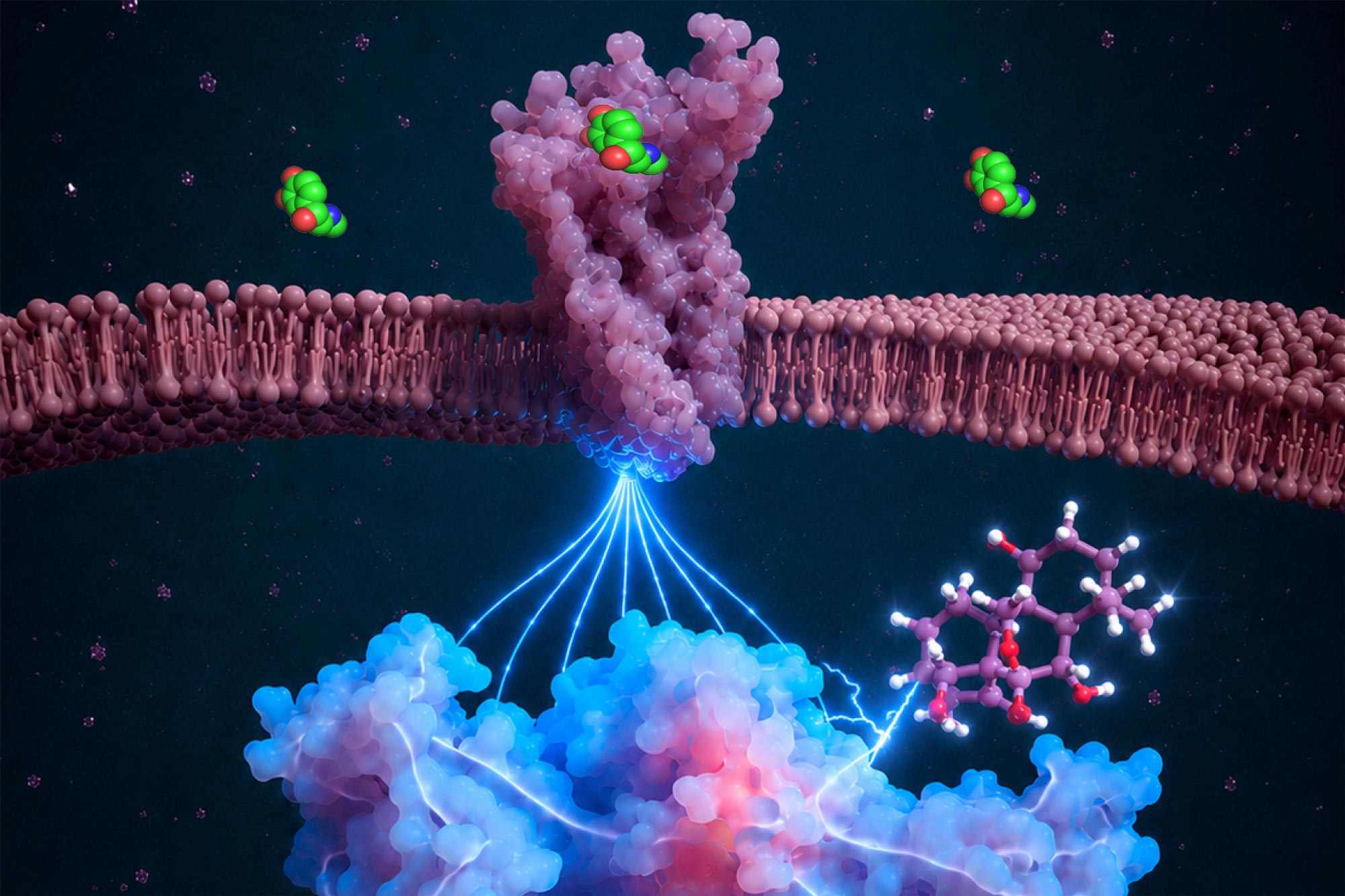
New compounds have overcome a longstanding challenge by directly targeting β-arrestins, proteins that regulate cellular signals, providing laboratory tools that could help guide more precise treatments with fewer side effects.
A drug can hit its intended target and still have its effects cut short. That’s because cells have built-in molecular brakes that dial down signals after a receptor is activated. Now, scientists have discovered a way to interfere with those brakes, keeping an important signaling pathway active longer at the same receptor targeted by the blockbuster weight-loss drugs Ozempic and Wegovy.
The breakthrough involves three new drug-like molecules that block β-arrestins, proteins that normally dampen cellular signals. In laboratory experiments, the compounds prolonged signaling without directly targeting the GLP-1 receptor, opening a potential path toward more precise medicines with fewer side effects.
Decades ago, Duke University biochemist and cardiologist Robert J. Lefkowitz, MD, and his colleagues discovered those regulatory proteins, called β-arrestins. Now, work from his laboratory, published in Nature, gives scientists their first chemical tools for directly controlling β-arrestins and investigating how they shape cellular responses.
β-Arrestins restrain some signals and trigger others
β-Arrestins help regulate G protein-coupled receptors, or GPCRs, the family that includes the GLP-1 receptor. Nearly every human cell depends on GPCRs to receive and send signals for normal function, and roughly one-third of all FDA-approved drugs target them. When these receptors become active, G proteins relay their signals within the cell. β-Arrestins can limit the response by attaching to the receptors, dampening their signaling, and drawing them inside the cell.
In the early 2000s, the Lefkowitz lab established that β-arrestins also initiate signaling pathways of their own. That discovery revealed two distinct roles for the proteins, restraining signals carried by G proteins while setting other cellular responses in motion. The new compounds let researchers interfere directly with both β-arrestin functions while preserving G protein signaling.
Blocking β-arrestins preserves G protein signaling
Finding and understanding these molecules took more than a decade of work by co-first authors Alem W. Kahsai, PhD, an assistant professor of medicine, and Natalia Pakharukova, PhD, a postdoctoral researcher. Lefkowitz said Kahsai “lived and breathed” the molecules 24 hours a day, bringing together collaborators from Duke and across the country to “describe an extraordinary amount of their biology.”
The search started with a broad, unbiased screen of the National Cancer Institute’s extensive compound library. Researchers looked for molecules that might bind β-arrestins, then used additional tests to establish which candidates physically attached to the protein and stabilized it.

To see what that binding accomplished, the team tested promising compounds in engineered human cells that allowed GPCR signaling to be monitored as it happened. Experiments then moved into physiologically relevant immune cells and heart muscle cells, allowing the researchers to assess whether the effects held beyond simplified laboratory systems.
Three compounds emerged that prevented β-arrestins from being recruited to receptors. They blocked desensitization, which reduces a receptor’s responsiveness, and internalization, which moves receptors inside the cell. The compounds also suppressed β-arrestin-specific signaling. Tests across several GPCRs showed that G protein signaling remained intact, including at the GLP-1 receptor, where it continued longer than usual even during stimulation with Ozempic and Wegovy.
“We tested these compounds from every angle we could think of before we were convinced they were bona fide β-arrestin inhibitors,” Kahsai said.
Binding to a pocket reshapes β-arrestin
Pakharukova uncovered a structural explanation using cryo-electron microscopy. She visualized a compound called Cmpd-5 nestled in a previously unknown pocket on β-arrestin. Binding there altered the protein’s overall shape, leaving it unable to fully engage with GPCRs. This mechanism is called allosteric inhibition, because a molecule binding at one site changes how the protein functions elsewhere.
“Alem could have published a creditable paper about these molecules 10 years ago,” said Lefkowitz, Duke Health Distinguished Professor of Medicine and the study’s senior author. “But he’s a perfectionist. He wanted to figure out how they actually work.”
The ability to control β-arrestins with pharmacological precision could help researchers determine how individual signaling pathways influence metabolism, immune responses, cardiovascular function, and brain signaling. Eventually, adjusting those pathways could offer a route to more precise treatments with fewer unwanted side effects.
Reference: “Small-molecule modulation of β-arrestins” by Alem W. Kahsai, Natalia Pakharukova, Henry Y. Kwon, Kunal S. Shah, Caroline T. del Real, Bowie N. Shreiber, Jason G. Liang-Lin, Paul J. Shim, Mason A. Lee, Van A. Ngo, Allison M. Schwalb, Uyen Pham, Anand Chundi, Haoran Jiang, Emmanuel Flores-Espinoza, Samuel Liu, Preston C. Nibley, Dana K. Bassford, Hyunggu Hahn, Cal A. Kunzle, Brittany N. Thomas, Jihee Kim, Yang Zhou, Jialu Wang, Xingdong Zhang, Jeffrey S. Smith, Lindsay A. M. Rein, Alex R. B. Thomsen, Sudha K. Shenoy, Sudarshan Rajagopal, Lei Shi, Seungkirl Ahn, Howard A. Rockman, Ali Masoudi and Robert J. Lefkowitz, 24 June 2026, Nature.
DOI: 10.1038/s41586-026-10683-5
Funding: Howard Hughes Medical Institute, the National Institutes of Health, the St. Jude Children’s Research Hospital Collaborative Research Consortium on GPCRs, and the Mandel Foundation.
Never miss a breakthrough: Join the SciTechDaily newsletter.
Follow us on Google and Google News.