
Close Menu
    Facebook X (Twitter) Instagram
    SciTechDaily
    • Biology
    • Chemistry
    • Earth
    • Health
    • Physics
    • Science
    • Space
    • Technology
    Facebook X (Twitter) Pinterest YouTube RSS
    SciTechDaily
    Home»Health»New Research Shows Cellular Clean-Up Can Also Sweep Away Forms of Cancer
    Health

    New Research Shows Cellular Clean-Up Can Also Sweep Away Forms of Cancer

    By Bill Hathaway, Yale UniversityNovember 10, 2017No Comments2 Mins Read
    Facebook Twitter Pinterest Telegram LinkedIn WhatsApp Email Reddit
    Share
    Facebook Twitter LinkedIn Pinterest Telegram Email Reddit
    Yale Research Shows Cellular Clean-Up Can Also Sweep Away Forms of Cancer
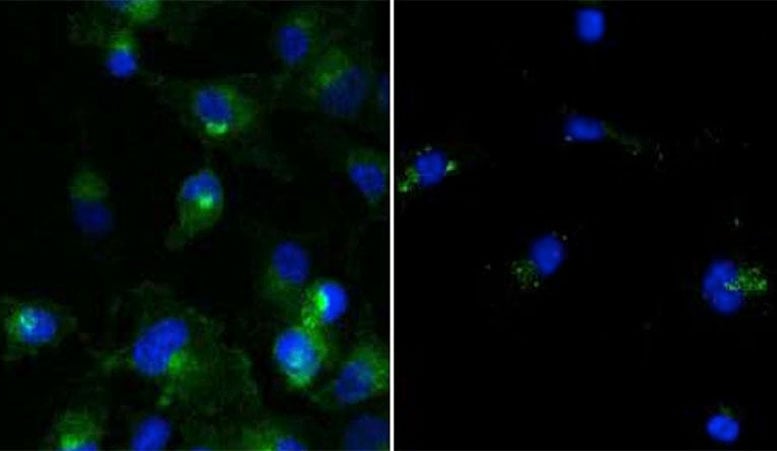
    Cells treated (right) or untreated (left) with a PROTAC that degrades the target protein (green).

    Two new research papers from Yale University reinforce the benefits of a novel therapy that hijacks the cell’s own protein degradation machinery to destroy cancer cells. The Yale researchers report the findings in the journal Cell Chemical Biology.

    The new approach to drug discovery, called Proteolysis Targeting Chimeras or PROTACs, was developed in the laboratory of Craig Crews, the Lewis B. Cullman Professor of Molecular, Cellular, and Developmental Biology, professor of chemistry and pharmacology, as well as executive director of the Yale Center for Molecular Discovery.

    The system engages the cell’s own protein degradation machinery to destroy targeted proteins by tagging them for removal. Most drugs are based on the ability of small molecules to bind to and block the function of disease-causing proteins, but some proteins are resistant to such intervention.

    “This system will help us change the current small-molecule drug paradigm that fails to target 75% of rogue proteins,” said Crews, scientific founder of Arvinas LLC, the New Haven biotechnology company developing the concept.

    The first paper shows for the first time that PROTAC system can target mutant RTK proteins, which have been linked to several forms of cancer. The second paper proves that the PROTAC system can target rogue proteins with greater specificity than traditional approaches.

    Yale’s George M. Burslem and Blake E. Smith are first authors of the first paper. Smith and Yale’s Daniel P. Bondeson are co-first authors of the second paper.

    The two papers were primarily funded by the National Institutes of Health. Crews is a shareholder of Arvinas, which also provided researchers to the projects.

    References:

    • “The Advantages of Targeted Protein Degradation Over Inhibition: An RTK Case Study” by George M. Burslem, Blake E. Smith, Ashton C. Lai, Saul Jaime-Figueroa, Daniel C. McQuaid, Daniel P. Bondeson, Momar Toure, Hanqing Dong, Yimin Qian, Jing Wang, Andrew P. Crew, John Hines and Craig M. Crews, 9 November 2017, Cell Chemical Biology.
      DOI: 10.1016/j.chembiol.2017.09.009
    • “Lessons in PROTAC Design from Selective Degradation with a Promiscuous Warhead” by Daniel P. Bondeson, Blake E. Smith, George M. Burslem, Alexandru D. Buhimschi, John Hines, Saul Jaime-Figueroa, Jing Wang, Brian D. Hamman, Alexey Ishchenko and Craig M. Crews, 9 November 2017, Cell Chemical Biology.
      DOI: 10.1016/j.chembiol.2017.09.010

    Never miss a breakthrough: Join the SciTechDaily newsletter.
    Follow us on Google and Google News.

    Cancer Cell Biology Developmental Biology Medicine Molecular Biology Pharmacology Yale University
    Share. Facebook Twitter Pinterest LinkedIn Email Reddit

    Related Articles

    Molecular Switch Serves as New Target Point for Cancer and Diabetes Therapies

    Scientists Study “Magical” Royal Jelly for Clues to Control Cancer

    Yale Study Shows Key Protein In Pancreatic Cancer Growth May Also Be Its Undoing

    PROTACs: A New Type of Drug That Can Target All Disease-Causing Proteins

    Drug-Resistant EGFR May Have “Achilles Heel”

    Vitamin A Receptor Helps Protect Lungs from Smoke Exposure and Viral Infections

    A Real-Time Blood Test for Cancer Tumors

    Yale Researchers Develop Method to Attack Cancer at Its Source

    Yale Researchers Discover New Cancer Cell Vulnerability

    Leave A Reply Cancel Reply

    • Facebook
    • Twitter
    • Pinterest
    • YouTube

    Don't Miss a Discovery

    Subscribe for the Latest in Science & Tech!

    Trending News

    New “Nanozyme Hypothesis” Could Rewrite the Story of Life’s Origins

    Anatomy Isn’t Finished: The Human Body Still Holds Secrets

    “Pretty Close to Home”: The Hidden Earthquake Threat Beneath Seattle

    The Surprising Reason You Might Want To Sleep Without a Pillow

    Scientists Say This Natural Hormone Reverses Obesity by Targeting the Brain

    35-Million-Year-Old Mystery: Strange Arachnid Discovered Preserved in Amber

    Is AI Really Just a Tool? It Could Be Altering How You See Reality

    JWST Reveals a “Forbidden” Planet With a Baffling Composition

    Follow SciTechDaily
    • Facebook
    • Twitter
    • YouTube
    • Pinterest
    • Newsletter
    • RSS
    SciTech News
    • Biology News
    • Chemistry News
    • Earth News
    • Health News
    • Physics News
    • Science News
    • Space News
    • Technology News
    Recent Posts
    • Saunas May Do More Than Raise Body Temperature – They Activate Your Immune System
    • Exercise in a Pill? Metformin Shows Surprising Effects in Cancer Patients
    • Saturn’s Magnetic Shield Isn’t What Scientists Expected
    • Hidden Oceans of Magma Could Be Protecting Alien Life
    • After Decades of Searching, Astronomers Finally Track Down the Universe’s Missing Hydrogen
    Copyright © 1998 - 2026 SciTechDaily. All Rights Reserved.
    • Science News
    • About
    • Contact
    • Editorial Board
    • Privacy Policy
    • Terms of Use

    Type above and press Enter to search. Press Esc to cancel.