
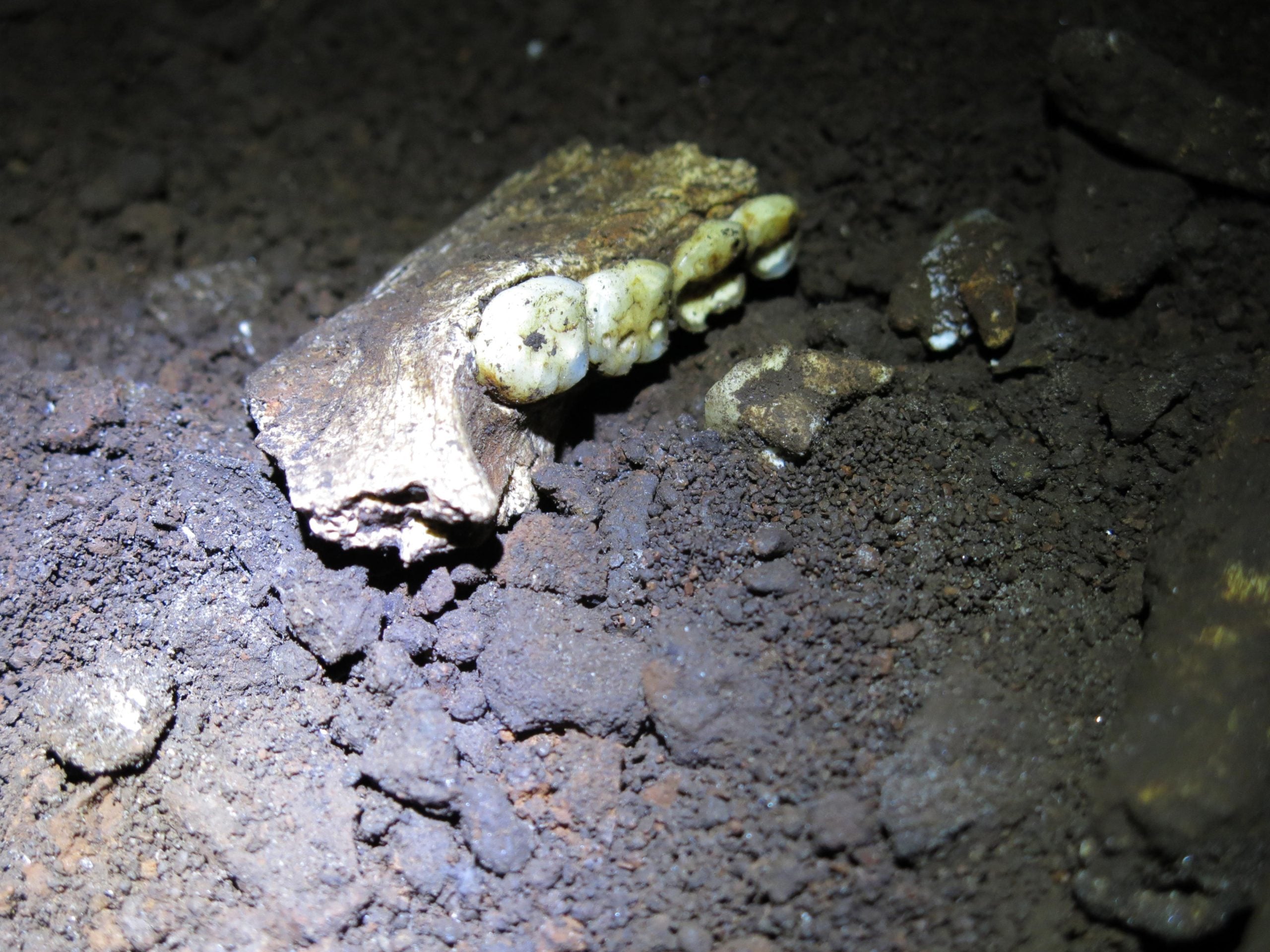
Ancient tooth proteins raise the possibility that Homo naledi, an extinct human relative, reserved a burial site for females, hinting at complex customs once thought unique to modern humans.
For more than a decade, researchers have wondered why the adult fossils in South Africa’s Dinaledi Chamber look so much alike. The remains of Homo naledi, an extinct relative of modern humans, show almost none of the physical variation expected between males and females. Ancient proteins extracted from teeth found in the chamber now suggest a possible explanation: the sampled individuals may all have been female.
The chamber lies within the Rising Star Cave system, where Homo naledi was discovered in 2013. The species lived between 335,000 and 241,000 years ago and possessed an unusual combination of primitive, ape-like traits and human-like features.
No male marker in 23 teeth
To investigate the lack of variation, researchers from the University of York, the University of Copenhagen, and more than 10 other international institutions recovered the first ancient proteins from Homo naledi fossils. Their study, published in Cell, examined the largest extinct hominin population yet studied through protein analysis.
The team used a minimally destructive acid-etching technique to extract microscopic protein fragments, called peptides, from the enamel of 23 teeth representing at least 20 individuals. They looked for Amelogenin-Y, a protein encoded by a gene on the male Y chromosome, but found no trace of the male marker.
To check that the recovered proteins were genuinely ancient rather than modern contamination, a team at the University of York’s specialized chemistry facility analyzed their amino acids, the molecular building blocks of proteins.
Palesa Madupe, who completed the work as part of her postdoctoral research at the University of Copenhagen, explained why tooth enamel can preserve evidence that other skeletal material may lose.
“Unlike those found in other remains like bone fragments, proteins in tooth enamel are preserved because dental enamel – the hardest tissue in the human body – shields proteins from environmental contamination even for millions of years.
“This makes them ideal carriers of genetic information from deep time. Our study helps in the long-standing mystery of why Homo naledi lacked significant variation; it’s probably because they could have all belonged to one sex.”
Burial customs or a genetic difference
If the Dinaledi Chamber was a burial site reserved exclusively for females, it could represent the first known example of sex-specific burial by a species other than Homo sapiens. Such a practice could imply complex, symbolic treatment of the dead previously thought unique to modern humans, raising questions about how Homo naledi organized its society.
Dr. Marc Dickinson, from the University of York’s Department of Chemistry, said, “The lack of male markers with the group is truly fascinating. It is incredibly exciting to gain a window not only into the biology of our ancestors, but also into how they lived.
“These findings offer rare insights into a culture that has, until now, been difficult to access directly. Advances in ancient protein analysis are opening the door to a far richer and more nuanced understanding of ancient hominins.”
The absence of Amelogenin-Y does not, however, establish that every sampled individual was female. The researchers also identified a possible biological explanation. If the Homo naledi population was highly isolated, the gene encoding the protein could have mutated or been deleted. Males could therefore have been present in the chamber, with teeth that lacked the usual male marker.
Reference: “Proteomic analysis of dental enamel from 20 Homo naledi individuals shows no male markers” by Palesa P. Madupe, Alberto J. Taurozzi, Claire Koenig, Ioannis Patramanis, Fazeelah Munir, Marc R. Dickinson, Meaghan Mackie, Gaudry Troché, Glendon Parker, Pelagia Kyriakidou, Patrick Mahoney, Gina McFarlane, Bernhard Zipfel, Jürgen Cox, Kirsty Penkman, Lauren Schroeder, Rebecca R. Ackermann, Jesper V. Olsen, John Hawks, Lee Berger and Enrico Cappellini, 24 June 2026, Cell.
DOI: 10.1016/j.cell.2026.05.044
Never miss a breakthrough: Join the SciTechDaily newsletter.
Follow us on Google and Google News.
3 Comments
So how about a discussion of how this affects the assertion that Homo naledi buried their dead? If there’s nothing but females in the cave that’s some strong evidence they at least ritualized death.
Or the males ate the females
This paper was published in June and I remember hearing about it at the time. Why, exceptionally, is it being publicised again?