
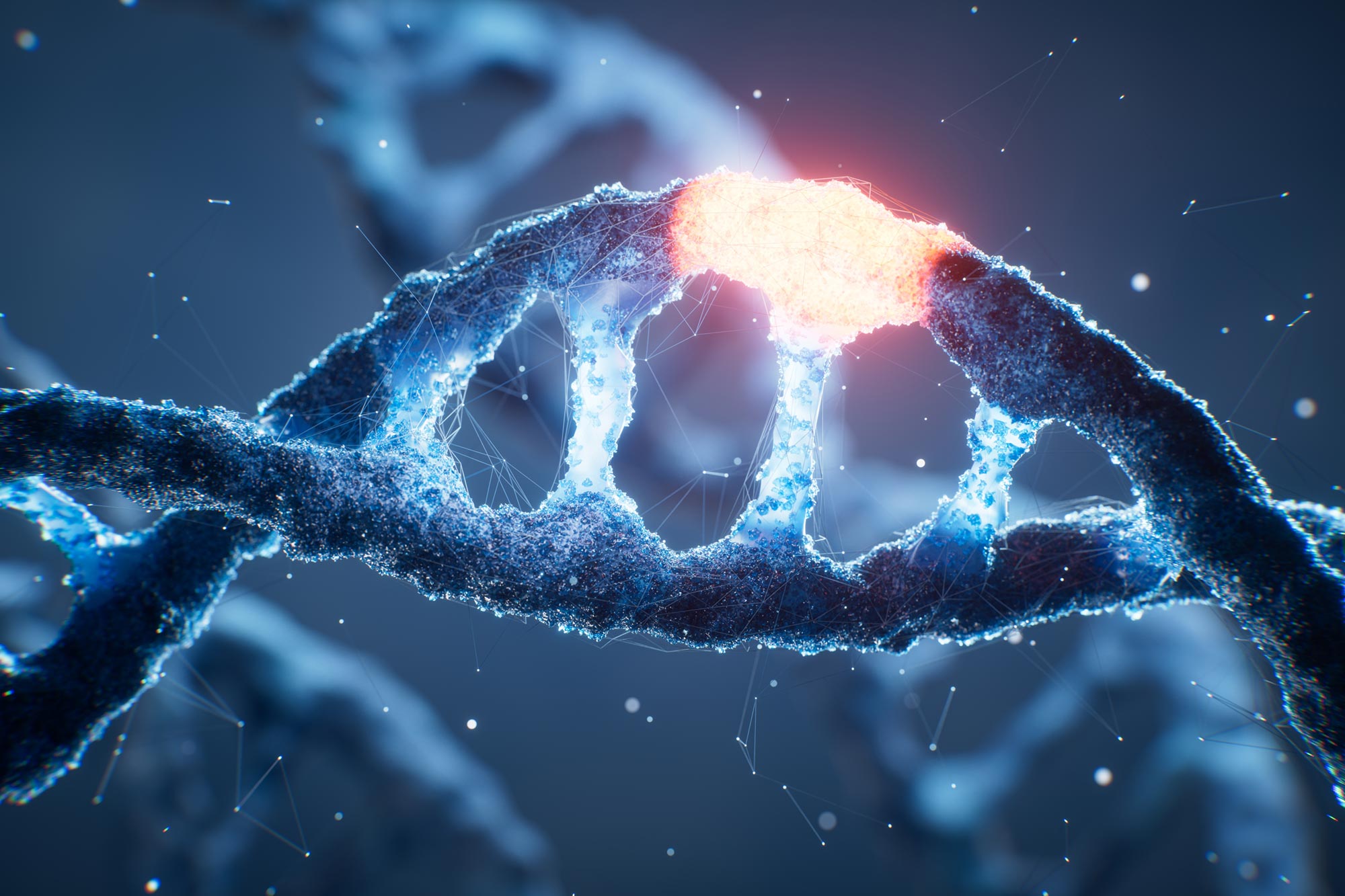
A study reveals that calorie restriction affects genetic mutations differently across tissues and regions of DNA.
Eating fewer calories may do more than slow certain aspects of aging. Scientists have found that mice consuming 30 percent less food accumulated fewer DNA mutations across several tissues, suggesting that diet can influence how genetic damage builds up over time.
The study, published in Cell, examined mutations across a large portion of the genome rather than focusing on individual genes. The results showed that calorie restriction affected different organs and regions of DNA in surprisingly different ways.
How Eating Less Affects DNA Mutations
DNA mutations develop throughout life as cells experience genetic damage or make mistakes while copying and repairing their DNA. Most mutations are harmless, but some interfere with normal gene function and can contribute to cancer and other diseases. Although animal studies have established that calorie restriction can extend lifespan and slow certain effects of aging, its broader influence on mutation accumulation has remained unclear.
To investigate, researchers led by NYU Langone Health and University Hospitals Cleveland worked with scientists at the University of Texas Southwestern Medical Center and the National Institutes of Health. Using highly accurate DNA sequencing technology, they examined genetic changes in mice fed 30 percent fewer calories than animals allowed to eat freely.
The restricted diet reduced several types of mutations, including substitutions, which occur when one DNA letter is replaced by another, and insertions and deletions, which add or remove DNA letters. However, the reductions differed across tissues, with liver cells showing a stronger response than kidney or brain cells.
“While links between diet and lifespan have been established in animals, our results show that diet and mutations across the genome are also linked,” said co-corresponding study author Gilad D. Evrony, MD, PhD, a researcher at NYU Langone Health and associate professor at NYU Grossman School of Medicine. “Mice on a calorie-restricted diet are healthier for longer, but this diet is too challenging for humans. Nevertheless, considering the role mutations play in cancer and many other diseases, it’s exciting to have found a way to decrease mutations, which we can now work to understand.”
The Unexpected Pattern Hidden Across the Genome
The researchers also discovered that calorie restriction did not affect all regions of DNA equally. In liver and kidney cells, the greatest reductions in mutations occurred in the least active portions of the genome. These regions contain either no genes or genes that are not being used by the cells.
One possible explanation involves differences in DNA repair activity. Regions containing actively used genes already undergo frequent DNA repair, which may limit how much additional protection they receive if calorie restriction reduces DNA damage. Less active regions, where repair occurs less frequently, could experience a larger reduction in accumulated mutations. The researchers have not yet established whether this mechanism explains the pattern.
“We didn’t expect to find this asymmetry across the genome,” said co-corresponding author Jonathan Shoag, MD, an associate professor in the Department of Urology at University Hospitals Cleveland and Case Western Reserve University School of Medicine. “By profiling more dietary interventions and mutations in additional tissues and cell types, we hope to learn what drives the connection between diet and mutations.”
Could Genetic Damage Be Reduced Without Extreme Dieting?
The findings establish a connection between calorie restriction and lower mutation levels in mice, but they do not demonstrate that people would experience the same benefits. Sustained, substantial calorie restriction is also difficult to maintain and can carry health risks.
Researchers now hope to identify the biological processes responsible for the reduction in mutations. Understanding those processes could help scientists investigate approaches that protect DNA without requiring people to follow severely restricted diets.
“Understanding these mechanisms could eventually reveal new ways to reduce mutations – without the challenges and risks of an extreme diet—to counter diseases of aging,” said first study author Marta Grońska-Pęski, PhD, a postdoctoral fellow in Evrony’s laboratory.
The research relied on a specially established group of mice used to study the biological effects of calorie restriction. “We were fortunate to have collaborated with Dr. Victoria Acosta-Rodríguez, Dr. Joseph Takahashi, and Dr. Carla Green, who established this mouse caloric restriction cohort,” said Dr. Evrony.
Reference: “Caloric restriction modulates genome-wide somatic mutation in mice” by Marta Grońska-Pęski, Victoria Acosta-Rodríguez, Amoolya Srinivasa, Amanda Garrido, Shany Picciotto, Carla B. Green, Joseph S. Takahashi, Jonathan E. Shoag and Gilad D. Evrony, 9 September 2026, Cell.
DOI: 10.1016/j.cell.2026.08.013
This work was supported by National Institutes of Health grants T32AG052909, F32AG076287, and UH3NS132024, the Pew Charitable Trusts, the Jacob Goldfield Foundation, the Damon Runyon Cancer Research Foundation, the Smythe Family Impact Fund, the Vail family, and the Howard Hughes Medical Institute.
Never miss a breakthrough: Join the SciTechDaily newsletter.
Follow us on Google and Google News.
1 Comment
That particular difference shouldn’t have been much of a surprise. Kidney and brain cells don’t have a replacement rate to speak of, while livers are able to grow significantly in adults. A difference between liver and skin or liver and muscle cells would have more significance. Also, the reduction in mutations was mostly in DNA that was never going to be used? Looks to me like a whole lot more research would be required to prove anything at all. On the other hand, there are very few people in N America who wouldn’t benefit from consuming fewer calories. Maybe the next few steps could be figuring out whether a 30% reduction is significantly better than a 20% reduction or a 15% reduction. Could there be an actual optimum number of calories or an optimum BMI? How much difference does it make whether the reduction is in fat, carbohydrates, or protein? Perhaps someday there can be a preformulated human diet, and everyone can eat that. Just the lack of variety might help some people lose weight! People who really want to live to be 120 could eat the longevity diet and people who like food could take a chance on being dead at 55, but really enjoying life.