
Close Menu
    Facebook X (Twitter) Instagram
    SciTechDaily
    • Biology
    • Chemistry
    • Earth
    • Health
    • Physics
    • Science
    • Space
    • Technology
    Facebook X (Twitter) Pinterest YouTube RSS
    SciTechDaily
    Home»Biology»Mass of Human Chromosomes Measured for the First Time – Mysteriously Heavier Than Expected
    Biology

    Mass of Human Chromosomes Measured for the First Time – Mysteriously Heavier Than Expected

    By University College LondonJune 10, 2021No Comments3 Mins Read
    Facebook Twitter Pinterest Telegram LinkedIn WhatsApp Email Reddit
    Share
    Facebook Twitter LinkedIn Pinterest Telegram Email Reddit
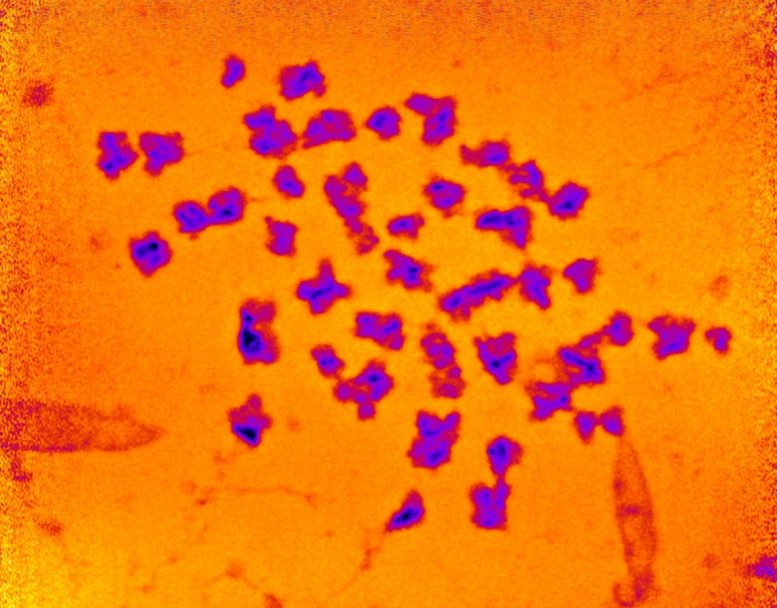
    Chromosomes Imaged
    The spread of 46 human chromosomes measured using X-rays in the study, with color added. Credit: Archana Bhartiya et al/ Chromosome Research

    The mass of human chromosomes, which contain the instructions for life in nearly every cell of our bodies, has been measured with X-rays for the first time in a new study led by University College London (UCL) researchers.

    For the study, published in Chromosome Research, researchers used a powerful X-ray beam at the UK’s national synchrotron facility, Diamond Light Source, to determine the number of electrons in a spread of 46 chromosomes which they used to calculate mass.

    They found that the chromosomes were about 20 times heavier than the DNA they contained – a much larger mass than previously expected, suggesting there might be missing components yet to be discovered.

    As well as DNA, chromosomes consist of proteins that serve a variety of functions, from reading the DNA to regulating processes of cell division to tightly packaging two-meter strands of DNA into our cells.

    A Milestone in Chromosome Measurement

    Senior author Professor Ian Robinson (London Centre for Nanotechnology at UCL) said: “Chromosomes have been investigated by scientists for 130 years but there are still parts of these complex structures that are poorly understood.

    “The mass of DNA we know from the Human Genome Project, but this is the first time we have been able to precisely measure the masses of chromosomes that include this DNA.

    “Our measurement suggests the 46 chromosomes in each of our cells weigh 242 picograms (trillionths of a gram). This is heavier than we would expect, and, if replicated, points to unexplained excess mass in chromosomes.”

    In the study, researchers used a method called X-ray ptychography, which involves stitching together the diffraction patterns that occur as the X-ray beam passes through the chromosomes, to create a highly sensitive 3D reconstruction. The fine resolution was possible as the beam deployed at Diamond Light Source was billions of times brighter than the Sun (ie, there was a very large number of photons passing through at a given time). 

    Visualizing Chromosomes in Metaphase

    The chromosomes were imaged in metaphase, just before they were about to divide into two daughter cells. This is when packaging proteins wind up the DNA into very compact, precise structures.

    Archana Bhartiya, a PhD student at the London Centre for Nanotechnology at UCL and lead author of the paper, said: “A better understanding of chromosomes may have important implications for human health.

    “A vast amount of study of chromosomes is undertaken in medical labs to diagnose cancer from patient samples. Any improvements in our abilities to image chromosomes would therefore be highly valuable.”

    Each human cell, at metaphase, normally contains 23 pairs of chromosomes, or 46 in total. Within these are four copies of 3.5 billion base pairs of DNA.

    Reference: “X-ray Ptychography Imaging of Human Chromosomes After Low-dose Irradiation” by Archana Bhartiya, Darren Batey, Silvia Cipiccia, Xiaowen Shi, Christoph Rau, Stanley Botchway, Mohammed Yusuf and Ian K. Robinson, 31 March 2021, Chromosome Research.
    DOI: 10.1007/s10577-021-09660-7

    The research was supported by Diamond Light Source, UKRI, the Biotechnology and Biological Sciences Research Council (BBSRC), the Engineering and Physical Sciences Research Council (EPSRC), the European Research Council, and the US Department of Energy.

    Never miss a breakthrough: Join the SciTechDaily newsletter.
    Follow us on Google and Google News.

    Cell Biology DNA Genetics Popular University College London
    Share. Facebook Twitter Pinterest LinkedIn Email Reddit

    Related Articles

    MIT Researchers Devised a Way To Program Memories Into Bacterial Cells by Rewriting Their DNA

    Mysteries of Epigenetics: There’s More to Genes Than DNA

    New Discovery Shows Human Cells Can Write RNA Sequences Into DNA – Challenges Central Principle in Biology

    Biologists Discover a Trigger for Cell Extrusion – Process for Eliminating Unneeded Cells

    DNA Energy Code: “Survival of the Fittest” Phenomenon Is Only Part of the Evolution Equation

    Rare Quadruple-Helix DNA Found in Living Human Cells With Glowing Probes

    Quadruple Helix DNA Formation Tracked in Live Human Cells for the First Time

    DNA May Not Be the Blueprint for Life – Just a Scrambled List of Ingredients

    Scientists Discover Genes for a Longer, Healthier Life

    Leave A Reply Cancel Reply

    • Facebook
    • Twitter
    • Pinterest
    • YouTube

    Don't Miss a Discovery

    Subscribe for the Latest in Science & Tech!

    Trending News

    The Universe Is Expanding Too Fast and Scientists Can’t Explain Why

    “Like Liquid Metal”: Scientists Create Strange Shape-Shifting Material

    Early Warning Signals of Esophageal Cancer May Be Hiding in Plain Sight

    Common Blood Pressure Drug Shows Surprising Power Against Deadly Antibiotic-Resistant Superbug

    Scientists Uncover Dangerous Connection Between Serotonin and Heart Valve Disease

    Scientists Discover a “Protector” Protein That Could Help Reverse Hair Loss

    Bone-Strengthening Discovery Could Reverse Osteoporosis

    Scientists Uncover Hidden Trigger Behind Stem Cell Aging

    Follow SciTechDaily
    • Facebook
    • Twitter
    • YouTube
    • Pinterest
    • Newsletter
    • RSS
    SciTech News
    • Biology News
    • Chemistry News
    • Earth News
    • Health News
    • Physics News
    • Science News
    • Space News
    • Technology News
    Recent Posts
    • Why Popular Diabetes Drugs Like Ozempic Don’t Work for Everyone: The “Genetic Glitch”
    • Scientists Create Improved Insulin Cells That Reverse Diabetes in Mice
    • Scientists Stunned After Finding Plant Thought Extinct for 60 Years
    • A Common Diabetes Drug May Hold the Key to Stopping HIV From Coming Back
    • Ancient “Syphilis-Like” Disease in Vietnam Challenges Key Scientific Assumptions
    Copyright © 1998 - 2026 SciTechDaily. All Rights Reserved.
    • Science News
    • About
    • Contact
    • Editorial Board
    • Privacy Policy
    • Terms of Use

    Type above and press Enter to search. Press Esc to cancel.