
Ancient DNA From an American Domesticated Horse Lends Credence to Shipwreck Folklore
An abandoned Caribbean colony discovered centuries later and a case of mistaken identity in the archaeological record have colluded to rewrite the history of a barrier island off the shores of Virginia and Maryland.
When Nicolas Delsol, a postdoctoral researcher at the Florida Museum of Natural History, set out to analyze ancient DNA recovered from cow bones discovered in archaeological sites, these seemingly unrelated threads were woven together. Delsol wanted to know how cattle were domesticated in the Americas, and he discovered the answer in the genetic information preserved in centuries-old teeth. However, they also held a surprise.
“It was a serendipitous finding,” he said. “I was sequencing mitochondrial DNA from fossil cow teeth for my Ph.D. and realized something was very different with one of the specimens when I analyzed the sequences.”

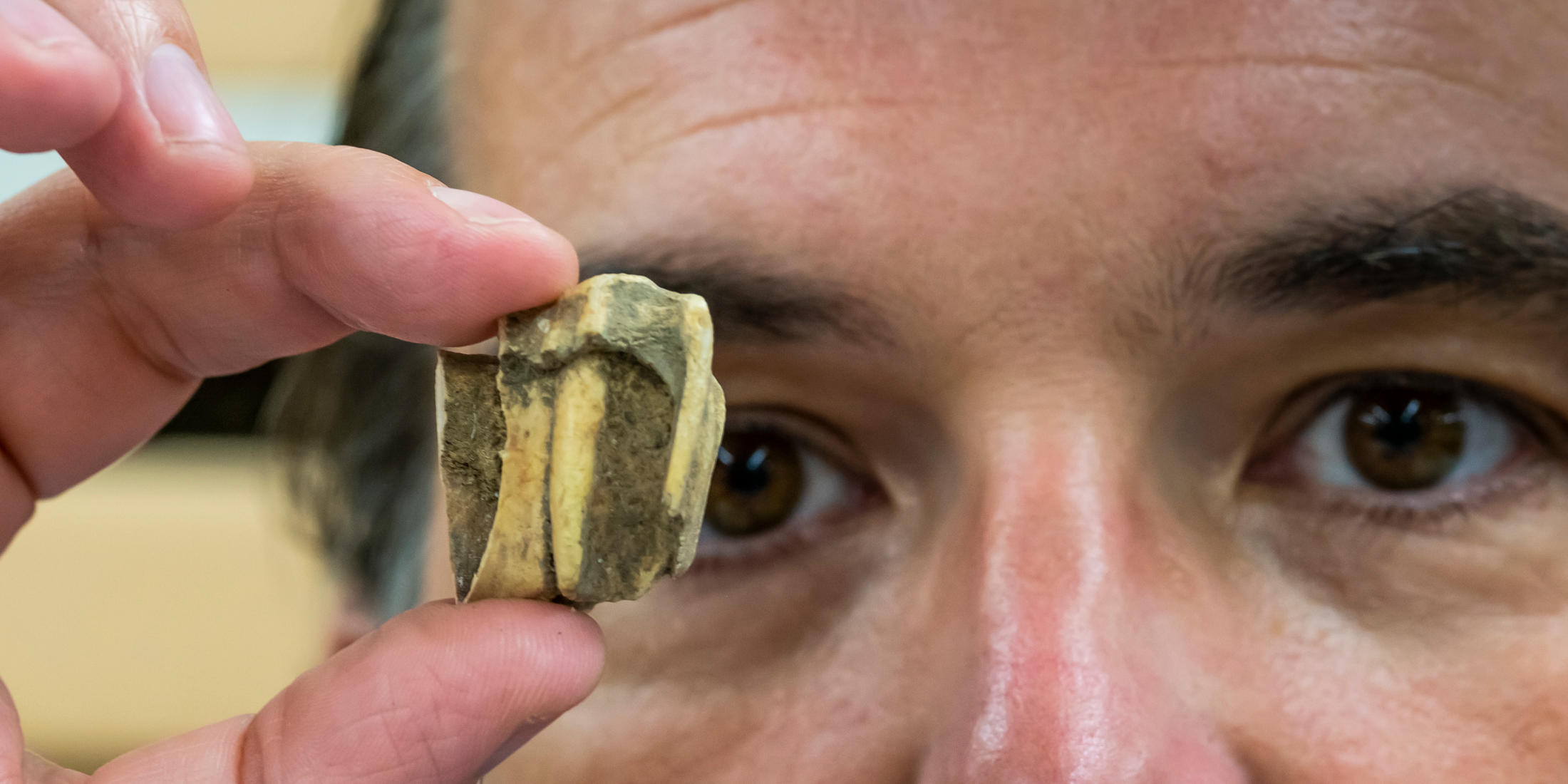
That’s because the specimen in question, a portion of an adult molar, was a horse tooth rather than a cow tooth. According to recent research published in PLOS ONE, the DNA extracted from the tooth is also the oldest ever sequenced for a domesticated horse from the Americas.
Puerto Real: A Spanish Colonial Settlement
The tooth was discovered during the excavation of one of Spain’s oldest colonized settlements. Puerto Real, located on the island of Hispaniola, was founded in 1507 and served as the final port of call for ships traveling from the Caribbean for decades. In the 16th century, however, widespread piracy and the expansion of illegal commerce drove the Spanish to concentrate their influence elsewhere on the island, and people were ordered to abandon Puerto Real in 1578. The abandoned settlement was razed by Spanish authorities the following year.
The ruins of the once-bustling harbor were unexpectedly uncovered in 1975 by a medical missionary called William Hodges. Between 1979 and 1990, archaeologists headed by Florida Museum distinguished research curator Kathleen Deagan excavated the site.

Horse fossils and related artifacts are very uncommon at Puerto Real and comparable time-period sites, whereas cow remains are plentiful. According to Delsol, this lopsided ratio is mostly attributed to the way Spanish colonialists valued their livestock.
“Horses were reserved for individuals of high status, and owning one was a sign of prestige,” he said. “There are full-page descriptions of horses in the documents that chronicle the arrival of [Hernán] Cortés in Mexico, demonstrating how important they were to the Spanish.”
In contrast, cows were used as a source of meat and leather, and their bones were regularly discarded in communal waste piles called middens. But one community’s trash is an archaeologist’s treasure, as the refuse from middens often confers the clearest glimpse into what people ate and how they lived.
DNA Analysis Links Puerto Real Horse to Assateague Island
The specimen’s biggest surprise wasn’t revealed until Delsol compared its DNA with that of modern horses from around the world. Given that the Spanish brought their horses from the Iberian Peninsula in southern Europe, he expected horses still living in that region would be the closest living relatives of the 500-year-old Puerto Real specimen.
Instead, Delsol found its next of kin over 1,000 miles (1,600 kilometers) north of Hispaniola, on the island of Assateague off the coast of Maryland and Virginia. Feral horses have roamed freely across the long stretch of barrier island for hundreds of years, but exactly how they got there has remained a mystery.
According to the National Park Service, which manages the northern half of Assateague, the likeliest explanation is that the horses were brought over in the 1600s by English colonists from the mainland in an attempt to evade livestock taxes and fencing laws. Others believe the feral herds descended from horses that survived the shipwreck of a Spanish galleon and swam to shore, a theory popularized in the 1947 children’s novel “Misty of Chincoteague.” The book was later adapted to film, helping spread the shipwreck legend to an even wider audience.
Until now, there has been little evidence to support either theory. Proponents of the shipwreck theory claim it would be unlikely that English colonists would lose track of valuable livestock, while those in favor of an English origin of the herds point to the lack of sunken vessels nearby and the omission of feral horses in historical records of the region.
The Spanish Connection to Assateague’s Horses
The results of the DNA analysis, however, unequivocally point to Spanish explorers as being the likeliest source of the horses on Assateague, Delsol explained.
“It’s not widely reported in the historical literature, but the Spanish were exploring this area of the mid-Atlantic pretty early on in the 16th century. The early colonial literature is often patchy and not completely thorough. Just because they don’t mention the horses doesn’t mean they weren’t there.”
The feral herds on Assateague weren’t the only horses to revert back to their wild heritage after arriving in the Americas. Colonists from all over Europe brought with them horses of various breeds and pedigrees, some of which bucked their bonds and escaped into the surrounding countryside.
Today, the U.S. Bureau of Land Management estimates there are roughly 86,000 wild horses across the country, most of which are located in western states, such as Nevada and Utah. Delsol hopes that future ancient DNA studies will help decode the complex history of equine introductions and migrations that occurred over the last several centuries and offer a clearer understanding of today’s diversity of wild and domesticated horses.
Reference: “Analysis of the earliest complete mtDNA genome of a Caribbean colonial horse (Equus caballus) from 16th-century Haiti” by Nicolas Delsol, Brian J. Stucky, Jessica A. Oswald, Elizabeth J. Reitz, Kitty F. Emery and Robert Guralnick, 27 July 2022, PLOS ONE.
DOI: 10.1371/journal.pone.0270600
The study was funded by the National Science Foundation.
Never miss a breakthrough: Join the SciTechDaily newsletter.
Follow us on Google and Google News.
13 Comments
… now we get surprised or what! … one can say that sarcasm is not sign of intelligence, but there are moments when it is more than appropriate…
Very interesting article. But why are they calling it ancient DNA when the specimen seems to be from the 1500’s? Ancient would have to be before the CE, imo.
There is a heard of wild horses on the coastal plains of the outer banks of North Carolina.
You know, I find it very very interesting the conclusions reached about how those horses got to that island and the only possible way was either because the Spaniards or British brought them over. But the Africans had been traveling to the Americas for thousands of years before anyone in Europe ever had the concept of the existence of the Americas. The Europeans thought the world was flat and the African explorer’s knew otherwise.The first navigator’s trans Atlantic and otherwise we’re African. They were the first ship builders not Vikings or any other European. The Europeans had no concept of such navigational aspirations as traveling to the Americas especially during the time when the African was coming to what was deemed the New World to the Europeans but was just “old hat” to the African explorers!! That is a fact! There are significant proof of the African explorers existence in the Americas a very long time before any European stumbled upon a place that they at first never had an inkling that it existed. The sheer arrogance of such notions as that the only way it could’ve possibly happened was if someone from Europe brought them here. Interesting indeed!!
Would that make them ancestors of the Ocracoke Island ,NC and the Corolla NC herds?
horses native to america hunted to extinction by early ( red) indians reintroduced mostly by spanish
Adding to the idea of earlier travel than Europeans is the American cocaine plant material found in an African ancient mummy. Also Book of Mormon reference to horses in the America’s between 500bc and 400ad. Also evidence of human habitation of far southern south America at the same time ancients were starting to migrate over the land bridge from Asia. We’re just scratching the surface of what went on thousands of years ago and honoring the facts spoken by experts who in fact are guessing. Grant money does not go to those who say…I don’t know…I think maybe…
There are wild horses on Payne’s Prairenear Gainesville, FL that were brought here by Spainards.
We just visited Chincoteague in July and saw the ponies. They’re beautiful
Before land masses shifted horses existed on the russian steppes and were herded and used, so came from there too. Just like the caribou. Reindeer. Open the mind let the truth shine.
What about the horses on Cumberland Island in Georgia USA?
Mr. Merritt, interesting information. Any references you can offer regarding North or Sub- Saharan Africans sailing to the Americas?
Just to make a point, the Book fo Mormon ref by Bruce is not a historical text. Even the church has admitted such at this point, but swept it under the rug. The BOM also referenced many other animals and chariots and with that there is no archeological evidence for in South America. Plus, DNA evidence has already proven the ancestors of the Native American peoples (North and South) were from Asia via a land bridge between Asia and Alaska, not via ships from Jeruslalem. Maybe the BOM has some nice stories, but it is not historical fact.
I would like to know also if there was