
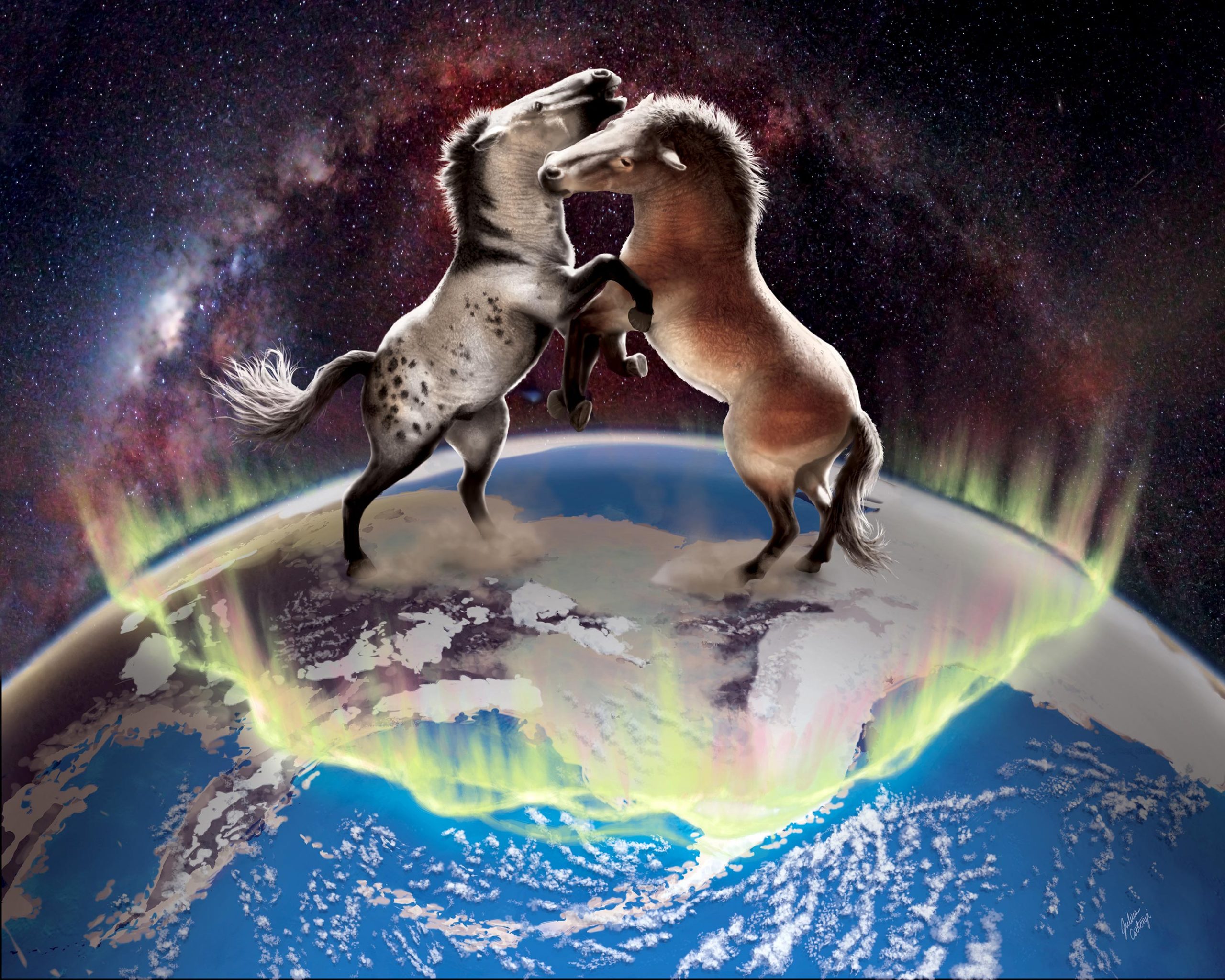
New findings show connections between the ancient horse populations in North America, where horses evolved, and Eurasia, where they were domesticated.
A new study of ancient DNA from horse fossils found in North America and Eurasia shows that horse populations on the two continents remained connected through the Bering Land Bridge, moving back and forth and interbreeding multiple times over hundreds of thousands of years.
The new findings demonstrate the genetic continuity between the horses that died out in North America at the end of the last ice age and the horses that were eventually domesticated in Eurasia and later reintroduced to North America by Europeans. The study has been accepted for publication in the journal Molecular Ecology and is currently available online.
“The results of this paper show that DNA flowed readily between Asia and North America during the ice ages, maintaining physical and evolutionary connectivity between horse populations across the Northern Hemisphere,” said corresponding author Beth Shapiro, professor of ecology and evolutionary biology at UC Santa Cruz and a Howard Hughes Medical Institute investigator.
Bering Land Bridge: A Vital Corridor
The study highlights the importance of the Bering Land Bridge as an ecological corridor for the movement of large animals between the continents during the Pleistocene, when massive ice sheets formed during glacial periods. Dramatically lower sea levels uncovered a vast land area known as Beringia, extending from the Lena River in Russia to the MacKenzie River in Canada, with extensive grasslands supporting populations of horses, mammoths, bison, and other Pleistocene fauna.
Paleontologists have long known that horses evolved and diversified in North America. One lineage of horses, known as the caballine horses (which includes domestic horses) dispersed into Eurasia over the Bering Land Bridge about 1 million years ago, and the Eurasian population then began to diverge genetically from the horses that remained in North America.
Two Major Periods of Genetic Exchange Identified
The new study shows that after the split, there were at least two periods when horses moved back and forth between the continents and interbred, so that the genomes of North American horses acquired segments of Eurasian DNA and vice versa.
“This is the first comprehensive look at the genetics of ancient horse populations across both continents,” said first author Alisa Vershinina, a postdoctoral scholar working in Shapiro’s Paleogenomics Laboratory at UC Santa Cruz. “With data from mitochondrial and nuclear genomes, we were able to see that horses were not only dispersing between the continents, but they were also interbreeding and exchanging genes.”
Mitochondrial DNA, inherited only from the mother, is useful for studying evolutionary relationships because it accumulates mutations at a steady rate. It is also easier to recover from fossils because it is a small genome and there are many copies in every cell. The nuclear genome carried by the chromosomes, however, is a much richer source of evolutionary information.
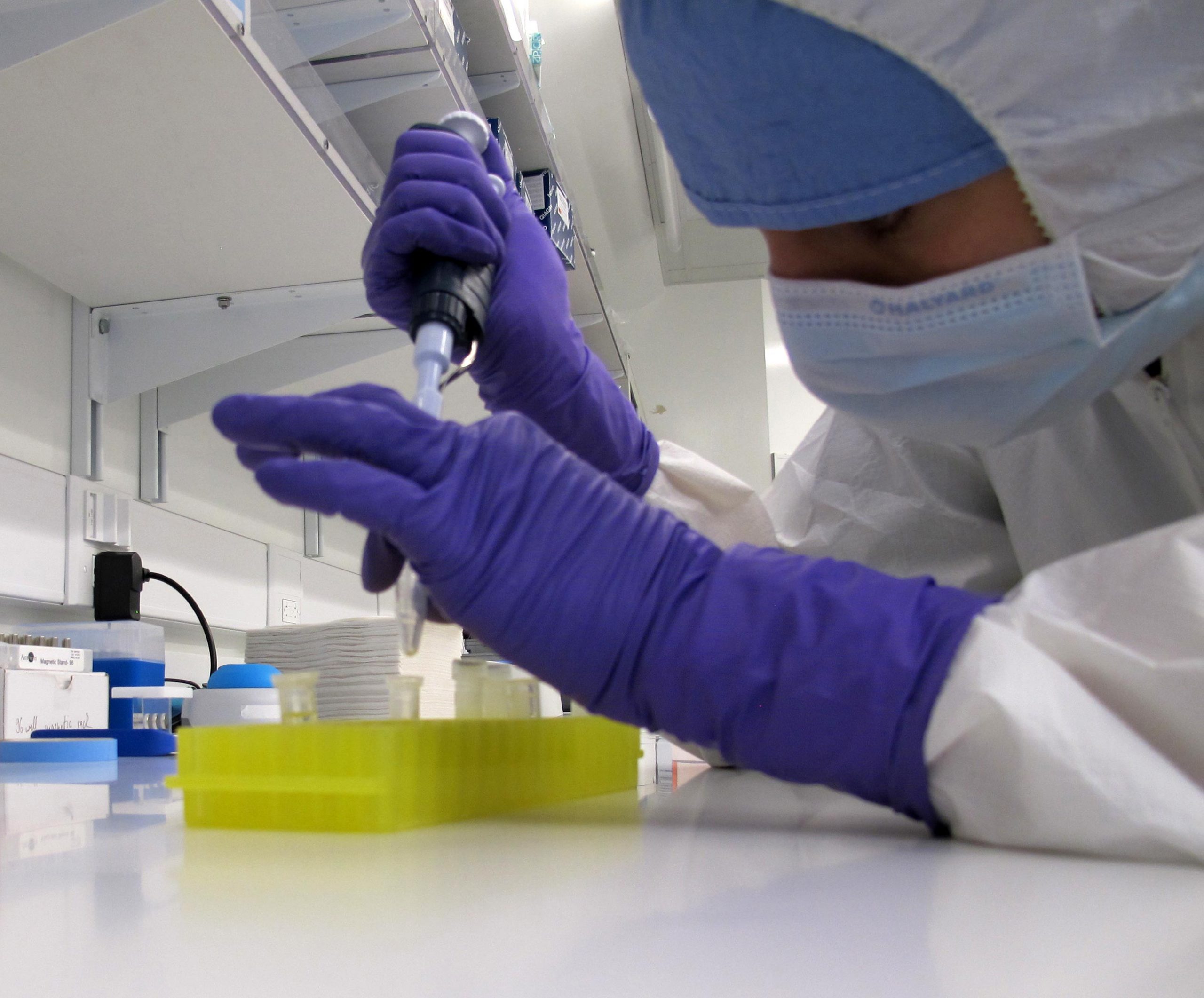
The researchers sequenced 78 new mitochondrial genomes from ancient horses found across Eurasia and North America. Combining those with 112 previously published mitochondrial genomes, the researchers reconstructed a phylogenetic tree, a branching diagram showing how all the samples were related. With a location and an approximate date for each genome, they could track the movements of different lineages of ancient horses.
“We found Eurasian horse lineages here in North America and vice versa, suggesting cross-continental population movements. With dated mitochondrial genomes we can see when that shift in location happened,” Vershinina explained.
Dispersal Events Mirror Ice Age Climate Changes
The analysis showed two periods of dispersal between the continents, both coinciding with periods when the Bering Land Bridge would have been open. In the Middle Pleistocene, shortly after the two lineages diverged, the movement was mostly east to west. A second period in the Late Pleistocene saw movement in both directions, but mostly west to east. Due to limited sampling in some periods, the data may fail to capture other dispersal events, the researchers said.
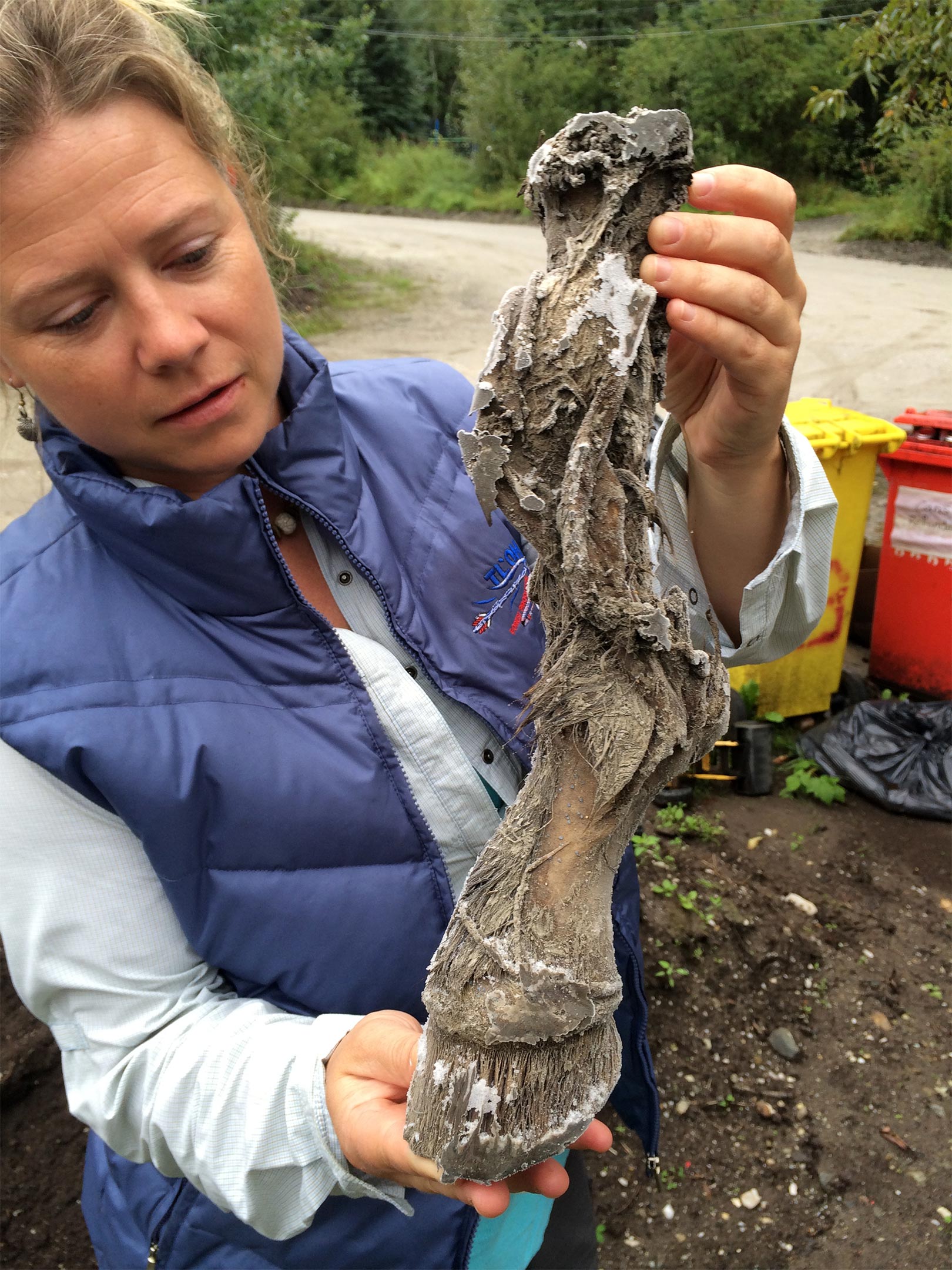
The team also sequenced two new nuclear genomes from well-preserved horse fossils recovered in Yukon Territory, Canada. These were combined with 7 previously published nuclear genomes, enabling the researchers to quantify the amount of gene flow between the Eurasian and North American populations.
A Shift in Evolutionary Thinking
“The usual view in the past was that horses differentiated into separate species as soon as they were in Asia, but these results show there was continuity between the populations,” said coauthor Ross MacPhee, a paleontologist at the American Museum of Natural History. “They were able to interbreed freely, and we see the results of that in the genomes of fossils from either side of the divide.”
The new findings are sure to fuel the ongoing controversy over the management of wild horses in the United States, descendants of domestic horses brought over by Europeans. Many people regard those wild horses as an invasive species, while others consider them to be part of the native fauna of North America.
“Horses persisted in North America for a long time, and they occupied an ecological niche here,” Vershinina said. “They died out about 11,000 years ago, but that’s not much time in evolutionary terms. Present-day wild North American horses could be considered reintroduced, rather than invasive.”
Coauthor Grant Zazula, a paleontologist with the Government of Yukon, said the new findings help reframe the question of why horses disappeared from North America. “It was a regional population loss rather than an extinction,” he said. “We still don’t know why, but it tells us that conditions in North America were dramatically different at the end of the last ice age. If horses hadn’t crossed over to Asia, we would have lost them all globally.”
Reference: “Ancient horse genomes reveal the timing and extent of dispersals across the Bering Land Bridge” by Alisa O. Vershinina, Peter D. Heintzman, Duane G. Froese, Grant Zazula, Molly Cassatt-Johnstone, Love Dalén, Clio Der Sarkissian, Shelby G. Dunn, Luca Ermini, Cristina Gamba, Pamela Groves, Joshua D. Kapp, Daniel H. Mann, Andaine Seguin-Orlando, John Southon, Mathias Stiller, Matthew J. Wooller, Gennady Baryshnikov, Dmitry Gimranov, Eric Scott, Elizabeth Hall, Susan Hewitson, Irina Kirillova, Pavel Kosintsev, Fedor Shidlovsky, Hao-Wen Tong, Mikhail P. Tiunov, Sergey Vartanyan, Ludovic Orlando, Russell Corbett-Detig, Ross D. MacPhee and Beth Shapiro, 10 May 2021, Molecular Ecology.
DOI: 10.1111/mec.15977
This project was a large international collaborative effort involving researchers at multiple institutions working together to obtain DNA from fossils of ancient horses over a wide range of sites in Eurasia and North America. The coauthors include researchers from the University of Toulouse, France, the Arctic University of Norway, and other institutions in the United States, Canada, Sweden, Denmark, Germany, Russia, and China. This work was supported in part by the U.S. National Science Foundation, Gordon & Betty Moore Foundation, and the American Wild Horse Campaign.
Never miss a breakthrough: Join the SciTechDaily newsletter.
Follow us on Google and Google News.
1 Comment
Simply an exciting research and quite a revealing article. But it also tengentially proves that horses, in general, had better senses in themselves than did the dinosaurs for they had the intution to migrate to Asia rather than to stay put relatively and get themselves extincted by an asteroid disaster !