
CSL researchers have created a laser-based method to trace stray light in space telescopes, allowing pinpoint fixes and better image quality.
A team of researchers at the Centre Spatial de Liège (CSL) of the University of Liège has just developed a method to identify the contributors and origins of stray light on space telescopes. This is a major advance in the field of space engineering that will help in the acquisition of even finer space images and the development of increasingly efficient space instruments. This study has just been published in the journal Scientific Reports.
Space telescopes are becoming more and more powerful. Technological developments in recent years have made it possible, for example, to observe objects further and further into the universe or to measure the composition of the Earth’s atmosphere with ever greater precision. However, there is still one factor limiting the performance of these telescopes: stray light. A phenomenon that has been known for a long time, stray light results in light reflections (ghost reflections between lenses, scattering, etc.) that damage the quality of images and often lead to blurred images. Until now, the methods for checking and characterizing this stray light during the development phase of the telescopes have been very limited, making it possible to “just” know whether or not the instrument was sensitive to the phenomenon, forcing engineers to revise all their calculations in positive cases, leading to considerable delays in the commissioning of these advanced tools.
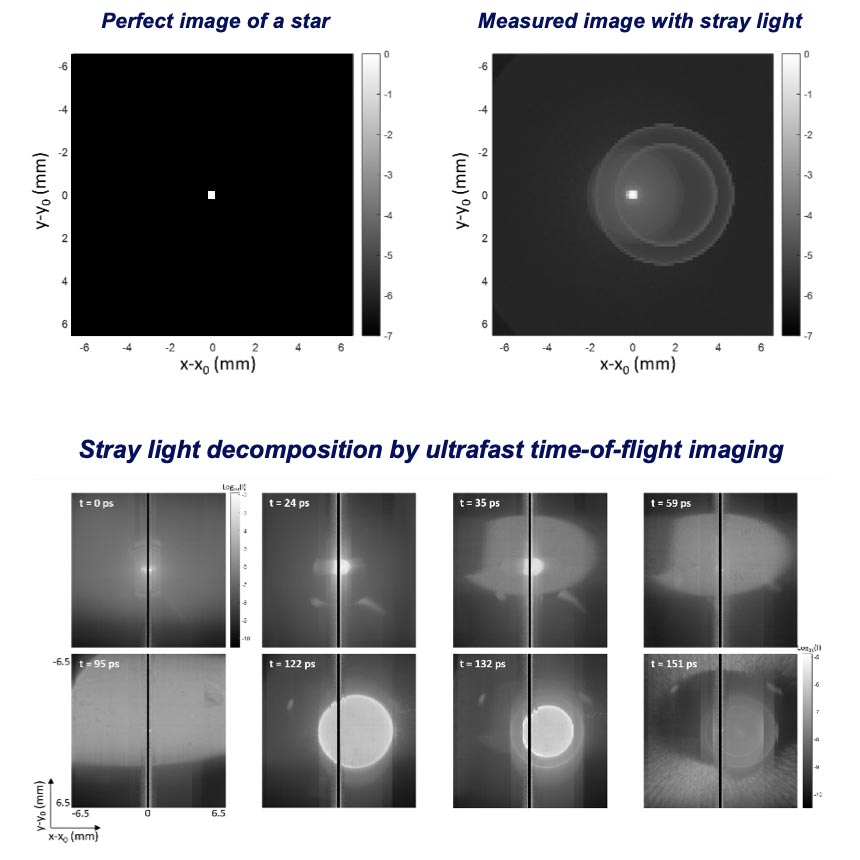
As time passes, different stray light contributors (ghosts) appear and disappear on the detector. The time of arrival is related to the optical path length, we can identify each contributor and compare them with the theoretical model. Credit: Lionel Clermont / Centre Spatial de Liège / Université de Liège
Laser and Ultrafast Detection Revolutionize Stray Light Analysis
Researchers at the Centre Spatial de Liège (CSL), in collaboration with the University of Strasbourg, have just developed a revolutionary method for solving this problem by using a femto-second pulsed laser to send light beams to illuminate the telescope. “Stray light rays take (in the telescope) different optical paths from the rays that form the image,” explains Lionel Clermont, an expert in space optical systems and stray light at CSL. Thanks to this, and using an ultra-fast detector (of the order of 10-9 seconds of resolution, i.e. a thousandth of a millionth of a second), we are measuring the image and the different stray light effects at different times. In addition to this decomposition, we can identify each of the contributors using their arrival times, which are directly related to the optical path, and thus know the origin of the problem.”
The CSL engineers have now demonstrated the effectiveness of this method in a paper, just published in the journal Scientific Reports, in which they present the first film showing ghost reflections in a refractive telescope arriving at different times. “We have also been able to use these measurements to reverse engineer theoretical models,” says Lionel Clermont, “which will make it possible, for example, to build better image processing models in the future.”
Precision Modeling and Practical Improvements
By correlating these measurements with numerical models, the scientists will now be able to determine precisely the origin of the stray light and thus act accordingly to improve the system, both by improving the hardware and with the development of correction algorithms.
More than just a scientific curiosity, this method developed at the CSL could well lead to a small revolution in the field of high-performance space instruments. “We have already received a great deal of interest from the ESA (European Space Agency) and from industrialists in the space sector,” says Marc Georges, an expert in metrology and lasers at CSL and co-author of the study. This method responds to an urgent problem that has been unresolved until now.”
In the near future, CSL researchers intend to continue the development of this method, to increase its TRL (Technology Readiness Level) and bring it to an industrial level. An industrial application is already planned for the FLEX (Fluorescence Explorer) project, an earth observation telescope that is part of ESA’s Living Planet Program. The researchers hope to be able to apply it to scientific instruments as well.
Reference: “Stray light characterization with ultrafast time-of-flight imaging” by L. Clermont, W. Uhring and M. Georges, 12 May 2021, Scientific Reports.
DOI: 10.1038/s41598-021-89324-y
Never miss a breakthrough: Join the SciTechDaily newsletter.
Follow us on Google and Google News.