

Close Menu
    Facebook X (Twitter) Instagram
    SciTechDaily
    • Biology
    • Chemistry
    • Earth
    • Health
    • Physics
    • Science
    • Space
    • Technology
    Facebook X (Twitter) Pinterest YouTube RSS
    SciTechDaily
    Home»Science»Ancient Deep-Sea Dwellers: 104 Million-Year-Old Fossils Unveil Ocean’s Past
    Science

    Ancient Deep-Sea Dwellers: 104 Million-Year-Old Fossils Unveil Ocean’s Past

    By University of GöttingenSeptember 8, 20232 Comments4 Mins Read
    Facebook Twitter Pinterest Telegram LinkedIn WhatsApp Email Reddit
    Share
    Facebook Twitter LinkedIn Pinterest Telegram Email Reddit
    Deep Ocean Underwater
    Scientists have found fossil evidence that higher invertebrates, specifically irregular echinoids or sea urchins, have stably colonized the deep sea for at least 104 million years since the Cretaceous period. Analyzing over 40,000 spine fragments from sediment samples, the team discovered evolutionary changes over time, notably after major extinction events, and suggested potential impacts of future global warming on deep-sea ecosystems.

    A team led by Göttingen University described the early occurrence of irregular sea urchins in the depths of the oceans.

    Deep within the ocean’s abyss, it’s believed that the earliest and most rudimentary life forms on our planet took shape ages ago. Nowadays, the deep sea is known for its bizarre fauna. Researchers are delving into how the species diversity on the ocean floor has evolved over time.

    There are hypotheses suggesting that the deep-sea ecosystems have been reborn repeatedly following numerous mass extinctions and marine disturbances. Hence, the current marine life in these depths might be relatively recent in Earth’s timeline. However, growing evidence hints that segments of this underwater realm might be older than once assumed.

    A research team led by the University of Göttingen has now provided the first fossil evidence for a stable colonization of the deep sea floor by higher invertebrates for at least 104 million years. Fossil spines of irregular echinoids (sea urchins) indicate their long-standing existence since the Cretaceous period, as well as their evolution under the influence of fluctuating environmental conditions. The results have been published in the journal PLOS ONE.
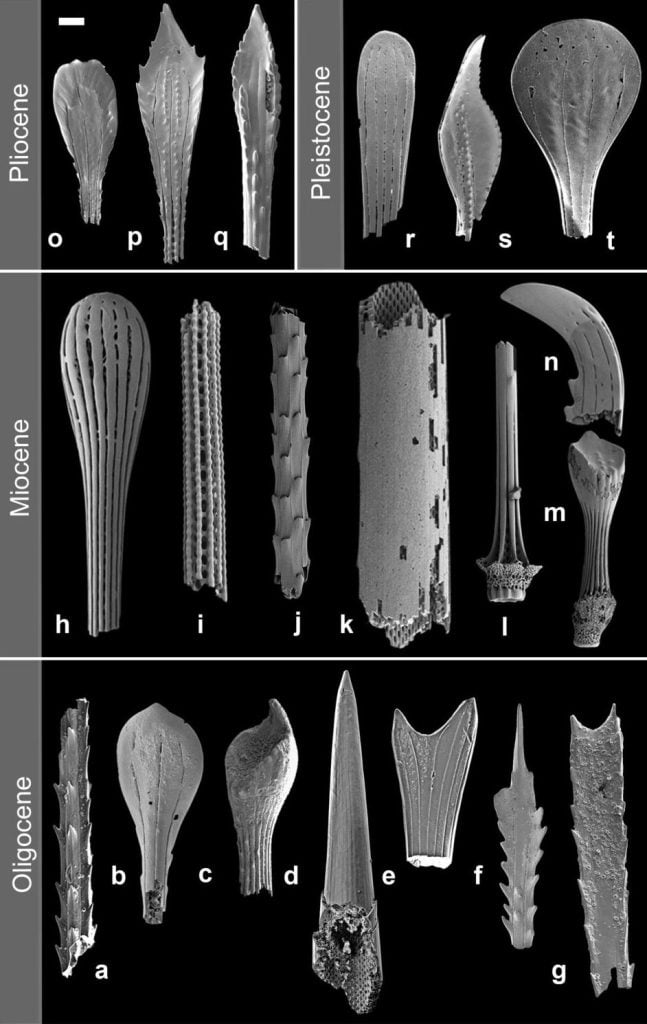
    A Range of Sea Urchin Spines From Different Periods of the Earth’s History Illustrating the Diversity of Shapes
    A range of sea urchin spines from different periods of the Earth’s history illustrating the diversity of shapes. Credit: PLOS ONE, 2023 Wiese et al.

    The researchers examined over 1,400 sediment samples from boreholes in the Pacific, Atlantic, and Southern Ocean representing former water depths of 200 to 4,700 meters (660 to 15,400 feet). They found more than 40,000 fragments of spines, which they assigned to a group called irregular echinoids, based on their structure and shape.

    For comparison, the scientists recorded morphological characteristics of the spines, such as shape and length, and determined the thickness of around 170 spines from each of the two time periods. As an indicator of the total mass of the sea urchins in the habitat – their biomass – they determined the amount of spiny material in the sediments.

    Impact of Mass Extinctions on Deep-Sea Life

    What these fossil spines document is that the deep sea has been continuously populated by irregular echinoids since at least the early Cretaceous period about 104 million years ago. And they provide further exciting insights into the past: the devastating meteorite impact at the end of the Cretaceous period about 66 million years ago, which resulted in a worldwide mass extinction – with the dinosaurs as the most prominent victims – also caused considerable disturbances in the deep sea.

    This is shown by the morphological changes in the spines: they were thinner and less diverse in shape after the event than before. The researchers interpret this as the “Lilliput Effect”. This means that smaller species have a survival advantage after a mass extinction, leading to the smaller body size of a species. The cause could have been the lack of food at the bottom of the deep sea.

    “We interpret the changes in the spines as an indication of the constant evolution and emergence of new species in the deep sea,” explains Dr Frank Wiese from the Department of Geobiology at the University of Göttingen, the lead author of the study. He emphasizes another finding: “About 70 million years ago, the biomass of sea urchins increased. We know that the water cooled down at the same time. This relationship between biomass in the deep sea and water temperature allows us to speculate how the deep sea will change due to human-induced global warming.”

    Reference: “A 104-Ma record of deep-sea Atelostomata (Holasterioda, Spatangoida, irregular echinoids) – a story of persistence, food availability and a big bang” by Frank Wiese, Nils Schlüter, Jessica Zirkel, Jens O. Herrle and Oliver Friedrich, 9 August 2023, PLOS ONE.
    DOI: 10.1371/journal.pone.0288046

    In addition to the University of Göttingen, the Universities of Heidelberg and Frankfurt as well as the Museum für Naturkunde Berlin were involved in the research project.

    Never miss a breakthrough: Join the SciTechDaily newsletter.
    Follow us on Google and Google News.

    Evolution Extinction Fossils Invertebrates University of Göttingen
    Share. Facebook Twitter Pinterest LinkedIn Email Reddit

    Related Articles

    Scientists Discover Ancient Bees Built Nests Inside Animal Bones

    Fossils Inside Fossils: The Bizarre Discovery Hidden in a Caribbean Cave

    Textbooks Were Wrong: 249-Million-Year-Old Fossil Discovery Upends Timeline of Evolution

    10,000-Year-Old Cave Fossils Reveal Secrets of Mysterious Lost Caribbean Monkeys

    Brawn Before Brains: Mammals Bulked Up To Survive Post-Dinosaur World

    Scientists Discover A New Species of Hominin

    Ancient DNA Reveals the First Detailed Genetic History of Modern Europe

    400,000 Year Old Fossil Helps Shed New Light on Human Evolution

    28-Foot Ichthyosaur Discovered

    2 Comments

    1. Kolitha on September 12, 2023 1:08 am

      Site is Wonderful

      Reply
    2. Amanda on September 12, 2023 8:45 am

      Can you tell me how an ape turned into a human?

      Reply
    Leave A Reply Cancel Reply

    • Facebook
    • Twitter
    • Pinterest
    • YouTube

    Don't Miss a Discovery

    Subscribe for the Latest in Science & Tech!

    Trending News

    Just a Few Breathless Minutes a Day Could Slash Your Risk of 8 Major Diseases

    This Simple Habit Could Cut Your Risk of Dementia by 30%

    Scientists Debunk Rattlesnake Myth That Fooled Hikers and Doctors for Decades

    Scientists Discover Plants Can “Count” – and May Be Smarter Than We Thought

    New Research Reveals Ancient Mars May Have Been Warm, Wet – and Possibly Alive

    This Surprising Daily Habit Could Cut Dementia Risk by 35%

    Just 10 Minutes a Day: Scientists Say This Ancient Chinese Practice Shows Powerful Blood Pressure Benefits

    Scientists Say This Popular Food Could Help Your Body Get Rid of Microplastics

    Follow SciTechDaily
    • Facebook
    • Twitter
    • YouTube
    • Pinterest
    • Newsletter
    • RSS
    SciTech News
    • Biology News
    • Chemistry News
    • Earth News
    • Health News
    • Physics News
    • Science News
    • Space News
    • Technology News
    Recent Posts
    • Scientists Discover Hidden “Footprint of Death” That Could Transform How We Fight Disease
    • Blood-Sucking Parasites Could Revolutionize Treatment for Autoimmune Diseases
    • Scientists Uncover Massive Climate Secret Beneath Sweden’s Forests
    • Scientists Unlock 3 Million Years of Climate Secrets Hidden in Antarctic Ice
    • “We Were Truly Astonished”: New Discovery Rewrites Earth’s Origin Story
    Copyright © 1998 - 2026 SciTechDaily. All Rights Reserved.
    • Science News
    • About
    • Contact
    • Editorial Board
    • Privacy Policy
    • Terms of Use

    Type above and press Enter to search. Press Esc to cancel.