
Close Menu
    Facebook X (Twitter) Instagram
    SciTechDaily
    • Biology
    • Chemistry
    • Earth
    • Health
    • Physics
    • Science
    • Space
    • Technology
    Facebook X (Twitter) Pinterest YouTube RSS
    SciTechDaily
    Home»Space»Epic Mars Selfie: NASA’s Perseverance Rover With the Ingenuity Helicopter
    Space

    Epic Mars Selfie: NASA’s Perseverance Rover With the Ingenuity Helicopter

    By Jet Propulsion LaboratoryApril 7, 20216 Comments4 Mins Read
    Facebook Twitter Pinterest Telegram LinkedIn WhatsApp Email Reddit
    Share
    Facebook Twitter LinkedIn Pinterest Telegram Email Reddit
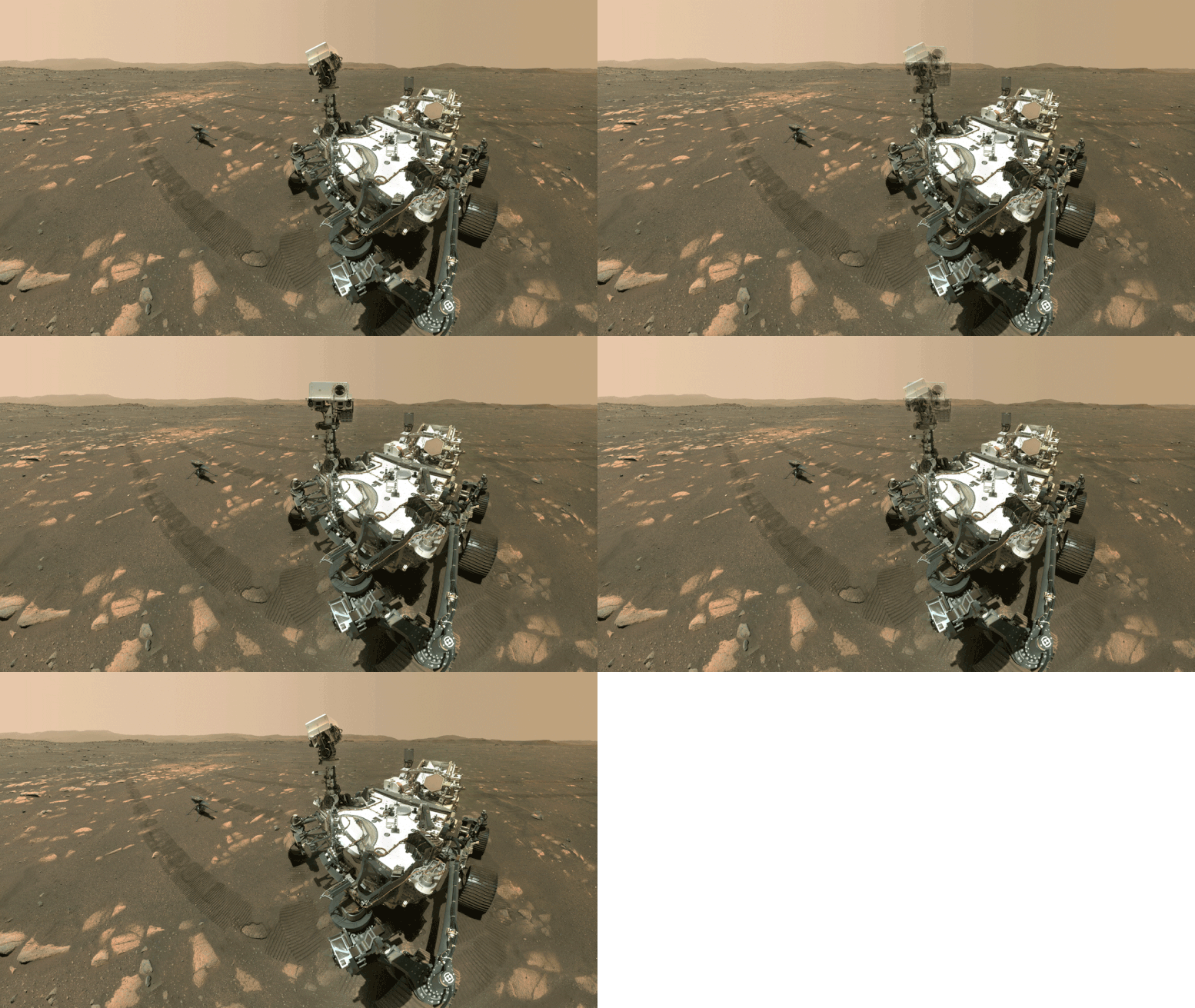
    Perseverance's Selfie With Ingenuity
    NASA’s Perseverance Mars rover took a selfie with the Ingenuity helicopter, seen here about 13 feet (3.9 meters) from the rover. This image was taken by the WASTON camera on the rover’s robotic arm on April 6, 2021, the 46th Martian day, or sol, of the mission. Credit: NASA/JPL-Caltech/MSSS

    NASA’s newest Mars rover used a camera on the end of its robotic arm to snap this shot of itself with the Ingenuity helicopter nearby.

    NASA’s Perseverance Mars rover took a selfie with the Ingenuity helicopter, seen here about 13 feet (4 meters) away in this image from April 6, 2021, the 46th Martian day, or sol, of the mission. Perseverance captured the image using a camera called WATSON (Wide Angle Topographic Sensor for Operations and eNgineering), part of the SHERLOC (Scanning Habitable Environments with Raman and Luminescence for Organics and Chemicals) instrument, located at the end of the rover’s robotic arm.

    Perseverance’s selfie with Ingenuity was stitched together from 62 individual images taken while the rover was looking at the helicopter, then again while it was looking at the WATSON camera. Videos explaining how NASA’s Perseverance and Curiosity rovers take their selfies can be found here.
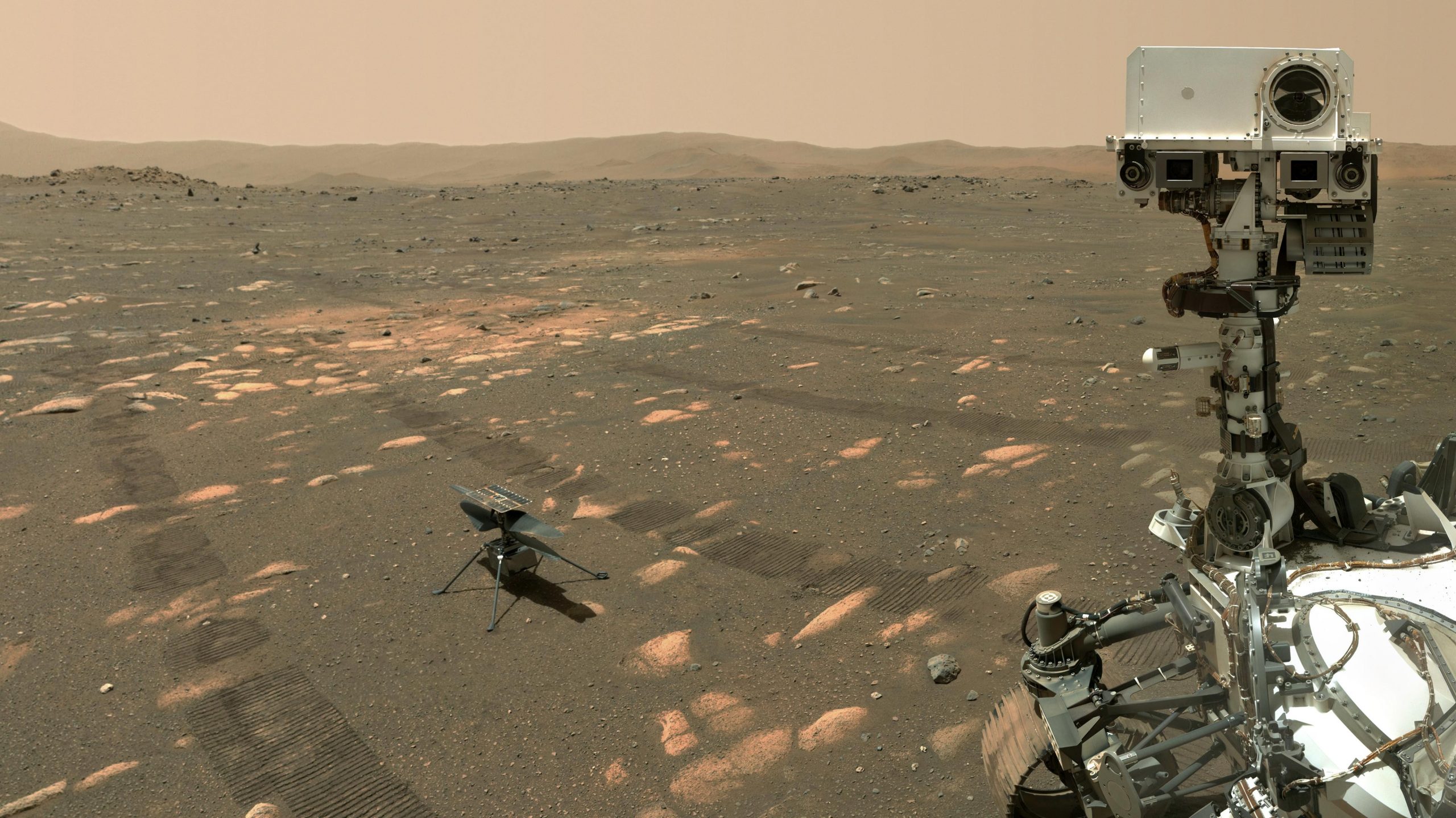
    Perseverance With Ingenuity on Mars Close Up
    NASA Perseverance Mars rover’s selfie with the Ingenuity helicopter on Mars, close up. Credit: NASA/JPL-Caltech/MSSS

    Once the team is ready to attempt the first flight, Perseverance will receive and relay to Ingenuity the final flight instructions from JPL mission controllers. Several factors will determine the precise time for the flight, including modeling of local wind patterns informed by measurements taken by the MEDA (Mars Environmental Dynamics Analyzer) instrument aboard Perseverance. Ingenuity will run its rotors to 2,537 rpm and, if all final self-checks look good, lift off. After climbing at a rate of about 3 feet per second (1 meter per second), the helicopter will hover at 10 feet (3 meters) above the surface for up to 30 seconds. Then, Ingenuity will descend and touch back down on the Martian surface.

    Perseverance Looking at Ingenuity on Mars
    NASA’s Perseverance Mars rover looking at the Ingenuity helicopter on Mars. Credit: NASA/JPL-Caltech/MSSS

    Several hours after the first flight has occurred, Perseverance will downlink Ingenuity’s first set of engineering data and, possibly, images and video from the rover’s Navigation Cameras and Mastcam-Z, a pair of zoomable cameras. From the data downlinked that first evening after the flight, the Ingenuity team expects to be able to determine if its first attempt to fly at Mars was a success. Flight test results will be discussed by the Ingenuity team in a media conference that same day.

    NASA’s Jet Propulsion Laboratory built and manages operations of Perseverance and Ingenuity for the agency. Caltech in Pasadena, California, manages JPL for NASA. WATSON was built by Malin Space Science Systems (MSSS) in San Diego, and is operated jointly by MSSS and JPL.

    Perseverance Looking at WATSON Camera on Mars
    NASA’s Perseverance Mars rover looking at the WATSON Camera on Mars. Credit: NASA/JPL-Caltech/MSSS

    The Mars helicopter technology demonstration activity is supported by NASA’s Science Mission Directorate, Aeronautics Research Mission Directorate, and Space Technology Mission Directorate.

    A key objective for Perseverance’s mission on Mars is astrobiology, including the search for signs of ancient microbial life. The rover will characterize the planet’s geology and past climate, pave the way for human exploration of the Red Planet, and be the first mission to collect and cache Martian rock and regolith (broken rock and dust).

    Subsequent NASA missions, in cooperation with ESA (European Space Agency), would send spacecraft to Mars to collect these sealed samples from the surface and return them to Earth for in-depth analysis.

    The Mars 2020 Perseverance mission is part of NASA’s Moon to Mars exploration approach, which includes Artemis missions to the Moon that will help prepare for human exploration of the Red Planet.

    Never miss a breakthrough: Join the SciTechDaily newsletter.
    Follow us on Google and Google News.

    Ingenuity Mars Helicopter JPL Mars Mars 2020 Perseverance Rover NASA Popular
    Share. Facebook Twitter Pinterest LinkedIn Email Reddit

    Related Articles

    NASA’s Perseverance Mars Rover Spots Ingenuity Helicopter at Its Final Resting Place

    NASA’s Ingenuity Mars Helicopter Concludes Mission After 3 Epic Years

    Sun’s Curtain Call: Mars Missions Go Rogue During Solar Conjunction

    NASA’s Ingenuity Mars Helicopter Flies Again After Premature Landing

    Communications Blackout Over: NASA’s Ingenuity Mars Helicopter Finally Phones Home

    Ingenuity Soars: NASA’s Mars Helicopter Aces 50th Flight – “We Are Not in Martian Kansas Anymore”

    NASA’s Ingenuity Mars Helicopter in Contact With Perseverance Rover After Communications Dropout

    NASA’s Ingenuity Mars Helicopter Scouts Ridgeline for Perseverance Science Team

    NASA Ingenuity Helicopter Spots Spacecraft Wreckage on Mars – Perseverance’s Cone-Shaped Backshell

    6 Comments

    1. PAUL ZUTAUTAS on April 8, 2021 12:33 am

      in the selfie of the rover and ingenuity, why is there no shadow of the arm holding the camera?

      Reply
    2. William Gaston on April 8, 2021 8:13 am

      This is beyond, only in ones dreams until now.
      Thanks NASA/JPL TEAM GREAT JOB.

      Reply
    3. Michael on April 8, 2021 10:30 am

      How did it take a selfie?

      Reply
    4. Nick on April 8, 2021 10:48 am

      @PAUL ZUTAUTAS – it’s because the sun is on the other side, look at the shadow under ingenuity, you can see that the shadow for the camera arm would be out of the view of the selfie.

      Reply
    5. Alan on April 12, 2021 1:34 pm

      @Nick, actually the arm IS casting a shadow. Look just to the left of the arm and you can clearly see it’s shadow. And at the end of the shadow you see a larger box looking shadow. That is the camera!

      Reply
    6. ROC on April 14, 2021 10:44 am

      The only way I could see this as being a selfy is if it took a 360 picture that showed all of the area surrounding it. There is no arm extending out beyond the rim of the photo.

      Reply
    Leave A Reply Cancel Reply

    • Facebook
    • Twitter
    • Pinterest
    • YouTube

    Don't Miss a Discovery

    Subscribe for the Latest in Science & Tech!

    Trending News

    Breakthrough Bowel Cancer Trial Leaves Patients Cancer-Free for Nearly 3 Years

    Natural Compound Shows Powerful Potential Against Rheumatoid Arthritis

    100,000-Year-Old Neanderthal Fossils in Poland Reveal Unexpected Genetic Connections

    Simple “Gut Reset” May Prevent Weight Gain After Ozempic or Wegovy

    2.8 Days to Disaster: Scientists Warn Low Earth Orbit Could Suddenly Collapse

    Common Food Compound Shows Surprising Power Against Superbugs

    5 Simple Ways To Remember More and Forget Less

    The Atomic Gap That Could Cost the Semiconductor Industry Billions

    Follow SciTechDaily
    • Facebook
    • Twitter
    • YouTube
    • Pinterest
    • Newsletter
    • RSS
    SciTech News
    • Biology News
    • Chemistry News
    • Earth News
    • Health News
    • Physics News
    • Science News
    • Space News
    • Technology News
    Recent Posts
    • Scientists Discover Stem Cells That Could Regrow Teeth and Bone
    • Scientists Discover Natural Molecule That Stops Alzheimer’s Protein Clumps From Forming
    • Early Cannabis Use May Stall Key Brain Skills in Teens
    • Popular Vitamin D Supplement Has “Previously Unknown” Negative Effect, Study Finds
    • Powerful Antioxidant Found To Play a Key Role in Proper Protein Folding
    Copyright © 1998 - 2026 SciTechDaily. All Rights Reserved.
    • Science News
    • About
    • Contact
    • Editorial Board
    • Privacy Policy
    • Terms of Use

    Type above and press Enter to search. Press Esc to cancel.