
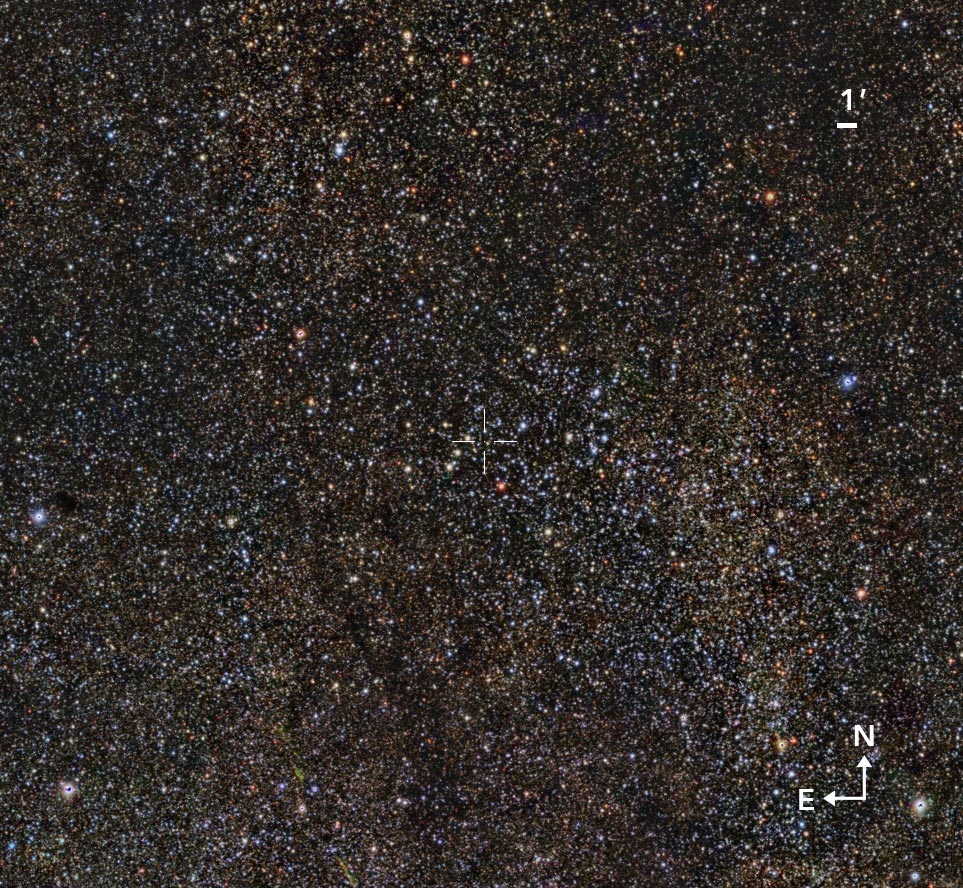
Astronomers have discovered Valparaíso 1, a massive cluster of over 15,000 stars, located 7,000 light-years away in the Scutum constellation. This intermediate-age cluster had gone unnoticed due to being hidden in a dense star field, but ESA’s Gaia satellite and follow-up observations revealed its nature.
An international team of astrophysicists led by the Stellar Astrophysics Group of the University of Alicante (UA), the Instituto de Astrofísica de Canarias (IAC), and the University of Valparaíso (Chile) has discovered a massive cluster of stars of intermediate age in the direction of the Scutum constellation. This object, which has been named Valparaíso 1, lies some seven thousand light years away from the Sun, and contains at least fifteen thousand stars. To detect it, observations have been combined from ESA’s Gaia satellite, and various ground-based telescopes, including the Isaac Newton Telescope at the Roque de los Muchachos Observatory (Garafía, La Palma, Canary Islands). The result has been published in Monthly Notices of the Royal Astronomical Society (MNRAS).
Open clusters are groups of stars that were born together, and move together, bound by gravity. This makes them natural laboratories for studying the physics and the lives of stars. The more stars there are in a cluster, the more useful it is, because the larger sample gives a better chance to find stars in less frequent evolutionary phases.

This is why astronomers are searching for the most massive clusters in our Galaxy, those with over ten thousand stars. Until twenty years ago it was thought that these are formed only in distant galaxies with exotic properties, but thanks to these searches now we know a dozen very young massive clusters (less than 25 million years old), and a few very old ones (thousands of millions of years old), which are descendants of former young clusters. But there are hardly any massive clusters known with intermediate ages, and it was not clear whether these do not exist, or whether they had not yet been found.
The newly discovered cluster, which they have called Valparaíso 1, is at some seven thousand light-years from the sun, and contains at least fifteen thousand stars. Its unexpected discovery, in a well-explored part of the sky, suggests that many other massive clusters might be hidden in the very dense star fields, which observers find when looking towards the center of our Galaxy.
“Valparaíso 1 contains dozens of stars sufficiently bright to be observable through an amateur telescope, but they are lost in the middle of a crowd of stars which don’t belong to the cluster, but which are in front of it or behind it, and which disguise the structure of the cluster,” explains Ignacio Negueruela, a researcher at the University of Alicante and the first author of the article.
“Previous searches tried to locate open clusters, but Valparaíso 1 does not look like a cluster similar to those which we usually find, and that is why it was not discovered before,” says Ricardo Dorda, an IAC researcher who is a co-author of the article.
The cluster was detectable thanks to the Gaia satellite of the European Space Agency (ESA), a space telescope that gives extremely accurate positions and distances of stars quite far away, and with this information we can measure the tiny motions across the sky shown by the stars over the years. Combining all of the information, we can detect clusters as groups of stars, which are at the same distance from us, and move together, groups of stars easier to detect using physics than just by looking at them on the sky. When the researchers had located this cluster, they used telescopes at the Las Campanas Observatory (in Chile) and the Isaac Newton Telescope (INT) at the Roque de los Muchachos Observatory (Garafía, La Palma, Canary Islands) to derive the physical properties of its stars.
Reference: “A massive open cluster hiding in full sight” by I Negueruela, A-N Chené, H M Tabernero, R Dorda, J Borissova and A Marco, R Kurtev, 24 April 2021, Monthly Notices of the Royal Astronomical Society.
DOI: 10.1093/mnras/stab1117
Never miss a breakthrough: Join the SciTechDaily newsletter.
Follow us on Google and Google News.