
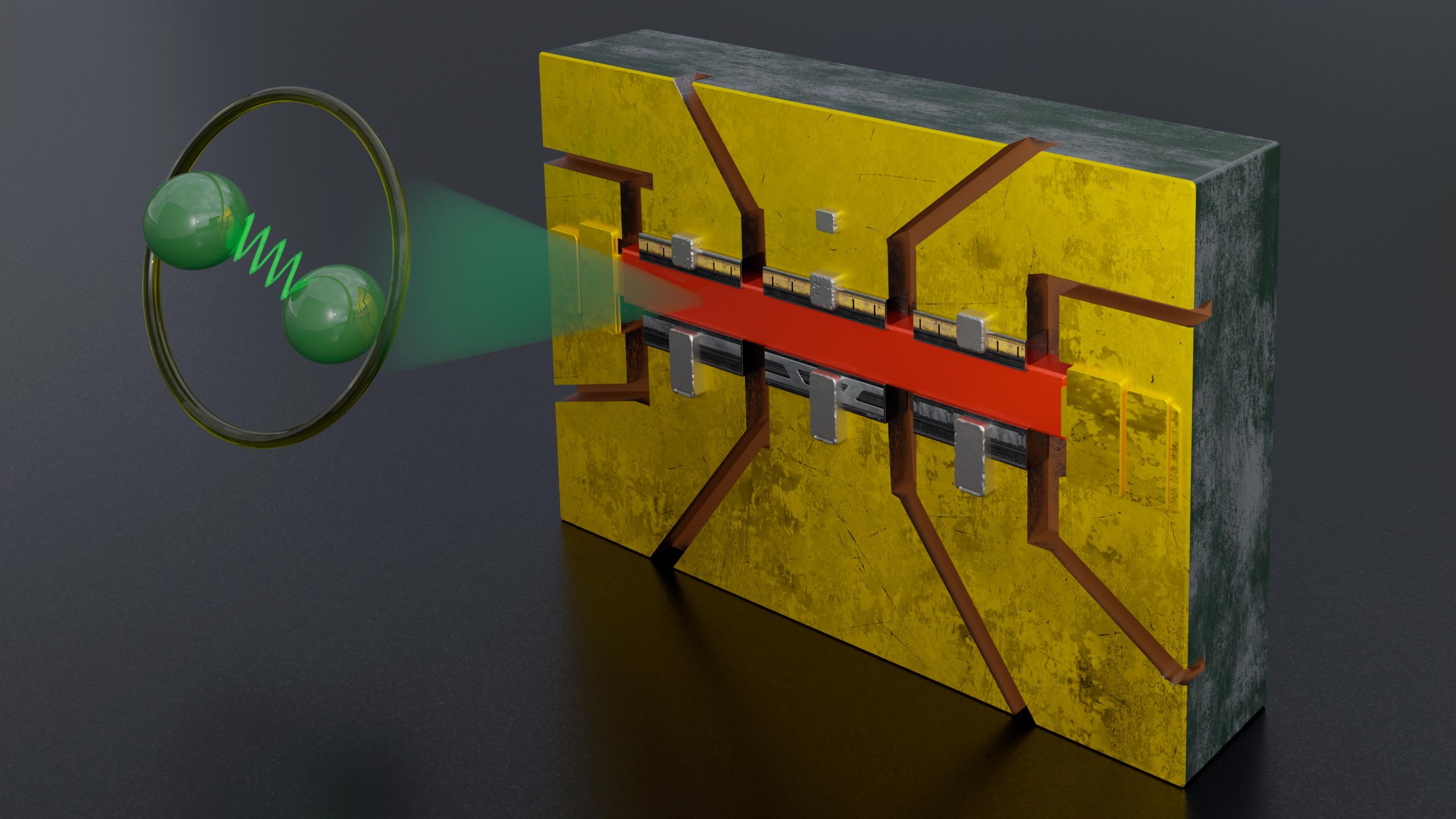
UTe2, an unconventional superconductor studied by international researchers, exhibits unique superconductivity under high magnetic fields, offering new technological potential.
At low enough temperatures, certain metals lose their electrical resistance and they conduct electricity without loss. This effect of superconductivity has been known for more than a hundred years and is well understood for so-called conventional superconductors. More recent, however, are unconventional superconductors, for which it is unclear yet how they work.
A team from the Helmholtz-Zentrum Dresden-Rossendorf (HZDR), together with colleagues from the French research institution CEA (Commissariat à l’énergie atomique et aux énergies alternatives), from Tohoku University in Japan, and the Max Planck Institute for Chemical Physics of Solids in Dresden, has now gained new insights. The researchers report their recent findings in the journal Nature Communications. They could explain why a new material remains superconducting even at extremely high magnetic fields – a property that is missing in conventional superconductors, with the potential to enable previously inconceivable technological applications.
Tracking Unconventional Superconductivity
“Uranium ditelluride, or UTe2 for short, is a high-flyer among superconducting materials,” says Dr. Toni Helm from the Dresden High Magnetic Field Laboratory (HLD) at HZDR. “As discovered in 2019, the compound conducts electricity without loss, however, in a different way than conventional superconductors do.”
Since then, research groups around the world have become interested in the material. This includes Helm’s team, which has come a step closer to understanding the material.
“To fully appreciate the hype surrounding the material, we need to take a closer look at superconductivity,” explains the physicist. “This phenomenon results from the movement of electrons in the material. Whenever they collide with atoms, they lose energy in form of heat. This manifests itself as electrical resistance. Electrons can avoid this by arranging themselves in pair formations, so-called Cooper pairs.”
This is when two electrons combine at low temperatures to move through a solid without friction. They then make use of the atomic vibrations around them as a kind of wave on which they can surf without losing energy. These atomic vibrations explain conventional superconductivity.
“For some years now, however, superconductors have also been known in which Cooper pairs are formed by effects that are not yet fully understood,” says the physicist. One possible form of unconventional superconductivity is spin-triplet superconductivity. It is believed to make use of magnetic fluctuations.
“There are also metals in which the conduction electrons come together collectively,” explains Helm. “Together, they can shield the magnetism of the material, behaving as a single particle with – for electrons – an extremely high mass.”
Such superconducting materials are known as heavy-fermion superconductors. UTe2, therefore, could be both a spin-triplet and a heavy-fermion superconductor, as current experiments suggest. On top of all, it is the heavyweight world champion: To date, no other heavy-fermion superconductor is known that is still superconducting at similar or higher magnetic fields. This too was confirmed by the present study.
Extremely Robust Against Magnetic Fields
Superconductivity depends on two factors: the critical transition temperature and the critical magnetic field. If the temperature falls below the critical transition temperature, the resistance drops to zero and the material becomes superconducting. External magnetic fields also influence superconductivity. If these exceed a critical value, the effect collapses.
“Physicists have a rule of thumb for this,” reports Helm: “In many conventional superconductors, the value of the transition temperature in kelvin is roughly one to two times the value of the critical magnetic-field strength in tesla. In spin-triplet superconductors, this ratio is often much higher.”
With their studies on the heavyweight UTe2, the researchers have now been able to raise the bar even higher: At a transition temperature of 1.6 kelvin (-271.55°C), the critical magnetic-field strength reaches 73 tesla, setting the ratio at 45 – a record.
“Until now, heavy-fermion superconductors were of little interest for technical applications,” explains the physicist. “They have a very low transition temperature and the effort required to cool them is comparatively high.”
Nevertheless, their insensitivity to external magnetic fields could compensate for this shortcoming. This is because lossless current transport is mainly used today in superconducting magnets, for example in magnetic-resonance-imaging (MRI) scanners. However, the magnetic fields also influence the superconductor itself. A material that can withstand very high magnetic fields and still conducts electricity without loss would represent a major step forward.
Special Treatment for a Demanding Material
“Of course, UTe2 cannot be used to make leads for a superconducting electromagnet,” says Helm. “Firstly, the material’s properties make it unsuitable for this endeavor, and secondly, it is radioactive. But it is perfectly suited for the exploration of the physics behind spin-triplet superconductivity.”
Based on their experiments, the researchers developed a model that could serve as an explanation for superconductivity with extremely high stability against magnetic fields. To do this, they worked on samples with thicknesses of a few micrometers – only a fraction of the thickness of a human hair (approximately 70 micrometers). The radioactive radiation emitted by the samples, therefore, remains much lower than that of the natural background.
In order to obtain and shape such a tiny sample, Helm used a high-precision ion beam with a diameter of just a few nanometers as a cutting tool. UTe2 is an air-sensitive material. Consequently, Helm carries out the sample preparation in vacuum and seals them in epoxide glue afterwards.
“For the final proof that our material is a spin-triplet superconductor, we would have to examine it spectroscopically while it is exposed to strong magnetic fields. However, current spectroscopy methods still struggle at magnetic fields above 40 tesla. Alongside other teams, we are also working on developing novel techniques. Eventually, this will enable us to provide definitive proof,” says Helm confidently.
Reference: “Field-induced compensation of magnetic exchange as the possible origin of reentrant superconductivity in UTe2” by Toni Helm, Motoi Kimata, Kenta Sudo, Atsuhiko Miyata, Julia Stirnat, Tobias Förster, Jacob Hornung, Markus König, Ilya Sheikin, Alexandre Pourret, Gerard Lapertot, Dai Aoki, Georg Knebel, Joachim Wosnitza and Jean-Pascal Brison, 2 January 2024, Nature Communications.
DOI: 10.1038/s41467-023-44183-1
Never miss a breakthrough: Join the SciTechDaily newsletter.
Follow us on Google and Google News.
2 Comments
Whenever electrons collide with atoms, they lose energy in form of heat.
Electrons is one of the important forms of topological vortex interactions and connections.
Understanding the ways in which topological vortices interact and connect is beneficial for integrating electronic functionalities. According to topological vortex gravitational field theory, the heat is not only influenced by the direction of spin, but also by the angle of spin.
The interaction of topological vortices gives humanity infinite possibilities. If you are interested, you can browse https://zhuanlan.zhihu.com/p/390071860 and https://zhuanlan.zhihu.com/p/463666584.
Another potential use for ‘depleted uranium’ instead of making bullets.