
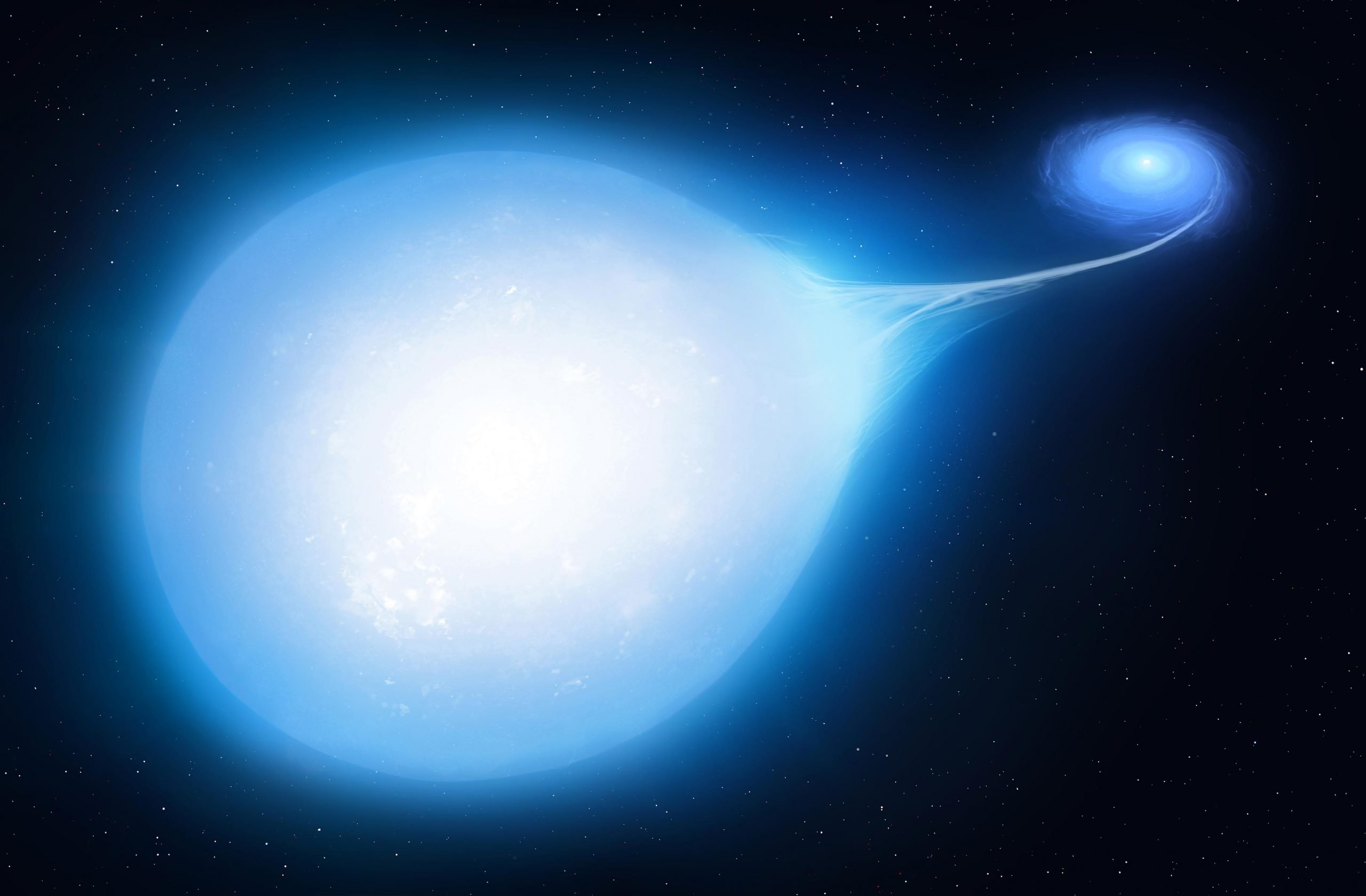
HD265435, a binary star system with a deformed subdwarf and dense white dwarf, is spiraling toward a supernova, offering rare insight into cosmic distance markers.
Astronomers have made the rare sighting of two stars spiraling to their doom by spotting the tell-tale signs of a teardrop-shaped star.
The tragic shape is caused by a massive nearby white dwarf distorting the star with its intense gravity, which will also be the catalyst for an eventual supernova that will consume both. Found by an international team of astronomers and astrophysicists led by the University of Warwick, it is one of only a very small number of star systems discovered that will one day see a white dwarf star reignite its core.
The team’s new research was published on July 12, 2021, in the journal Nature Astronomy.
With the help of W. M. Keck Observatory on Maunakea in Hawaiʻi, the astronomers were able to confirm that the two stars are in the early stages of a spiral that will likely end in a Type Ia supernova – a type that helps astronomers determine how fast the universe is expanding.
The couple – a binary star system called HD265435 – is located roughly 1,500 light-years away; it is comprised of a hot subdwarf star and a white dwarf star orbiting each other closely at a dizzying rate of around 100 minutes. White dwarfs are ‘dead’ stars that have burned all their fuel and collapsed in on themselves, making them small but extremely dense.
Path to a Type Ia Supernova
A type Ia supernova is generally thought to occur when a white dwarf star’s core reignites, leading to a thermonuclear explosion. There are two scenarios where this can happen. In the first, the white dwarf gains enough mass to reach 1.4 times the mass of our Sun, known as the Chandrasekhar limit. HD265435 fits in the second scenario, in which the total mass of a close stellar system of multiple stars is near or above this limit. Only a handful of other star systems have been discovered that will reach this threshold and result in a Type Ia supernova.
Lead author Ingrid Pelisoli from the University of Warwick Department of Physics explains: “We don’t know exactly how these supernovae explode, but we know it has to happen because we see it happening elsewhere in the universe.”
“One way is if the white dwarf accretes enough mass from the hot subdwarf, so as the two of them are orbiting each other and getting closer, matter will start to escape the hot subdwarf and fall onto the white dwarf. Another way is that because they are losing energy to gravitational wave emissions, they will get closer until they merge. Once the white dwarf gains enough mass from either method, it will go supernova,” she says.
Using data from NASA’s Transiting Exoplanet Survey Satellite, the team was able to observe the hot subdwarf. While they did not detect the white dwarf, the researchers observed the brightness of the hot subdwarf varied over time; this suggests a nearby massive object was distorting the star into a teardrop shape.
The astronomers then used Palomar Observatory and Keck Observatory’s Echellette Spectrograph and Imager (ESI) to measure the radial velocity and rotational velocity of the hot subdwarf star, which allowed them to confirm that the hidden white dwarf is as heavy as our Sun, but just slightly smaller than the Earth’s radius. Combined with the mass of the hot subdwarf, which is a little over 0.6 times the mass of our Sun, both stars have the mass needed to cause a Type Ia supernova.
“Keck’s ESI data was crucial in determining that the compact binary system exceeds the Chandrasekhar mass limit, which makes HD265435 one of the very few supernova Ia progenitor systems known,” says co-author Thomas Kupfer, assistant professor at Texas Tech University’s Department of Physics and Astronomy.
Final Fate: Supernova in 70 Million Years
As the two stars are already close enough to begin spiraling closer together, the white dwarf will inevitably go supernova in around 70 million years. Theoretical models produced specifically for this study also predict that the hot subdwarf will contract to become a white dwarf star before merging with its companion.
Type Ia supernovae are important for cosmology as ‘standard candles.’ Their brightness is constant and of a specific type of light, which means astronomers can compare what luminosity they should be with what we observe on Earth, and from that work out how distant they are with a good degree of accuracy. By observing supernovae in distant galaxies, astronomers combine what they know of how fast this galaxy is moving with our distance from the supernova and calculate the expansion of the universe.
“The more we understand how supernovae work, the better we can calibrate our standard candles. This is very important at the moment because there’s a discrepancy between what we get from this kind of standard candle, and what we get through other methods,” says Pelisoli.
She adds, “The more we understand about how supernovae form, the better we can understand whether this discrepancy we are seeing is because of new physics that we’re unaware of and not taking into account, or simply because we’re underestimating the uncertainties in those distances.”
“There is another discrepancy between the estimated and observed galactic supernovae rate, and the number of progenitors we see. We can estimate how many supernovae are going to be in our galaxy through observing many galaxies, or through what we know from stellar evolution, and this number is consistent. But if we look for objects that can become supernovae, we don’t have enough. This discovery was very useful to put an estimate of what a hot subdwarf and white dwarf binaries can contribute. It still doesn’t seem to be a lot, none of the channels we observed seems to be enough,” Pelisoli says.
Read Impending Supernova Doom: Astronomers Rare Sighting of a Teardrop-Shaped Star for more on this research.
Reference: “A hot subdwarf–white dwarf super-Chandrasekhar candidate supernova Ia progenitor” by Ingrid Pelisoli, P. Neunteufel, S. Geier, T. Kupfer, U. Heber, A. Irrgang, D. Schneider, A. Bastian, J. van Roestel, V. Schaffenroth and B. N. Barlow, 12 July 2021, Nature Astronomy.
DOI: 10.1038/s41550-021-01413-0
This research was funded by the Deutsche Forschungsgemeinschaft (DFG, German Research Foundation) and the Science and Technology Facilities Council, part of UK Research and Innovation.
About ESI
The Echellette Spectrograph and Imager (ESI) is a medium-resolution visible-light spectrograph that records spectra from 0.39 to 1.1 microns in each exposure. Built at UCO/Lick Observatory by a team led by Prof. Joe Miller, ESI also has a low-resolution mode and can image in a 2 x 8 arc min field of view. An upgrade provided an integral field unit that can provide spectra everywhere across a small, 5.7 x4.0 arc sec field. Astronomers have found a number of uses for ESI, from observing the cosmological effects of weak gravitational lensing to searching for the most metal-poor stars in our galaxy.
About W. M. Keck Observatory
The W. M. Keck Observatory telescopes are among the most scientifically productive on Earth. The two 10-meter optical/infrared telescopes atop Maunakea on the Island of Hawaiʻi feature a suite of advanced instruments including imagers, multi-object spectrographs, high-resolution spectrographs, integral-field spectrometers, and world-leading laser guide star adaptive optics systems. Some of the data presented herein were obtained at Keck Observatory, which is a private 501(c) 3 non-profit organization operated as a scientific partnership among the California Institute of Technology, the University of California, and the National Aeronautics and Space Administration. The Observatory was made possible by the generous financial support of the W. M. Keck Foundation. The authors wish to recognize and acknowledge the very significant cultural role and reverence that the summit of Maunakea has always had within the Native Hawaiian community. We are most fortunate to have the opportunity to conduct observations from this mountain.
Never miss a breakthrough: Join the SciTechDaily newsletter.
Follow us on Google and Google News.