
Rare Binary Stars Set To Explode Offer Clues to Universe’s Expansion and Stellar Evolution
- Rare sighting of a binary star system heading towards supernova made by International team led by University of Warwick
- Star system’s fate was identified from its unusual light variations, a sign that one star has been distorted into a teardrop shape by a massive white dwarf companion
- Supernovas from such star systems can be used as ‘standard candles’ to measure the expansion of the universe
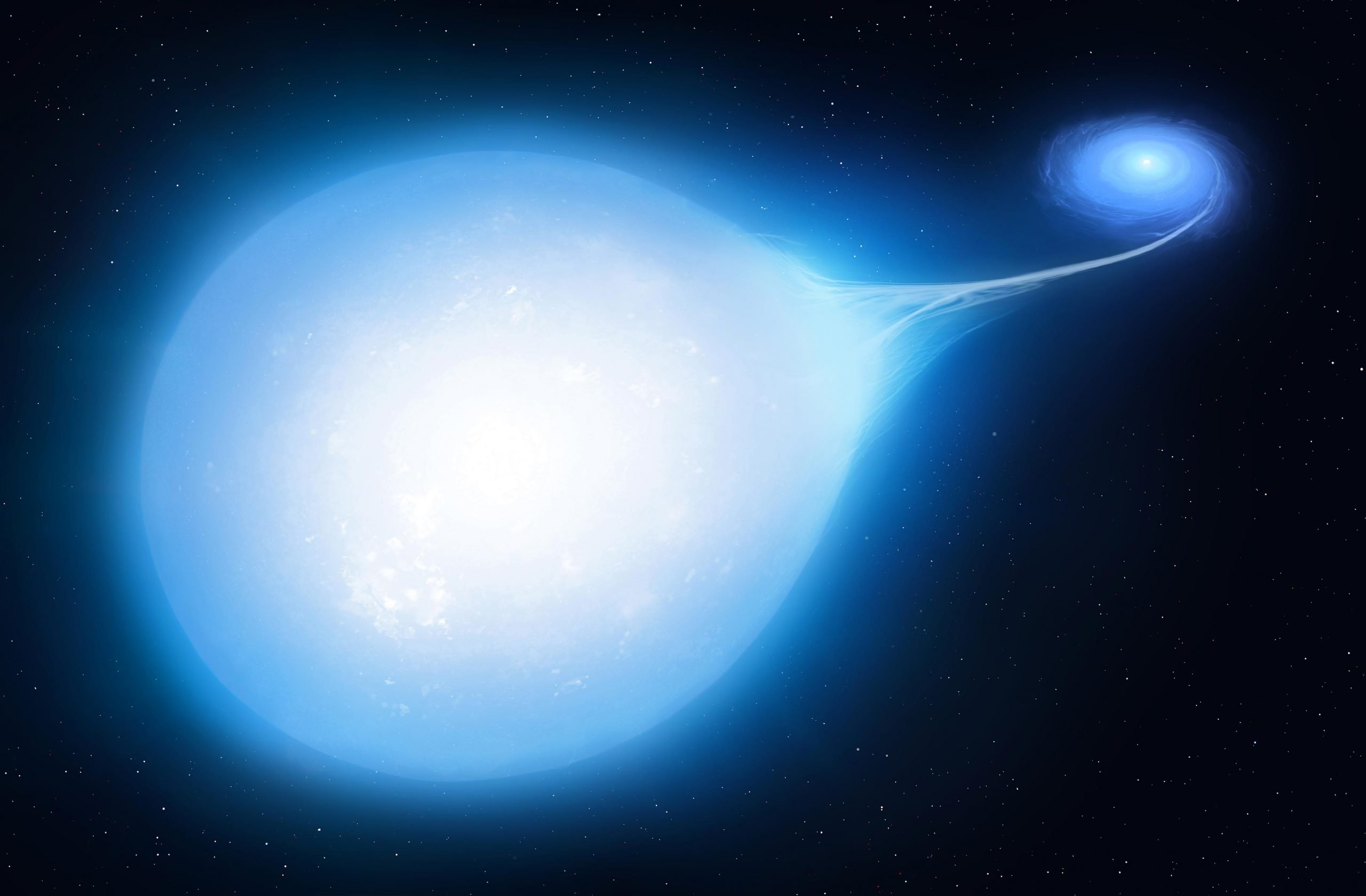
Rare sighting of two stars spiraling to their doom made by astronomers by spotting the tell-tale signs of a teardrop-shaped star.
The tragic shape is caused by a massive nearby white dwarf distorting the star with its intense gravity, which will also be the catalyst for an eventual supernova that will consume both. Found by an international team of astronomers and astrophysicists led by the University of Warwick, it is one of only a very small number of star systems that have been discovered that will one day see a white dwarf star reignite its core.
A Binary System Destined for Supernova
New research published by the team on July 12, 2021, in Nature Astronomy confirms that the two stars are in the early stages of a spiral that will likely end in a Type Ia supernova, a type that helps astronomers determine how fast the universe is expanding.
This research received funding from the Deutsche Forschungsgemeinschaft (DFG, German Research Foundation) and the Science and Technology Facilities Council, part of UK Research and Innovation.
HD265435 is located roughly 1,500 light-years away and comprises a hot subdwarf star and a white dwarf star orbiting each other closely at a rate of around 100 minutes. White dwarfs are ‘dead’ stars that have burnt out all their fuel and collapsed in on themselves, making them small but extremely dense.
A type Ia supernova is generally thought to occur when a white dwarf star’s core reignites, leading to a thermonuclear explosion. There are two scenarios where this can happen. In the first, the white dwarf gains enough mass to reach 1.4 times the mass of our Sun, known as the Chandrasekhar limit. HD265435 fits in the second scenario, in which the total mass of a close stellar system of multiple stars is near or above this limit. Only a handful of other star systems have been discovered that will reach this threshold and result in a Type Ia supernova.
Lead author Dr. Ingrid Pelisoli from the University of Warwick Department of Physics, and formerly affiliated with the University of Potsdam, explains: “We don’t know exactly how these supernovae explode, but we know it has to happen because we see it happening elsewhere in the universe.
“One way is if the white dwarf accretes enough mass from the hot subdwarf, so as the two of them are orbiting each other and getting closer, matter will start to escape the hot subdwarf and fall onto the white dwarf. Another way is that because they are losing energy to gravitational wave emissions, they will get closer until they merge. Once the white dwarf gains enough mass from either method, it will go supernova.”
Using data from NASA’s Transiting Exoplanet Survey Satellite (TESS), the team were able to observe the hot subdwarf, but not the white dwarf as the hot subdwarf is much brighter. However, that brightness varies over time which suggests the star was being distorted into a teardrop shape by a nearby massive object. Using radial velocity and rotational velocity measurements from the Palomar Observatory and the W. M. Keck Observatory, and by modeling the massive object’s effect on the hot subdwarf, the astronomers could confirm that the hidden white dwarf is as heavy as our Sun, but just slightly smaller than the Earth’s radius.
Supernova in 70 Million Years—and a White Dwarf Duo
Combined with the mass of the hot subdwarf, which is a little over 0.6 times the mass of our Sun, both stars have the mass needed to cause a Type Ia supernova. As the two stars are already close enough to begin spiraling closer together, the white dwarf will inevitably go supernova in around 70 million years. Theoretical models produced specifically for this study predict that the hot subdwarf will contract to become a white dwarf star as well before merging with its companion.
Type Ia supernovae are important for cosmology as ‘standard candles’. Their brightness is constant and of a specific type of light, which means astronomers can compare what luminosity they should be with what we observe on Earth, and from that work out how distant they are with a good degree of accuracy. By observing supernovae in distant galaxies, astronomers combine what they know of how fast this galaxy is moving with our distance from the supernova and calculate the expansion of the universe.
Dr Pelisoli adds: “The more we understand how supernovae work, the better we can calibrate our standard candles. This is very important at the moment because there’s a discrepancy between what we get from this kind of standard candle, and what we get through other methods.
“The more we understand about how supernovae form, the better we can understand whether this discrepancy we are seeing is because of new physics that we’re unaware of and not taking into account, or simply because we’re underestimating the uncertainties in those distances.
“There is another discrepancy between the estimated and observed galactic supernovae rate, and the number of progenitors we see. We can estimate how many supernovae are going to be in our galaxy through observing many galaxies, or through what we know from stellar evolution, and this number is consistent. But if we look for objects that can become supernovae, we don’t have enough. This discovery was very useful to put an estimate of what a hot subdwarf and white dwarf binaries can contribute. It still doesn’t seem to be a lot, none of the channels we observed seems to be enough.”
Reference: “A hot subdwarf–white dwarf super-Chandrasekhar candidate supernova Ia progenitor” by Ingrid Pelisoli, P. Neunteufel, S. Geier, T. Kupfer, U. Heber, A. Irrgang, D. Schneider, A. Bastian, J. van Roestel, V. Schaffenroth and B. N. Barlow, 12 July 2021, Nature Astronomy.
DOI: 10.1038/s41550-021-01413-0
Never miss a breakthrough: Join the SciTechDaily newsletter.
Follow us on Google and Google News.
12 Comments
“Tragic shape”?
Who writes this stuff in a science report?
It’s not a report, it is a press release describing a report (peer reviewed published paper).
70 million years is not “impending” and should be removed from this headline. The adjective “impending” is meant to refer to something expected to happen very soon. For a human audience, millions and millions of years is not “very soon” nor even “soon” for that matter. If “Supernova Doom” isn’t clickbait enough, just give up.
It’s short in the lifetime of a white dwarf (can become hundreds of billion years old). It’s “concealed” clickbait for those who like those things.
If one searches the literature about cataclysmic variable stars you will find other examples of “impending” supernovas. SS Cygni, for instance, has a white dwarf which is much closer to the Chandrasekhar limit than the example reported here. And the SS Cyg white dwarf is currently accreting matter from its companion star and the two stars probably don’t have to merge for the white dwarf to go over the Chandrasekhar limit. And SS Cyg is much closer to Earth than 1500 light years. It could be a nice show, eventually.
sorry but when you make huge assumptions on such limited data… and information it becomes stupid. it’s like saying.. oh look there’s a red shirt… we conclude it’s being worn by a man with two kids from india… who lives in a two bedroom house with his wife… give me a break… radio spectronomy isn’t science it’s especially when it’s one sample… it’s guessing.
It is an open pathway hypothesis – the not-guessing (or hypothesizing which isn’t wild guessing) is the upper age limit until merger.
The merger result is less conclusive, but it is a strong hypothesis.
I just learnt more from the comments than the article
It really is quite embarrassing! Listening to these fools, try to falsy claim they actually no what that is?? Great, now we have CNN nasa
Huh!? Who dis?
ET phone hone
Get back to the moon again?? Where you belong