
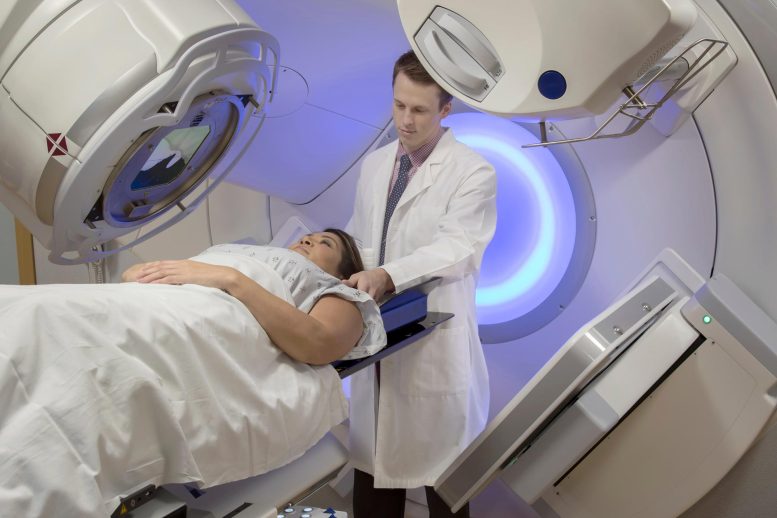
Researchers at the University of Missouri have developed a new form of radiation therapy that successfully put cancer into remission in mice without the harmful side effects of conventional chemo and radiation cancer therapies.
Cancer painfully ends more than 500,000 lives in the United States each year, according to the Centers for Disease Control and Prevention. The scientific crusade against cancer recently achieved a victory under the leadership of University of Missouri Curators’ Professor M. Frederick Hawthorne. Hawthorne’s team has developed a new form of radiation therapy that successfully put cancer into remission in mice. This innovative treatment produced none of the harmful side effects of conventional chemo and radiation cancer therapies. Clinical trials in humans could begin soon after Hawthorne secures funding.
“Since the 1930s, scientists have sought success with a cancer treatment known as boron neutron capture therapy (BNCT),” said Hawthorne, a recent winner of the National Medal of Science awarded by President Obama in the White House. “Our team at MU’s International Institute of Nano and Molecular Medicine finally found the way to make BNCT work by taking advantage of a cancer cell’s biology with nanochemistry.”
Cancer cells grow faster than normal cells and in the process absorb more materials than normal cells. Hawthorne’s team took advantage of that fact by getting cancer cells to take in and store a boron chemical designed by Hawthorne. When those boron-infused cancer cells were exposed to neutrons, a subatomic particle, the boron atom shattered and selectively tore apart the cancer cells, sparing neighboring healthy cells.
The physical properties of boron made Hawthorne’s technique possible. A particular form of boron will split when it captures a neutron and releases lithium, helium, and energy. Like pool balls careening around a billiards table, the helium and lithium atoms penetrate the cancer cell and destroy it from the inside without harming the surrounding tissues.
“A wide variety of cancers can be attacked with our BNCT technique,” Hawthorne said. “The technique worked excellently in mice. We are ready to move on to trials in larger animals, then people. However, before we can start treating humans, we will need to build suitable equipment and facilities. When it is built, MU will have the first radiation therapy of this kind in the world.”
Hawthorne believes that his discovery was possible only at the University of Missouri because MU has three features that separate it from other universities in the nation, the reason Hawthorne came to MU from the University of California, Los Angeles in 2006.
“First, it is an example of a small number of universities in the United States with a large number of science and engineering disciplines on the same campus,” said Hawthorne. “Second, the largest university research nuclear reactor is located at MU. Finally, it has strong, collegial biomedicine departments. This combination is unique.”
The Proceedings of the National Academy of Science (PNAS) recently published the study, entitled “Boron neutron capture therapy demonstrated in mice bearing EMT 6 tumors following selective delivery of boron by rationally designed liposomes.”
Reference: “Boron neutron capture therapy demonstrated in mice bearing EMT6 tumors following selective delivery of boron by rationally designed liposomes” by Peter J. Kueffer, Charles A. Maitz, Aslam A. Khan, Seth A. Schuster, Natalia I. Shlyakhtina, Satish S. Jalisatgi, John D. Brockman, David W. Nigg and M. Frederick Hawthorne, 27 March 2013, Proceedings of the National Academy of Science.
DOI: 10.1073/pnas.1303437110
Never miss a breakthrough: Join the SciTechDaily newsletter.
Follow us on Google and Google News.
3 Comments
I am very interested to know when testing on volunteer cancer patients will begin; and I would like to submit my name as a possible candidate. I have prostate cancer but have so far eschewed traditional forms of surgical remedies in favor of diet, medication and supplements.
If you click on the link to the study you’ll find an email address for correspondence…E-mail: [email protected].
Robert,
Prostate cancer is generally very treatable and survivable with ‘standard of care treatments’, of course this heavily depends upon how early or late it is caught along with a long list of other factors. However, diet, supplements, and medicine (? What do you mean by medicine? Chemo is medicine, so is asprin, I assume you do not mean chemo meds here) are not cures. You need to consult with a reputable oncology team (surgical, radiation and medical) and assess and chose among the standard treatments that fit your disease profile and personal needs. Do NOT be drawn into the pseudo-scientific snake oil purveyors of B.S.
The treatment in this story sounds very interesting. They have been looking for radiation sensitizers for a long time, maybe this on e will work. However, if it is being tested on mice now, it is probably a fair time away from human trials and is unlikely to be of use to you now. Again, go get competent oncology care now.