
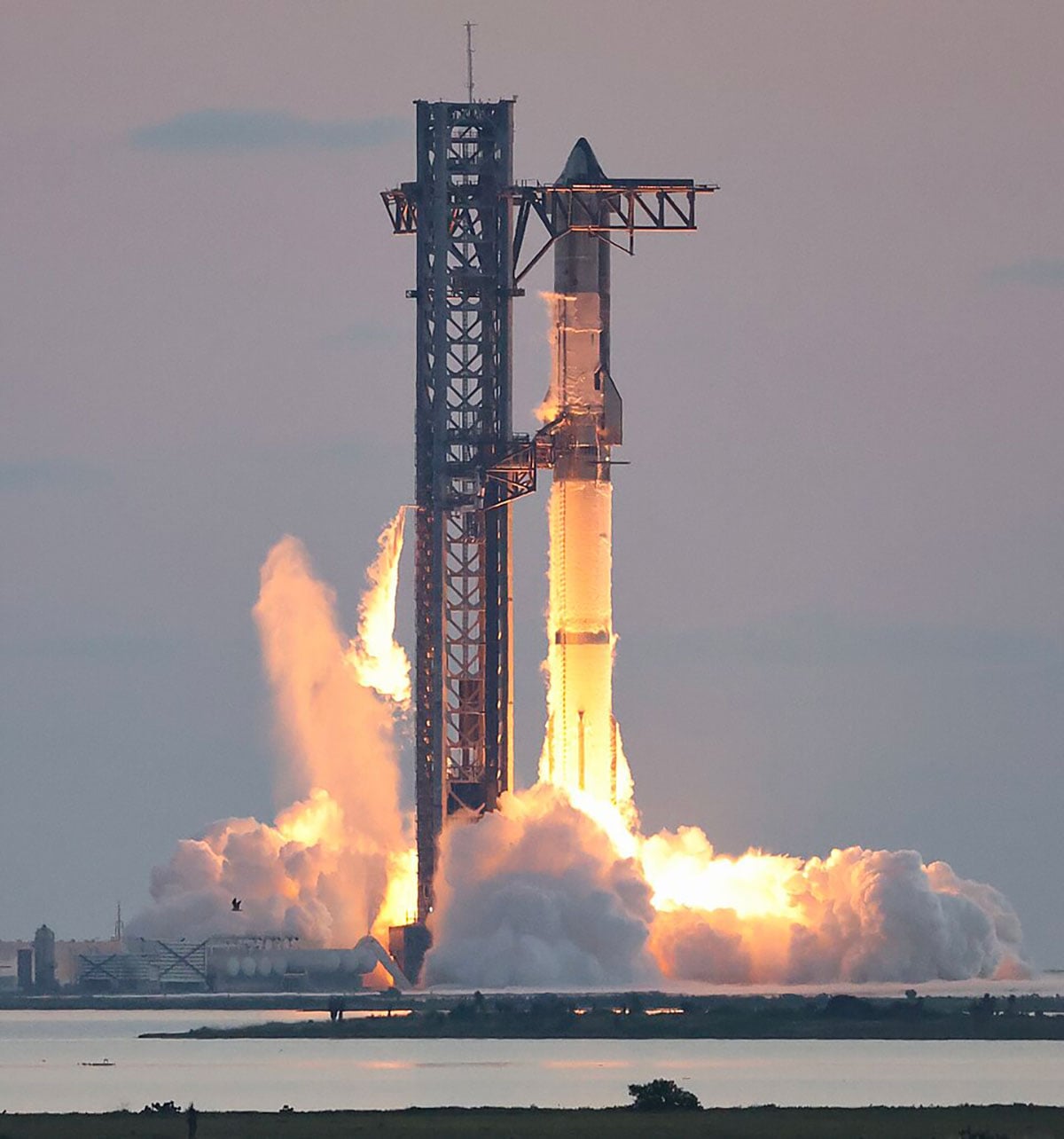
A DLR analysis suggests Starship may define the future of heavy launch, but Europe could pursue a smaller, more efficient partially reusable path of its own.
In the summer of 2023, SpaceX achieved something that aerospace engineers had discussed for generations, even if many did not expect to witness it themselves. Starship, a stainless steel vehicle taller than a thirty-story building, fired all thirty-three of its engines at once and rose from the coast of Texas.
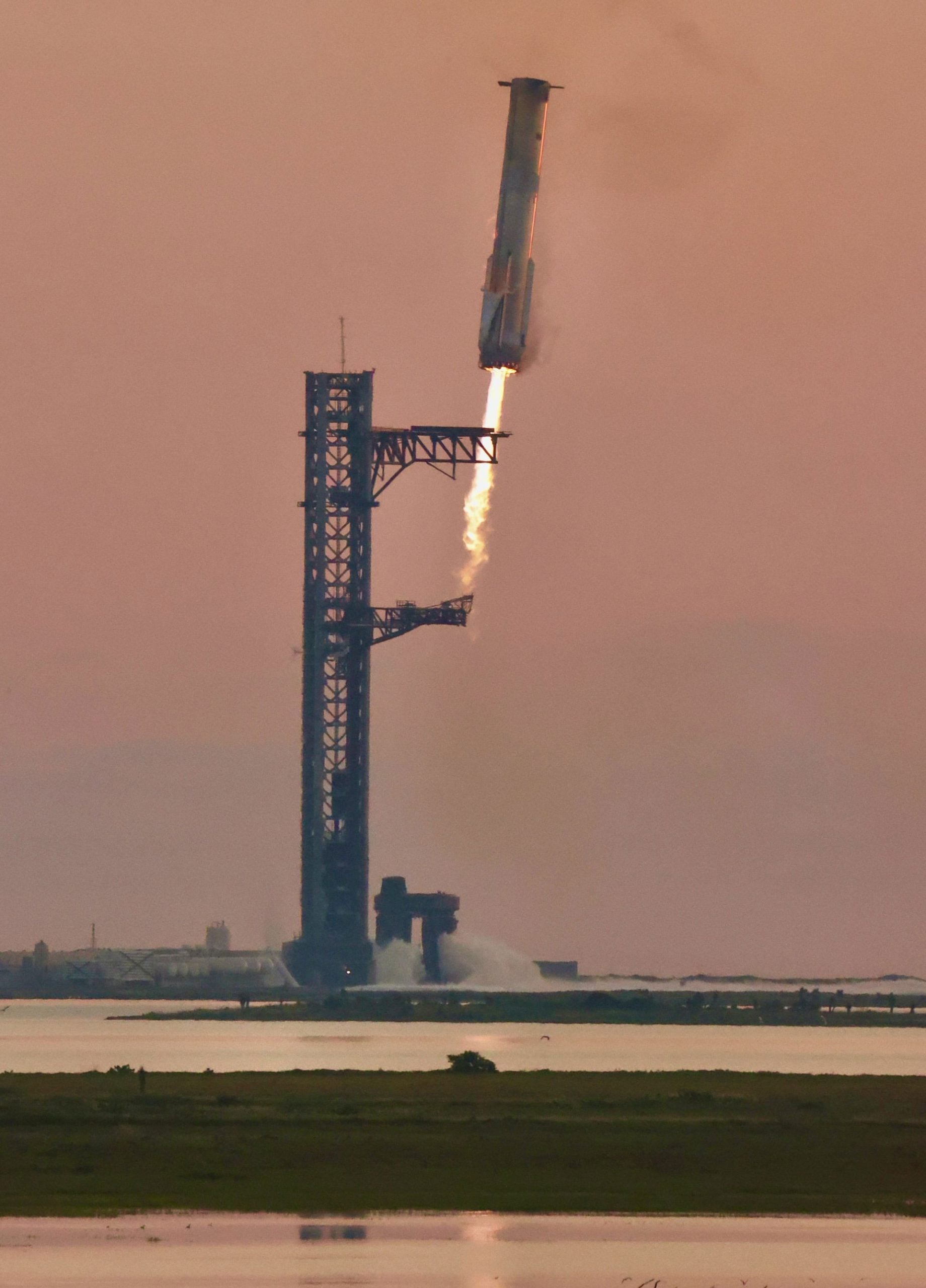
The test flight was not flawless. But the rocket left the pad. Later, during flight test five, the Super Heavy booster returned and was caught in mid air by the giant mechanical arms of its own launch tower. At that point, it became hard to deny that spaceflight had entered a new era.
Starship is being built to deliver more than 100 metric tons to low Earth orbit while being fully reusable. If SpaceX reaches that target, Starship would become the most powerful and most economical rocket ever built. For national space agencies and private launch companies worldwide, the central question has shifted. It is no longer whether Starship could transform the industry, but how everyone else should respond.
Starship’s numbers face scrutiny
Researchers at the German Aerospace Center (DLR) have now released one of the most detailed independent studies of Starship’s performance to date. Notably, they did not base their work on SpaceX’s public performance claims. Instead, they reviewed the publicly streamed footage from the first four integrated flight tests and extracted telemetry data moment by moment.
They then used those data to create and test detailed performance models of the vehicle. The resulting assessment presents Starship as a system whose real capabilities are more carefully defined, yet still more impressive than its promotional image might suggest.
The analysis confirmed that in its current form, a fully reusable Starship that can deliver around 59 tons to low Earth orbit. That is roughly what a Falcon Heavy can achieve without recovering any of its boosters at all. The next generation version, equipped with the more powerful Raptor 3 engines and enlarged fuel tanks, is projected to achieve around 115 tons in reusable mode and potentially 188 tonnes if flown expendably, surpassing even the mighty Saturn V of the Apollo era. But the more striking part of the paper is a detailed design for a European alternative capable of launching over 70 tonnes to orbit, called the RLV C5.
Europe’s alternative trades scale for efficiency
The concept pairs the winged, reusable booster stage from DLR’s long-running SpaceLiner project with an expendable upper stage designed to maximize payload. It burns liquid hydrogen and liquid oxygen, which is a more efficient combination than the methane and oxygen that power Starship’s Raptor engines, and its booster does not land the way Starship’s does.
Instead of descending tail-first on a column of rocket fire, the SpaceLiner booster glides back through the atmosphere on wings, before being captured in mid-air by a large subsonic aircraft. It is a recovery method that sounds almost science fictional, but one that DLR researchers argue has distinct advantages: the booster needs no fuel reserved for landing burns, which means more of every kilogram of propellant goes towards actually reaching orbit.
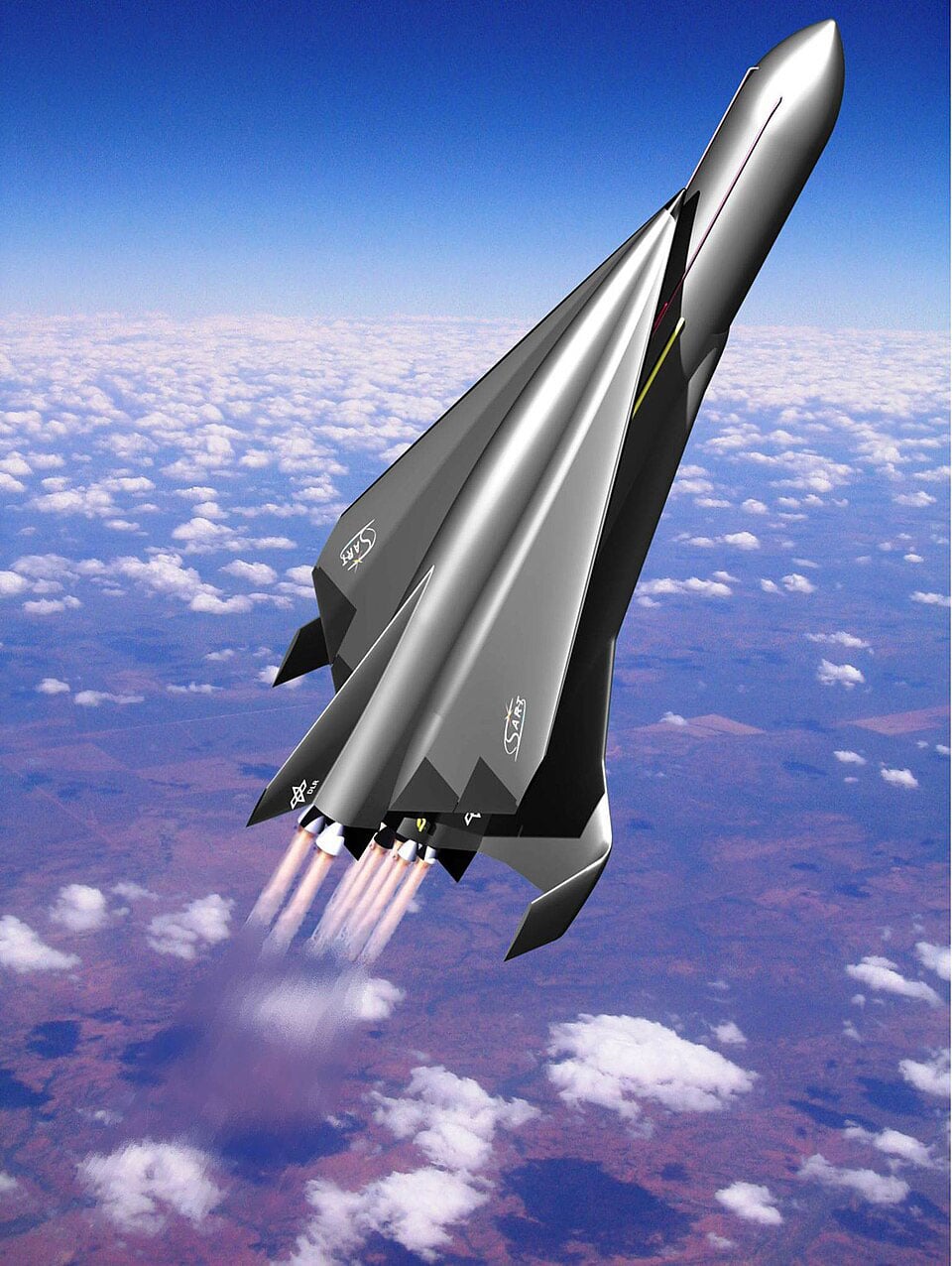
In comparison, Starship is more than three times heavier than the RLV C5 at launch. A significant portion of that mass is the cost of full reusability: heat shield tiles, landing fuel, structural reinforcements, the wings. Of every ton Starship sends to orbit, only around 40% is payload however the RLV C5, with its simpler partially reusable approach, manages to put 74% of its mass-to-orbit into useful payload. What it lacks in raw capacity, it gains in efficiency.
Reusability creates strategic choices
The DLR researchers are careful to frame this not as a competition but as a choice. Starship’s extraordinary capacity and planned rapid reuse make it ideal for missions requiring truly massive payloads, for example, moon bases, Mars missions, and giant satellite constellations.
The RLV C5 addresses a different need for sovereign European access to super-heavy lift without the extraordinary investment required to develop a fully reusable system from scratch. It could be built using components already under investigation, and the researchers suggest it could slot in as an intermediate step within the SpaceLiner program before a fully reusable version arrives.
Flying hardware still matters
There is a caveat that hangs over all of this, and the DLR team acknowledges it plainly. Starship is already flying, even if imperfectly. The RLV C5 exists on paper. The gap between those two states is not trivial. The thermal protection system that keeps Starship alive during reentry was damaged so severely during the fourth test flight that it had to be completely redesigned. Full and rapid reusability, the thing that makes Starship’s economics work, remains an unsolved engineering problem.
Europe is starting far behind, but as lead author Moritz Herberhold and his colleagues at the German Aerospace Center conclude, the “RLV C5 offers an effective path for Europe to independently develop partially reusable super-heavy launch capabilities” and sometimes, a smarter path matters more than a faster one.
Reference: “Comparison of SpaceX’s Starship with winged heavy-lift launcher options for Europe” by Moritz Herberhold, Leonid Bussler, Martin Sippel and Jascha Wilken, 28 May 2025, CEAS Space Journal.
DOI: 10.1007/s12567-025-00625-8
Adapted from an article originally published in UniverseToday.
Never miss a breakthrough: Join the SciTechDaily newsletter.
Follow us on Google and Google News.
5 Comments
Yeah Europe again, coulda, woulda, shoulda. It only matters when it goes from pie in the sky design to actually launching anything even 5 kilos. These articles are ridiculous. Let’s see more action and less talk. Maybe in five years if they’re lucky – BUT then what will SpaceX be doing in 5 years?
Drivel.
A skydiver friend always maintained the advantages of a ram-air parachute for spacecraft. I still wonder if he was right.
These articles are just ridiculous. Europe? Lmao
Its the same bad analysis that kept space launch expensive for 50 years and led to the Space Shuttle, which holds the record for most expensive and dangerous launch system in history. They are focusing on maximizing performance, not economic efficiency.
First, Hydrolox is a dead end. It adds tons of dry mass because Hydrogen requires far larger and heavier tanks, which offsets its efficiency as a fuel. It also leaks like a sieve and will lead to regular launch delays, like it did for the Shuttle and has done for the SLS. Those launch delays will reduce launch cadence, raising costs.
The wings add dead mass during launch, and their more complex shape makes re-entry more difficult and dangerous. Catching the booster with a plane drastically limits its size and adds far more complexity, leading one to wonder why add the mass and complexity of wings if its going to be caught, and why catch it if it has wings to land on a runway.
Finally, expending the upper stage is massively expensive. Its estimated that over half the cost of a Falcon 9 launch is expending the upper stage, even though its a tiny fraction of the size of the first stage. They are throwing away tens of millions of dollars in carefully built expensive aerospace aluminum,, carbon fiber and rocket engines every launch. If Starship expended its upper stage its payload fraction to orbit would be far higher as well, and it would have entered service already. But SpaceX keeps plodding along testing its re-entry because the benefit of re-using the upper stage is a massive reduction in launch cost.